
📥 FREE DOWNLOAD
For research professionals only — instant download, no payment required
What Is GHK-Cu? Complete Copper Tripeptide Research Guide for UK Laboratory Research
What is GHK-Cu? GHK-Cu (glycyl-histidyl-lysine copper) is a naturally occurring copper-bound tripeptide complex consisting of three amino acids (glycine, histidine, lysine) bound to a divalent copper ion.
It is a well-characterised copper peptide complex published in-vitro research literature, with published in-vitro research covering fibroblast biology, copper-dependent enzyme research, collagen gene expression research, and antioxidant pathway research at the cellular level.
This guide sets out exactly what GHK-Cu is at the molecular level, how the copper binding mechanism works, and how UK laboratory researchers source GHK-Cu with full documentation transparency.
GHK-Cu is supplied for in vitro laboratory research only. It is not a licensed medicinal product under the UK Human Medicines Regulations 2012, and no dosing or administration guidelines are provided in this guide or in any Ascend Peptides UK documentation. The compound is supplied to qualified research professionals (laboratories, academic institutions, research scientists) for in-vitro cellular research applications across two principal research categories: skin biology research and tissue-model research . Every batch of GHK-Cu supplied by Ascend Peptides UK is HPLC verified at ≥98% purity by Janoshik laboratory, LC-MS confirmed for molecular identity, and accompanied by a publicly verifiable Certificate of Analysis.
📥 FREE DOWNLOAD
For research professionals only — instant download, no payment required
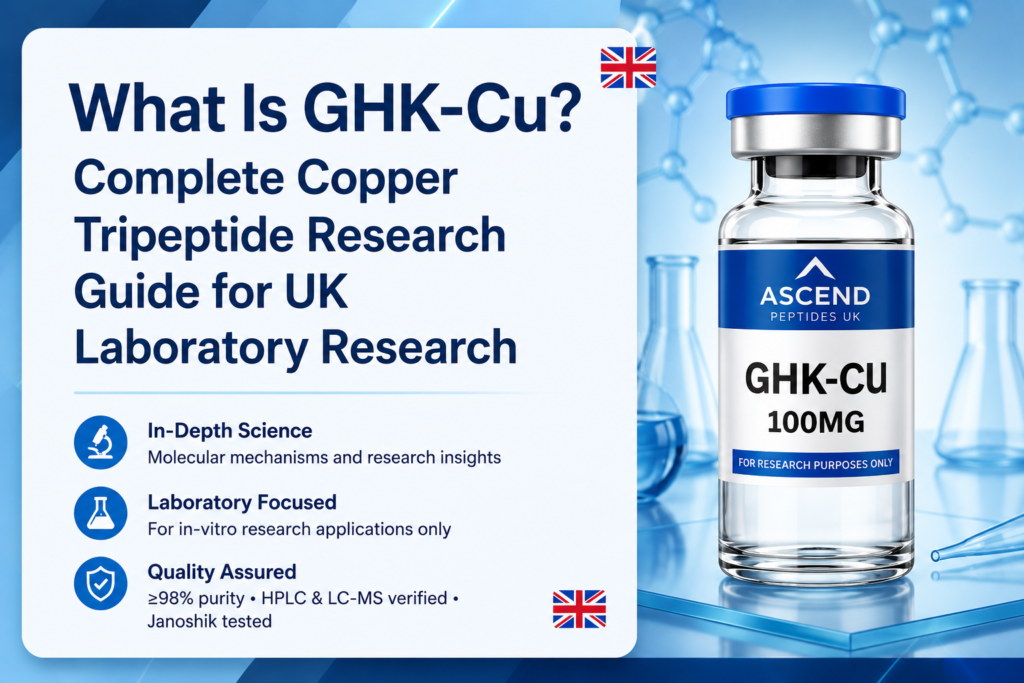
What Is GHK-Cu at the Molecular Level?
GHK-Cu is a copper-bound tripeptide complex with two structural components: a three-amino acid peptide chain (the GHK tripeptide) and a divalent copper ion (Cu2+) chelated to the peptide through specific binding residues. Together, the two components form a single coordinated complex with chemical and biological properties that differ from those of the unbound peptide or free copper ion alone.
The compound is supplied to laboratories as a lyophilised (freeze-dried) blue-tinted powder for reconstitution before in vitro research use. The molecular structure and key chemical properties of GHK-Cu are documented below.
|
Molecular Property |
Value |
|---|---|
|
Compound name |
GHK-Cu (Glycyl-Histidyl-Lysine Copper) |
|
Peptide class |
Copper-bound tripeptide complex |
|
Amino acid sequence |
Gly-His-Lys (glycine, histidine, lysine) |
|
Bound metal ion |
Cu2+ (divalent copper) |
|
Molecular formula |
C14H22CuN6O4 |
|
Molecular weight |
≈ 401.93 Da |
|
Chelation residues |
Histidine imidazole nitrogen + Lysine ε-amino nitrogen |
|
Visual appearance |
Blue to violet-tinted lyophilised powder (due to Cu2+ chromophore) |
|
Supplied format |
Lyophilised powder for reconstitution |
|
Storage |
−20°C lyophilised, 2 to 8°C reconstituted |
The defining structural property of GHK-Cu is the copper binding geometry. The Cu2+ ion is coordinated by the imidazole nitrogen of the histidine residue and the ε-amino nitrogen of the lysine residue, with additional coordination from the backbone amide nitrogens.
This square-planar copper coordination distinguishes GHK-Cu from the unbound GHK peptide and is believed to contribute to its copper-dependent activity in research models. The blue to violet visual appearance of the lyophilised powder is a direct consequence of the Cu2+ d-orbital electron transitions, which absorb light in the orange to red region of the visible spectrum.
The full molecular identity of GHK-Cu is confirmed on every Ascend Peptides UK batch by independent LC-MS analysis through Janoshik laboratory. The measured molecular weight is matched against the theoretical molecular weight (≈ 401.93 Da) to confirm structural identity. The complete laboratory quality control workflow is documented on the how we test peptides page.
How Does the Copper Binding Mechanism Work?
The copper binding mechanism is the operational key to understanding GHK-Cu research applications. Unlike most research peptides that act through receptor-mediated signalling pathways, GHK-Cu acts through copper-dependent biological pathways where the bound copper ion is the active component and the GHK peptide functions as the copper delivery carrier. Three operational properties define the copper binding mechanism in published in-vitro research literature.
Property 1: Copper Coordination Geometry
The Cu2+ ion in GHK-Cu is held in a square-planar coordination geometry by four ligand donors: the histidine imidazole nitrogen, the lysine ε-amino nitrogen, and two backbone amide nitrogens from the peptide chain.
This specific coordination geometry stabilises the copper ion in a biologically accessible form, allowing it to participate in cellular research pathways at controlled rates rather than as free copper, which would be cytotoxic at the same concentration.
Property 2: Conditional Copper Release
In cellular research models, the bound copper in GHK-Cu can be released from the peptide carrier under specific cellular conditions, including the presence of competing chelators (such as cellular metallothioneins) and changes in local pH.
This conditional release is what allows GHK-Cu to deliver copper to specific intracellular sites where it participates in copper-dependent enzyme research, rather than releasing copper in an uncontrolled manner within experimental research conditions.
Property 3: Copper-Dependent Pathway Activation
Once released or coordinated within the cellular environment, the copper ion participates in copper-dependent enzymatic and signalling pathways in research models. These include copper-dependent superoxide dismutase research (relevant to antioxidant pathway research), lysyl oxidase research (relevant to extracellular matrix and collagen cross-linking research), and cytochrome c oxidase research (relevant to mitochondrial enzyme research). The peptide carrier itself also has documented research activity, particularly in fibroblast biology research.
Why GHK-Cu Sits in Two Research Categories
GHK-Cu is positioned across two distinct research categories within the Ascend Peptides UK catalogue. The compound is positioned in both the tissue-model research peptides category (for tissue research model applications) and the skin and cellular research peptides category (for skin biology research model applications).
The dual positioning reflects the actual published in-vitro research literature, which spans both application domains. Researchers select GHK-Cu based on the specific experimental focus of the research programme.
|
Research Category |
Primary Research Applications |
Cell Models |
|---|---|---|
|
Recovery research |
Tissue research models, tissue-model biology research, copper-dependent enzyme research |
General tissue cell line models, fibroblast research, copper-dependent enzyme assays |
|
Skin biology research |
Fibroblast biology, collagen gene expression, and dermal extracellular matrix research |
Dermal fibroblast cell lines, keratinocyte cell lines, and melanocyte research models |
For UK researchers working on tissue research models or combined multi-compound recovery research protocols, GHK-Cu appears alongside BPC-157 and TB-500 in the Tri Regenerative Complex bundle. For UK researchers working on skin biology models or melanocyte research, GHK-Cu appears alongside the melanocortin compounds MT1 and MT2 in the skin and cellular research peptides category. The same product, same Certificate of Analysis, applies in both research contexts.
GHK-Cu Research Applications in UK Laboratory Research
UK laboratory researchers working with GHK-Cu typically apply the compound across four research application areas. The application chosen depends on the specific experimental focus of the research programme. Each application has a substantial published in-vitro literature base spanning four decades of research dating back to the original characterisation of the GHK tripeptide as a copper-binding factor.
Application 1: Fibroblast Biology Research in Dermal Cell Line Models
Fibroblast biology research examines the cellular biology of connective tissue cells, including fibroblast migration, proliferation kinetics, and extracellular matrix production. GHK-Cu has been investigated in dermal fibroblast cell line models with documented research applications covering fibroblast migration assays, fibroblast proliferation kinetic studies, and collagen gene expression analysis at the cellular level. This is among the more commonly discussed GHK-Cu research categories in the in-vitro literature.
Application 2: Collagen Gene Expression Research
Collagen is the principal structural protein of the extracellular matrix in connective tissue, with multiple gene products (Type I, Type III, Type IV) studied in distinct research contexts. GHK-Cu has been investigated in collagen gene expression research at the cellular level, examining how copper-dependent pathways influence collagen mRNA expression and procollagen synthesis in fibroblast research models. This research application sits at the intersection of fibroblast biology research and copper-dependent enzyme research.
Application 3: Copper-Dependent Enzyme Research
Multiple cellular enzymes require copper as a catalytic cofactor, including superoxide dismutase 1 (SOD1, antioxidant pathway), lysyl oxidase (collagen cross-linking), and cytochrome c oxidase (mitochondrial electron transport). GHK-Cu has been studied as a copper delivery vehicle in research models examining these copper-dependent enzymatic pathways. This research application connects GHK-Cu to broader research areas, including antioxidant biology and mitochondrial research at the cellular level.
Application 4: Tissue Recovery Research in Combined Multi-Compound Protocols
GHK-Cu is one of the three compounds in the most studied combined recovery research protocol, alongside BPC-157 (pentadecapeptide signalling pathway) and TB-500 (Thymosin Beta 4 actin sequestration pathway). The three compounds act through mechanistically independent pathways, which makes them appropriate independent variables within combined multi-compound research protocols. For combined recovery research programmes, the Tri Regenerative Complex bundle offers single supplier batch matching at £85 per bundle.
Before Ordering GHK-Cu: Free Research Buyer Starter Pack
The Research Buyer Starter Pack is a free downloadable guide for UK research buyers evaluating peptide suppliers. It converts the documentation framework into a practical buyer checklist covering exactly what to verify before ordering GHK-Cu or any other research peptide. Run any supplier against the checklist, including Ascend Peptides UK, to confirm the documentation standard before purchase.
📥 FREE DOWNLOAD
Research Buyer Starter Pack
A practical guide for UK research buyers. What to check before ordering a metabolic research peptide. What documentation to request from any supplier? What storage and dispatch standards to expect.
Inside the checklist:
Inside the pack:
✓ What “research-use only” means under UK regulation
✓ How to evaluate a UK research peptide supplier — 9-point checklist
✓ What documentation to request before purchase (CoA, HPLC, LC-MS)
✓ What storage and reconstitution standards to verify
✓ Pre-order buyer checklist — 16 items to confirm
✓ How to spot a low-quality metabolic peptide supplier — 7 warning signs
For research professionals only — instant download, no payment required
GHK-Cu UK Supplier Standards: What to Verify Before Purchase
GHK-Cu is a particularly important compound to source from a verified UK supplier because of the copper-binding component. The biological activity of GHK-Cu in research models depends on the integrity of the copper-peptide coordination complex.
Substandard manufacturing can produce material where the copper is not properly bound to the peptide, or where the peptide is present without the required copper content, both of which would invalidate downstream research results. Four documentation standards distinguish a verified UK supplier of GHK-Cu from an unverified one. The complete framework is set out on the batch verification page.
|
Documentation Standard |
Industry Norm |
Ascend Peptides UK |
|---|---|---|
|
HPLC purity verification |
Self-reported by the supplier |
Independent HPLC by Janoshik, ≥98% verified |
|
LC-MS molecular identity |
Often not performed |
LC-MS confirmation on every batch (verifies copper-peptide complex) |
|
Batch-specific Certificate of Analysis |
Generic or unavailable |
Per batch CoA tied to vial lot number |
|
UK dispatch standards |
3 to 7 working days |
Same day UK dispatch before 16:00 GMT |
Every GHK-Cu batch supplied by Ascend Peptides UK is independently HPLC verified at ≥98% purity and LC-MS confirmed for molecular identity, with the measured molecular weight (≈ 401.93 Da including the bound Cu2+ ion) confirming the intact copper-peptide complex. The Janoshik Certificate of Analysis is publicly accessible from the CoA archive before the order is placed. For the complete research grade standards framework, see the research grade standards page.
GHK-Cu Storage and Reconstitution Protocol
GHK-Cu follows the standard storage protocol applied across the Ascend Peptides UK research peptide catalogue, with one additional handling consideration specific to copper peptides. Lyophilised GHK-Cu powder is supplied in a sealed glass vial and should be stored at −20°C until reconstitution, protected from prolonged light exposure (the Cu2+ chromophore can undergo photochemical reactions under extended UV or visible light exposure).
Following reconstitution with BP-grade bacteriostatic water (water for injection with 0.9% benzyl alcohol preservative), the reconstituted solution should be stored at 2 to 8°C in dark conditions and used within the stability window commonly referenced in laboratory handling practices. The complete storage protocol is set out in the peptide storage guide.
Key Storage Standards for GHK-Cu
-
Lyophilised GHK-Cu storage: −20°C in the original sealed vial, protected from light, until reconstitution.
-
Reconstitution medium: BP-grade bacteriostatic water (0.9% benzyl alcohol) for standard research protocols.
-
Reconstituted GHK-Cu storage: 2 to 8°C in dark conditions (amber vial or dark refrigerator section) to protect the Cu2+ chromophore.
-
In use period: typically 28 days at 2 to 8°C following reconstitution under proper light-protected storage.
-
Avoid freezing reconstituted solutions where possible. Freeze-thaw cycles can disrupt the copper-peptide coordination complex.
GHK-Cu in the Tri Regenerative Complex Bundle
For UK research programmes running combined recovery research protocols, GHK-Cu is the third compound in the most studied multi-compound recovery research design alongside BPC-157 and TB-500.
The three compounds act through mechanistically independent pathways: BPC-157 through pentadecapeptide signalling, TB-500 through actin sequestration, and GHK-Cu through copper-dependent cellular pathways. The mechanistic independence is what makes the three-compound design analytically useful, as each functions as a separate variable within the research protocol. The Tri Regenerative Complex bundle from Ascend Peptides UK pairs all three compounds at £85 per bundle, with single supplier batch matching across all three Janoshik tested compounds.
|
Compound |
Mechanism |
Primary Pathway |
|---|---|---|
|
BPC-157 |
Pentadecapeptide signalling |
Angiogenic factor expression, fibroblast biology |
|
TB-500 |
Actin sequestration |
G-actin binding, cytoskeletal dynamics |
|
GHK-Cu |
Copper delivery and copper-dependent pathway activation |
Copper-dependent enzyme research, fibroblast research |
Why UK Researchers Source GHK-Cu from Ascend Peptides UK
- ≥98% HPLC purity verified independently by Janoshik laboratory on every batch.
- LC-MS molecular identity confirmation on every batch, verifying the intact copper-peptide coordination complex.
- Publicly verifiable Certificate of Analysis tied to the specific vial lot number.
- Same day UK dispatch before 16:00 GMT via Royal Mail Tracked 24.
- FREE 10ml BP grade bacteriostatic water on orders over £75.
- Tri Regenerative Complex bundle (BPC-157 + TB-500 + GHK-Cu) available at £85 for combined recovery research protocols.
- Dual category positioning across both skin biology and recovery research, with single supplier batch matching across all compounds in either category.
What Is GHK-Cu? Frequently Asked Questions
What does GHK-Cu stand for?
GHK-Cu stands for Glycyl-Histidyl-Lysine Copper. GHK is the three-letter code for the tripeptide composed of glycine (G), histidine (H), and lysine (K). Cu is the chemical symbol for copper. The compound is a tripeptide bound to a divalent copper ion (Cu2+) in a square-planar coordination complex.
What is the molecular structure of GHK-Cu?
GHK-Cu is a copper-bound tripeptide complex with the molecular formula C14H22CuN6O4 and molecular weight approximately 401.93 Da. The peptide component is the three-amino acid sequence Gly-His-Lys. The Cu2+ ion is coordinated by the histidine imidazole nitrogen, the lysine ε-amino nitrogen, and backbone amide nitrogens. The full molecular identity is confirmed on every Ascend Peptides UK batch by LC-MS analysis through Janoshik laboratory.
What is GHK-Cu used for in research?
In published in-vitro research literature, GHK-Cu has been studied across four principal application areas: fibroblast biology research in dermal cell line models, collagen gene expression research, copper-dependent enzyme research (SOD1, lysyl oxidase, cytochrome c oxidase), and tissue-model research in combined multi-compound laboratory protocols. All research applications are conducted in in-vitro cellular research models, not in human or veterinary clinical applications.
How does GHK-Cu differ from other research peptides?
Most research peptides act through protein-protein interactions, typically as ligands for cell surface receptors. GHK-Cu is mechanistically distinct because it acts through copper-dependent biological pathways, where the bound copper ion is the active component and the GHK peptide functions as the copper delivery carrier. This makes GHK-Cu suitable for combined research protocols with mechanistically independent compounds like BPC-157 and TB-500.
Why is GHK-Cu in both the skin and recovery research categories?
GHK-Cu has substantial published in-vitro research literature spanning both skin biology research models (fibroblast research, collagen gene expression, dermal extracellular matrix) and tissue research models (regenerative biology, copper-dependent enzyme pathways). Researchers select GHK-Cu based on the experimental focus of the specific research programme. The same compound, same Certificate of Analysis, applies in both research contexts. See the skin and cellular research peptides page or the recovery research peptides page for the relevant category framework.
What is the MHRA status of GHK-Cu in the UK?
GHK-Cu is not licensed as a medicinal product under the UK Human Medicines Regulations 2012. It is supplied strictly for in vitro laboratory research. The Medicines and Healthcare products Regulatory Agency (MHRA) is the relevant medicines regulator in the UK post Brexit (replacing the previous European Medicines Agency route).
How should GHK-Cu be stored?
Lyophilised GHK-Cu should be stored at −20°C in the original sealed vial, protected from prolonged light exposure to preserve the Cu2+ chromophore. Following reconstitution with BP-grade bacteriostatic water, the reconstituted solution should be stored at 2 to 8°C in dark conditions and used within the research literature-recommended in-use period of approximately 28 days. The complete storage protocol is set out in the peptide storage guide.
How much does GHK-Cu cost from Ascend Peptides UK?
GHK-Cu is supplied at £22 per vial from Ascend Peptides UK. For combined research protocols, the Tri Regenerative Complex bundle (BPC-157 + TB-500 + GHK-Cu) is available at £85, offering single supplier batch matching across all three compounds. All orders over £75 qualify for a free 10ml BP grade bacteriostatic water.
Order GHK-Cu from Ascend Peptides UK with Same Day Dispatch
Browse the GHK-Cu product page for batch-specific Certificate of Analysis documentation and same-day UK dispatch. For combined laboratory research designs, the Tri Regenerative Complex bundle (BPC-157 + TB-500 + GHK-Cu, £85) offers single supplier batch matching at the reduced bundle price. For the recovery research category framework, see the recovery research peptides UK page. For the skin biology research category framework, see the skin and cellular research peptides UK page. Or start with the main research peptides UK hub for the complete supplier model.
RESEARCH USE ONLY
All products supplied by Ascend Peptides UK are intended strictly for in-vitro laboratory research purposes only. GHK-CU is not a licensed medicinal product under the UK Human Medicines Regulations 2012 and is not for human or veterinary use. No dosing or administration guidelines are provided. Products are supplied to qualified research professionals only.
📥 FREE DOWNLOAD
For research professionals only — instant download, no payment required