
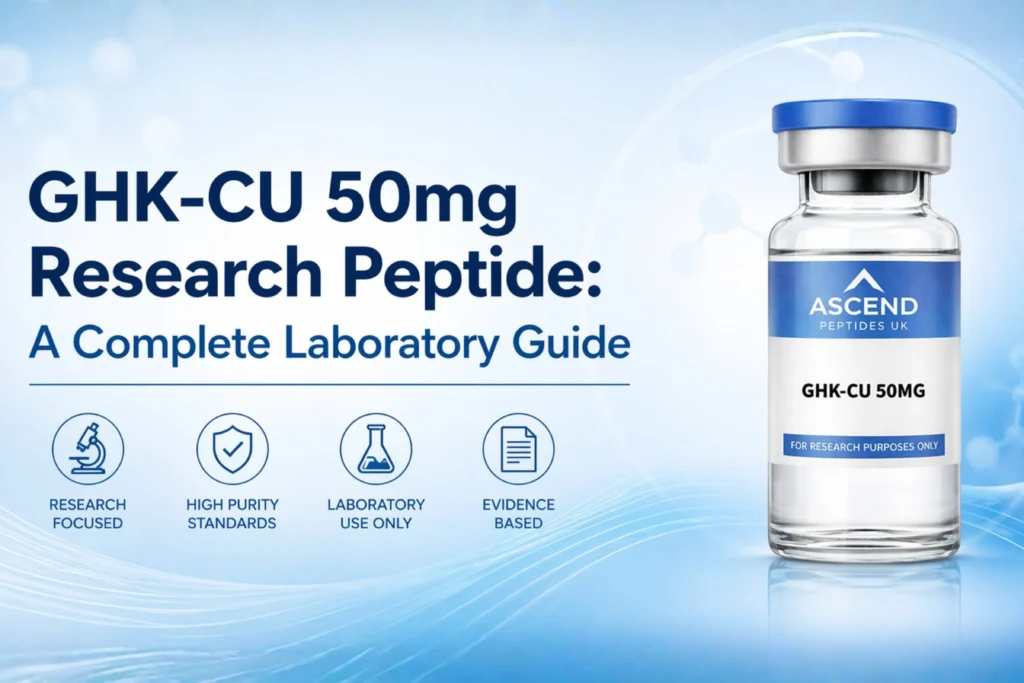
⚠️ Research Use Only. GHK-CU 50mg is supplied strictly for in-vitro laboratory research. It is not intended for human consumption, therapeutic, diagnostic, or clinical use. All information below reflects peer-reviewed preclinical and scientific literature only. This content is not medical advice. Ascend Peptides UK accepts no liability for misuse of this product
This guide is written for two audiences. For laboratory scientists and research professionals, it provides a thorough scientific overview of this compound — its structure, mechanism of action, and applications in controlled research settings. For scientifically engaged individuals (qualified researchers, laboratory professionals, and academic or institutional research settings) who follow developments in peptide biochemistry and skin research science, it offers an accessible explanation of why this copper peptide complex has attracted such sustained scientific attention.
Ascend Peptides UK supplies GHK-CU 50mg as a high-purity research peptide for laboratory investigation only. All content in this guide is provided strictly for scientific and educational purposes. This compound is not intended for human consumption, clinical use, or therapeutic application of any kind.
What Is GHK-CU? Structure, Origin, and Unique Properties
GHK-CU is a naturally occurring tripeptide-copper complex found in human plasma, saliva, and urine. The peptide component GHK consists of three amino acids: glycine (Gly), histidine (His), and lysine (Lys). The CU suffix denotes its association with a copper (II) ion, which the peptide binds with high affinity through the imidazole group of histidine and the amino-terminal amine.
This copper-binding characteristic is central to the compound’s biochemical identity. Copper is an essential trace mineral involved in a wide range of enzymatic processes in biological systems, including collagen synthesis, superoxide dismutase activity, and angiogenesis. The ability of the GHK tripeptide to chelate and transport copper ions in laboratory models has made it a subject of considerable research interest in fields ranging from dermatology research to wound biology and gene regulation studies.
What sets this compound apart from many other research peptides is its notably broad influence on cellular behaviour in laboratory models. Published research has documented interactions with over 4,000 human genes, a finding that has positioned this tripeptide as one of the most far-reaching small peptide sequences studied in modern biochemical research. It is this breadth of documented laboratory activity that makes it particularly relevant across multiple research disciplines.
Mechanism of Action: How GHK-CU Behaves in Laboratory Models
GHK-CU interacts with biological systems through several interconnected mechanisms, many of which have been documented across a substantial body of peer-reviewed research. Understanding these mechanisms is important for researchers designing experiments that incorporate this copper peptide complex as a research tool.
Key mechanisms identified in published laboratory research include:
-
Copper chaperone activity: This compound acts as a copper transport molecule in research models, delivering Cu(II) ions to copper-dependent enzymes, including lysyl oxidase (involved in collagen and elastin crosslinking) and superoxide dismutase (a key antioxidant enzyme). This copper delivery function is central to many of the biological activities observed in laboratory settings.
-
Collagen and extracellular matrix regulation: Multiple in vitro studies have documented the influence of this peptide on fibroblast gene expression, collagen synthesis, and extracellular matrix remodelling. This has made it a widely used research tool in skin biology and connective tissue research.
-
Antioxidant and anti-inflammatory signalling: Published research has shown interactions with antioxidant defence systems and inflammatory signalling pathways in laboratory models, including modulation of pro-inflammatory cytokine activity and upregulation of antioxidant enzyme expression.
-
Angiogenesis research: Studies have documented the ability of this compound to stimulate angiogenic signalling in laboratory models, particularly through interactions with VEGF and FGF pathway components, making it relevant to wound biology and vascular research.
-
Gene expression modulation: Genome-wide studies have identified interactions with thousands of human genes, including those involved in tissue remodelling, inflammation regulation, stem cell biology, and metabolic processes, highlighting the compound’s unusually broad influence in laboratory research contexts.
These mechanisms have been studied predominantly in in vitro cell culture models and animal research models. This compound is supplied strictly for research purposes, and none of this research constitutes clinical evidence of efficacy in human subjects.

Research Applications of GHK-CU 50mg in Laboratory Settings
The breadth of published research on this compound reflects its versatility as a laboratory research tool. Here are the primary disciplines in which it has been applied in controlled scientific settings:
1. Skin Biology and Dermatological Research
Skin biology is the most extensively published research area for this copper peptide complex. In vitro studies have examined its interactions with keratinocytes, fibroblasts, and melanocytes, the three primary cell types of the skin. Research in this field has focused on fibroblast proliferation and collagen gene expression, extracellular matrix dynamics, basement membrane integrity, and cellular responses to oxidative stress. For researchers investigating skin biology at the cellular and molecular level, this compound is one of the most well-characterised tools available among Ascend Peptides UK’s skin and cellular research peptides.
2. Wound Healing Biology Research
The compound’s documented interactions with fibroblast activity, angiogenic signalling, and extracellular matrix remodelling have made it a research tool of significant interest in wound healing biology. Laboratory studies have examined how this peptide influences fibroblast migration, collagen deposition patterns, and vascular endothelial cell behaviour in wound model systems. This research area has attracted sustained scientific attention and continues to generate active laboratory investigation.
3. Anti-Inflammatory and Antioxidant Research
Published laboratory research has documented this compound’s interactions with inflammatory cytokine signalling, including modulation of TNF-alpha, IL-6, and other pro-inflammatory mediators in cell culture models. Its upregulation of antioxidant enzyme expression, including superoxide dismutase and catalase, has also been a subject of research interest. These properties have positioned it as a valuable tool in studies examining oxidative stress responses and inflammation-related signalling at the cellular level.
4. Hair Follicle Biology Research
A notable area of published in vitro and in vivo research has examined the influence of this tripeptide on hair follicle biology, including dermal papilla cell behaviour, hair follicle cycling, and follicular growth factor signalling. For researchers studying hair follicle biology and dermal papilla cell models, this copper peptide complex provides a well-documented research reference point with substantial published evidence base.
5. Gene Expression and Genomics Research
Perhaps the most scientifically striking aspect of the published research on this compound is the scale of its documented influence on human gene expression. Genome-wide studies have reported interactions with over 4,000 genes, including those associated with tissue remodelling pathways, stem cell regulatory networks, and metabolic gene programmes. This positions this tripeptide as a research tool of interest to genomics researchers studying how small peptide sequences can modulate broad patterns of cellular gene activity.
6. Neuroprotective Research
An emerging body of laboratory research has begun to examine neuroprotective mechanisms associated with this copper-binding tripeptide in cell-based research models. Studies examining nerve growth factor (NGF) signalling, oxidative stress in neuronal models, and copper homeostasis in neuronal biology have incorporated this compound, reflecting the expanding scope of active research into its laboratory applications.
GHK-CU 50mg vs GHK-CU 100mg: Choosing the Right Format
Ascend Peptides UK supplies GHK-CU in both 50mg and 100mg formats. Selecting the appropriate quantity depends on the scale and duration of the research programme:
-
GHK-CU 50mg is suited to smaller-scale studies, preliminary investigations, method development, and research programmes that are in the early stages of incorporating this compound into their experimental design. It minimises initial investment whilst allowing researchers to validate their experimental approach.
-
GHK-CU 100mg is the appropriate choice for established research programmes with higher throughput requirements, dose-response studies requiring a range of concentrations, or multi-arm studies comparing this compound against other variables. It offers better cost efficiency per milligram and reduces sourcing frequency for active programmes.
Both formats are supplied as lyophilised powder to the same research-grade purity specification, with identical analytical documentation and the same-day UK dispatch standard.
Sourcing GHK-CU 50mg in the UK: What to Look For
When evaluating a copper peptide supplier UK for research-grade GHK-CU, the following quality standards should be considered non-negotiable:
-
HPLC purity verification: Research-grade purity should be 98% or above, confirmed by High-Performance Liquid Chromatography and documented in a batch-specific Certificate of Analysis.
-
LC-MS molecular weight confirmation: Mass spectrometry should confirm that the molecular weight matches the expected tripeptide-copper complex structure, approximately 340 Daltons for the GHK tripeptide, with copper binding verified.
-
Lyophilised format: Freeze-dried powder is the only appropriate format for research-grade stability. Liquid preparations are unsuitable for reliable long-term storage.
-
Batch traceability: Full batch records, including synthesis parameters, purification chromatograms, and QC release documentation, are essential for institutional procurement and published research referencing.
-
Research-only labelling: All legitimate skin research peptide products must carry clear research-use-only designations with no health, cosmetic, or clinical claims.
-
UK-based dispatch: Sourcing from a UK-based peptide distributor reduces transit time and associated stability risks during shipping.
At Ascend Peptides UK, our GHK-CU 50mg is produced under controlled conditions and supplied as part of our comprehensive range of high-purity research peptides. Every batch comes with full analytical documentation, HPLC-verified purity, and same-day UK dispatch for orders placed before 4 pm.

Reconstituting GHK-CU 50mg: A Laboratory Reference
In laboratory research settings, GHK-CU 50mg is supplied as a lyophilised powder and is prepared for experimental use under standard research laboratory conditions. This section is provided for general laboratory reference and does not constitute dosing, medical, or clinical guidance.
Commonly used reconstitution solvents in published research include:
-
Sterile bacteriostatic water the most widely used choice for research peptides, offering extended post-reconstitution stability when stored correctly.
-
Sterile 0.9% saline is appropriate when a physiological salt environment is required by the experimental design.
-
Phosphate-buffered saline (PBS) at pH 7.4 is suitable for in vitro cell culture applications requiring a neutral, buffered pH environment.
GHK-CU is generally water-soluble and reconstitutes readily in aqueous solvents. Gently swirl or invert to mix. Do not vortex or shake vigorously, as this can disrupt the copper-peptide coordination complex. Once reconstituted, aliquot into single-use volumes and store at -20°C under standard laboratory conditions to maintain experimental consistency. Protect from direct light exposure and avoid repeated freeze-thaw cycles to maintain complex integrity and ensure consistent experimental results.
Regulatory Compliance and Responsible Research
GHK-CU is classified as a research chemical in the United Kingdom. It is not a licensed medicine and is supplied strictly for laboratory research purposes is not approved for human consumption, and must not be used in any clinical, therapeutic, cosmetic, or diagnostic context, regardless of its natural origin or its documented activity in laboratory research models.
All purchasing researchers and institutions are fully responsible for ensuring their acquisition and use of this compound complies with applicable UK legislation and any relevant institutional ethics or procurement requirements. Ascend Peptides UK provides fully compliant, research-only labelled products and makes no health, cosmetic, or clinical claims about any compound in our range.
Conclusion
GHK-CU 50mg is one of the most scientifically documented copper-binding research peptides available to the laboratory community. Its well-characterised interactions with collagen synthesis pathways, antioxidant signalling systems, angiogenic mechanisms, and gene expression networks make it a genuinely versatile research compound equally relevant to skin biology researchers, wound healing scientists, genomics investigators, and cellular signalling specialists.
For UK researchers and laboratories seeking a reliable source of GHK-CU 50mg, Ascend Peptides UK supplies this compound to research-grade purity standards with full batch documentation, HPLC-verified analytical data, and same-day UK dispatch.
Whether you are establishing a new research programme around this copper peptide complex, or incorporating GHK-CU into an existing investigation, our team at Ascend Peptides UK is ready to support your laboratory with high-quality, fully documented research compounds.
Frequently Asked Questions About GHK-CU 50mg Research Peptide
Q: What is GHK-CU 50mg used for in research?
Q: What does GHK-CU stand for?
Q: Is GHK-CU a natural or synthetic compound?
Q: What is the difference between GHK-CU 50mg and GHK-CU 100mg?
Q: Is GHK-CU legal to buy in the UK?
Q: How does GHK-CU work in laboratory research models?
Q: How should GHK-CU 50mg be stored?
Q: How do you reconstitute GHK-CU 50mg for laboratory use?
Q: What purity is required for research-grade GHK-CU?
Q: Where can I buy GHK-CU 50mg research peptide in the UK?
DISCLAIMER
All products supplied by Ascend Peptides UK are intended strictly for research purposes only. They are not intended for human consumption or for any therapeutic, diagnostic, or clinical use. None of the items offered are classified as medicinal products by the MHRA. It is the buyer’s responsibility to ensure all purchases comply with applicable laws and regulations. Ascend Peptides UK accepts no liability for misuse.