
📥 FREE DOWNLOAD
For research professionals only — instant download, no payment required
Peptide Storage Guide UK — Complete Laboratory Storage and Reconstitution Protocol
A peptide storage guide UK researchers can rely on covers three things: how to store the lyophilised powder before reconstitution, how to reconstitute the compound correctly with BP-grade bacteriostatic water, and how to store the reconstituted solution until the research literature-recommended in-use period expires.
This guide sets out the complete laboratory storage and reconstitution protocol for synthetic research peptides supplied by Ascend Peptides UK, covering all thirteen compounds in the live catalogue across the GH axis, metabolic, recovery, and melanocortin research categories.
Correct storage protocol is the single largest determinant of research peptide stability outside of initial product purity. A research peptide that is HPLC-verified at ≥98% purity at the point of dispatch can degrade substantially within days if stored incorrectly after arrival.
The protocols set out on this page apply to every research peptide supplied by Ascend Peptides UK, all of which arrive as lyophilised powder dispatched same-day from the UK in temperature-controlled packaging. The Ascend Peptides UK Janoshik third-party Certificate of Analysis confirms the purity and identity at the point of dispatch, and correct buyer-side storage protocol protects that purity through the research workflow.
📥 FREE DOWNLOAD
For research professionals only — instant download, no payment required
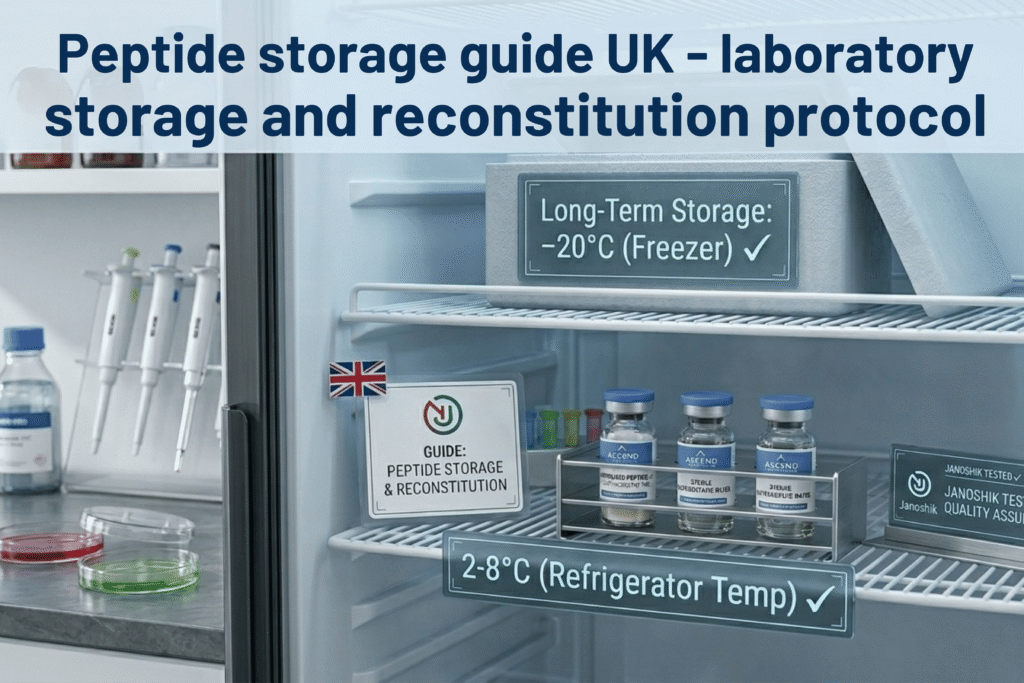
Why Peptide Storage Matters in UK Laboratory Research
Research peptide stability depends on four laboratory variables, each of which is fully controllable through correct storage protocol:
- Temperature the single largest determinant of peptide degradation rate. Synthetic peptides degrade exponentially faster at higher temperatures, with degradation kinetics following Arrhenius-type behaviour. Lyophilised peptides stored at −20°C remain stable for substantially longer than the same peptide stored at 4°C or room temperature.
- Moisture lyophilised peptides are hygroscopic and absorb atmospheric moisture rapidly once the vial seal is broken. Moisture exposure accelerates hydrolytic degradation pathways, including deamidation, oxidation, and peptide bond cleavage.
- Light UV and visible light exposure can drive photochemical degradation in peptides containing aromatic amino acids (tryptophan, tyrosine, phenylalanine). Amber glass vials and dark storage substantially reduce photodegradation risk.
- Repeated freeze-thaw cycles introduce mechanical stress on the peptide structure and can drive aggregation and conformational degradation. Single-use aliquots minimise freeze-thaw exposure.
The Ascend Peptides UK storage protocol is built around control of all four variables: temperature, moisture, light, and freeze-thaw cycles. The complete laboratory quality control workflow at the supplier side is documented on our ” How We Test Peptides ” page; this guide covers the buyer-side storage workflow once the product arrives at the research address.
Lyophilised Peptide Storage — Before Reconstitution
Lyophilised (freeze-dried) research peptides are the most stable form of synthetic peptide and are the standard supply format for all research compounds in the Ascend Peptides UK catalogue. The lyophilisation process removes water from the peptide, leaving a dry powder that resists hydrolytic degradation pathways. Stored correctly, lyophilised research peptides remain stable for extended periods substantially longer than reconstituted solutions of the same compound.
Optimal Storage Conditions for Lyophilised Peptides
| Storage Variable | Optimal Condition | Acceptable Range |
|---|---|---|
| Temperature | −20°C (freezer) | −80°C to +4°C (short-term) |
| Light exposure | Dark/amber glass vial | Original sealed container, dark location |
| Container | Original sealed vial, undisturbed | Original supplier packaging until use |
| Humidity | < 60% relative humidity (freezer ambient) | Sealed vial blocks ambient humidity |
| Expected shelf life | 24 months at −20°C (typical) | Compound-specific — see CoA |
In practical UK laboratory terms: store lyophilised research peptides in the original sealed Ascend Peptides UK vial in a domestic-grade or laboratory-grade freezer at −20°C until immediately before reconstitution. The vial does not need to be opened until reconstitution time. The Janoshik Certificate of Analysis supplied with every batch documents the compound-specific stability profile — consult the CoA for any compound-specific storage notes.
Peptide Reconstitution Protocol — Lyophilised Powder to Working Solution
Reconstitution converts the lyophilised peptide powder into a working solution for laboratory research. The reconstitution medium of choice for the majority of research peptides is BP-grade bacteriostatic water — water for injection containing 0.9% benzyl alcohol as a bacteriostatic preservative. Ascend Peptides UK stocks BP-grade bacteriostatic water (10ml) for all standard reconstitution work, and acetic acid (10ml) for compounds requiring acidic reconstitution conditions (a small subset of research peptides where the standard bacteriostatic water medium is unsuitable).
Standard Reconstitution Protocol
- Step 1 — Allow the lyophilised vial to equilibrate to room temperature (10–15 minutes) before opening.
- Step 2 — Remove the protective flip-cap from the bacteriostatic water vial and the lyophilised peptide vial. Sanitise both rubber stopper surfaces with a 70% isopropanol swab and allow to dry.
- Step 3 — Draw the target reconstitution volume of BP-grade bacteriostatic water into a sterile syringe. The volume depends on the desired working concentration — common reconstitution volumes are 1ml, 2ml, 3ml, or 5ml.
- Step 4 — Insert the needle into the lyophilised peptide vial through the rubber stopper. Direct the bacteriostatic water flow against the inner glass wall of the vial — NOT directly onto the lyophilised powder pellet. A direct stream onto the pellet can cause mechanical disruption and foaming.
- Step 5 — Slowly inject the full reconstitution volume. Withdraw the needle and gently swirl (do NOT shake) the vial until the lyophilised powder is fully dissolved. Most research peptides dissolve completely within 30–60 seconds of gentle swirling.
Step 6 — Once fully dissolved, the reconstituted solution should be clear and colourless. Record the reconstitution date and concentration on the vial label for laboratory traceability.
Reconstituted Peptide Storage — After Reconstitution
Once reconstituted, research peptide stability drops substantially compared to the lyophilised form. Reconstituted peptides are stored in the refrigerator (2–8°C), not the freezer, because freeze-thaw cycles of an already-reconstituted solution drive accelerated degradation and aggregation. The 0.9% benzyl alcohol bacteriostatic preservative in BP-grade bacteriostatic water inhibits bacterial growth in the reconstituted solution, extending the usable in-research period.
Optimal Storage Conditions for Reconstituted Peptides
|
Storage Variable |
Optimal Condition |
Acceptable Range |
|---|---|---|
|
Temperature |
2–8°C (refrigerator) |
2°C to +8°C strictly |
|
Container |
Original reconstituted vial |
Original Ascend Peptides UK vial |
|
Light exposure |
Dark/amber glass |
Refrigerator dark, vial labelled |
|
In-use period |
28 days (typical for most research peptides) |
Compound-specific — see literature for each peptide |
|
Freezing reconstituted solution |
AVOID where possible |
If unavoidable, single-use aliquots only |
In practical UK laboratory terms: store reconstituted research peptides in the refrigerator at 2–8°C in the original vial with the date of reconstitution clearly labelled. Use within the compound-specific research literature-recommended in-use period for most peptides in the Ascend Peptides UK catalogue, which is approximately 28 days from reconstitution. Discard any reconstituted solution that shows visible cloudiness, particulate matter, or colour change before the in-use period expires. These visual changes indicate degradation or contamination.
Free Download — Complete Storage and Handling Guide
This page sets out the principal storage and reconstitution protocol for research peptides. For the complete laboratory workflow, including compound-specific stability profiles, dispatch handling, packaging inspection on arrival, what to do if a parcel arrives damaged, and the full storage troubleshooting reference, download the free Storage and Handling Guide.
The guide is designed as a printable laboratory reference and covers every variable across the storage and handling workflow from supplier dispatch to research-end-of-use.
📥 FREE DOWNLOAD
Research Peptide Storage and Handling Guide
A practical buyer checklist for reviewing storage details, packaging, labels, documentation, and delivery condition for research-use-only peptides.
Inside the pack:
✓ Why storage review matters — reducing uncertainty in research materials
✓ Storage information checklist — what to review before storing
✓ Delivery arrival protocol — 5-point parcel inspection checklist
✓ Packaging and label verification — essential details to check before acceptance
✓ Batch and documentation review — COA and product specification guide
✓ Handling discrepancies — 4-step protocol if an item arrives damaged or incorrect
✓ Storage and documentation reminders — common buyer mistakes to avoid
✓ Final verification — complete 10-point research buyer checklist
For research professionals only — instant download, no payment required
Compound-Specific Storage Notes — Ascend Peptides UK Catalogue
The general storage and reconstitution protocol set out on this page applies to all thirteen research peptides in the Ascend Peptides UK catalogue. The compound-specific Janoshik Certificate of Analysis supplied with every batch documents any compound-specific stability notes — refer to the individual product page for batch-specific documentation. Below is a summary of the standard storage protocol applied across the catalogue:
GH Axis Research Peptides
The five GH axis research peptides — CJC-1295, Ipamorelin, Sermorelin, Tesamorelin, and IGF-1 LR3 — all follow the standard lyophilised storage protocol (−20°C, original sealed vial). Following reconstitution with BP-grade bacteriostatic water, store at 2–8°C for the compound-specific in-use period. Sermorelin may require careful refrigerated storage following reconstitution. Researchers should minimise prolonged storage after reconstitution where possible.
Metabolic Research Peptides
Recovery Research Peptides
The three recovery research peptides BPC-157, TB-500, and GHK-CU follow the standard storage protocol. BPC-157 is commonly supplied in lyophilised form for improved storage stability prior to reconstitution. GHK-CU is supplied as the copper-bound tripeptide complex and should be protected from prolonged light exposure post-reconstitution.
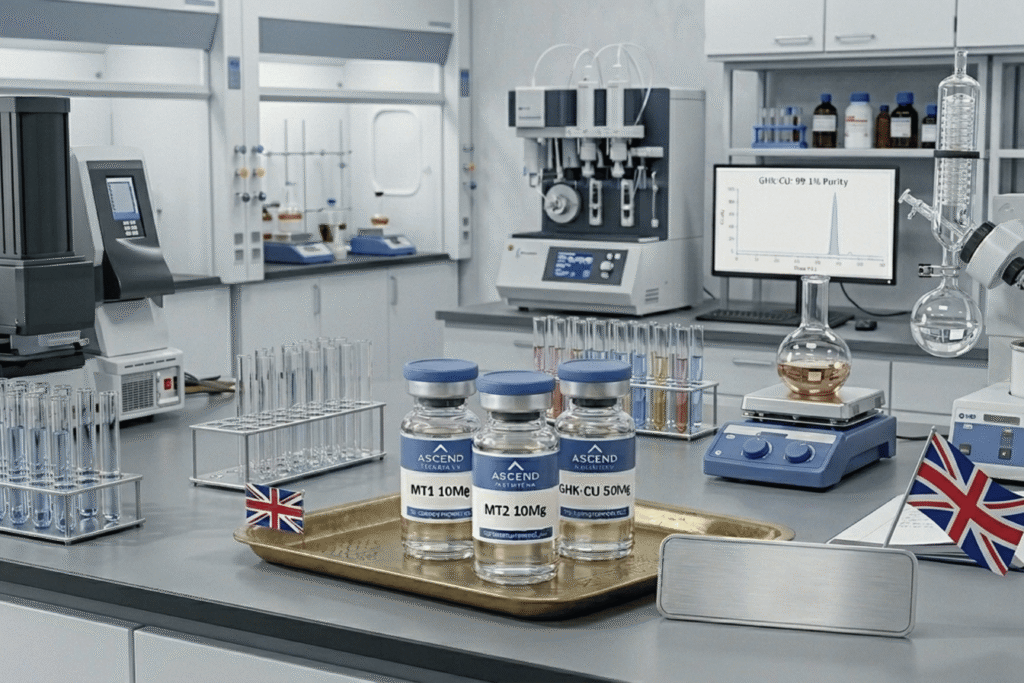
Reconstitution Media — BP-Grade Bacteriostatic Water and Acetic Acid
The two reconstitution media stocked by Ascend Peptides UK cover all reconstitution requirements across the catalogue. BP-grade bacteriostatic water (10ml) is the standard reconstitution medium for the majority of research peptides, water for injection containing 0.9% benzyl alcohol as a bacteriostatic preservative. The bacteriostatic preservative inhibits bacterial growth in the reconstituted solution, extending the usable in-research period to approximately 28 days at 2–8°C storage.
BP-grade acetic acid (10ml) is the reconstitution medium for a small subset of research peptides, where the standard bacteriostatic water medium is unsuitable, typically compounds with limited solubility at neutral pH that require an acidic reconstitution medium for complete dissolution.
Refer to the compound-specific product page for reconstitution medium guidance on any specific peptide. The standard reconstitution medium for most compounds in the Ascend Peptides UK catalogue is BP-grade bacteriostatic water.
Orders over £75 from Ascend Peptides UK qualify for a free 10ml bacteriostatic water bonus — designed to ensure UK research buyers have the correct BP-grade reconstitution medium available immediately on product arrival. See the payment and shipping page for full dispatch details.
Storage and Handling Troubleshooting — Common UK Laboratory Errors
Five recurring storage and handling errors are responsible for the majority of reduced-stability incidents in UK research peptide laboratory work. Each is fully avoidable through correct procedural discipline.
Error 1 — Opening a Cold Vial Without Equilibration
Opening a refrigerated or frozen lyophilised peptide vial without allowing temperature equilibration to room temperature causes condensation of ambient moisture on the cold powder surface. This introduces water into a product specifically lyophilised to remove water. The correction is procedural: always equilibrate sealed vials to room temperature for 10–15 minutes before breaking the seal.
Error 2 — Shaking Instead of Swirling
Vigorous shaking of the reconstitution vial drives air bubble formation and mechanical shear stress on the peptide structure. Both accelerate aggregation and partial denaturation. The correction is procedural: gentle swirling at the vial wall is sufficient and is the only mixing action required.
Error 3 — Direct Powder Stream Reconstitution
Directing the bacteriostatic water stream onto the lyophilised powder pellet rather than the inner vial wall can cause mechanical disruption, foaming, and incomplete dissolution. The correction is procedural: direct the reconstitution medium against the inner glass wall above the lyophilised powder, then allow gravity to bring the medium into contact with the pellet.
Error 4 — Freezing Reconstituted Solutions
Freezing a reconstituted peptide solution introduces freeze-thaw cycle stress that does not affect the lyophilised powder. Each freeze-thaw cycle can drive aggregation and partial degradation. The correction is procedural: store reconstituted solutions in the refrigerator at 2–8°C, not the freezer. Where freezing reconstituted solution is unavoidable (extended storage of a partially-used vial), use single-use aliquots so each freeze-thaw is the last.
Error 5 — Loss of Reconstitution Date Traceability
Failure to label the reconstituted vial with the date of reconstitution causes loss of in-use period tracking. The correction is procedural: write the date of reconstitution clearly on the vial label immediately after reconstitution. This single step protects the entire downstream research workflow.
Why UK Researchers Source Research Peptides from Ascend Peptides UK
The correct buyer-side storage protocol depends on receiving the product in the correct supplier-side dispatch condition. Ascend Peptides UK dispatches all research peptides from the UK same day before 3pm UK time in temperature-controlled packaging, with lyophilised compounds protected through the dispatch cold chain. Every batch is HPLC-verified at ≥98% purity by Janoshik laboratory, with publicly verifiable Certificates of Analysis available pre-purchase. The complete supplier-side quality control workflow is documented on our how we test peptides page. For background on the Ascend Peptides UK supplier model sourcing, testing partner, and dispatch standards — see the main research peptides UK page.
- ≥98% HPLC purity on every batch — independently verified by Janoshik laboratory
- LC-MS molecular identity confirmation — both purity and identity verified on every batch
- Publicly verifiable Certificate of Analysis — batch-specific, available pre-purchase
- Same-day UK dispatch before 3pm UK time — Royal Mail Tracked 24
- FREE 10ml BP-grade bacteriostatic water on orders over £75
- BP-grade reconstitution media stocked — bacteriostatic water and acetic acid
- Temperature-controlled storage chain — lyophilised powder, −20°C dispatch protocol
Peptide Storage Guide UK — Frequently Asked Questions
How long do lyophilised peptides last in storage?
Lyophilised research peptides stored at −20°C in the original sealed vial may remain stable for extended periods under appropriate storage conditions. Stability varies by compound and storage environment; refer to the batch-specific Certificate of Analysis and available stability data where applicable. The compound-specific stability profile is documented on the Janoshik Certificate of Analysis supplied with every batch. Stored correctly at −20°C, the lyophilised form is substantially more stable than the reconstituted solution of the same compound.
How long do reconstituted peptides last in storage?
Reconstituted research peptides in BP-grade bacteriostatic water stored at 2–8°C typically remain stable for approximately 28 days. The compound-specific in-use period varies — refer to the research literature for each specific peptide. The 0.9% benzyl alcohol bacteriostatic preservative in BP-grade bacteriostatic water inhibits bacterial growth, extending the usable period.
Should I freeze a reconstituted peptide solution?
Reconstituted peptide solutions should generally NOT be frozen. Freeze-thaw cycles introduce mechanical stress and can drive peptide aggregation. Store reconstituted solutions in the refrigerator at 2–8°C, not the freezer. If extended storage of a partially-used reconstituted vial is unavoidable, use single-use aliquots so each freeze-thaw is the last.
What bacteriostatic water should I use for reconstitution?
Use BP-grade bacteriostatic water for injection containing 0.9% benzyl alcohol as a bacteriostatic preservative. Ascend Peptides UK stocks BP-grade bacteriostatic water (10ml) as the standard reconstitution medium for the catalogue. Orders over £75 qualify for a free 10ml bacteriostatic water bonus.
Why does opening a cold vial cause problems?
Opening a cold vial allows ambient room-temperature moist air to condense on the cold lyophilised powder surface, introducing the very moisture that lyophilisation was designed to remove. Always allow refrigerated or frozen lyophilised peptide vials to equilibrate to room temperature for 10–15 minutes before breaking the seal.
What do I do if a parcel arrives damaged?
Inspect the parcel before accepting delivery. If the outer packaging is visibly damaged or the temperature-controlled packaging integrity is compromised, photograph the damage and contact Ascend Peptides UK immediately for replacement. The complete dispatch and damage protocol is documented on the payment and shipping page.
Where can I download the complete storage protocol?
The complete Storage and Handling Guide covering every variable across the storage and handling workflow from supplier dispatch to research-end-of-use is available as a free PDF download via the lead magnet on this page. The guide is designed as a printable laboratory reference.
Browse the Ascend Peptides UK Research Peptide Catalogue
The thirteen research compounds covered on this page across the GH axis, metabolic, recovery, and melanocortin research categories are available for direct order with same-day UK dispatch before 3pm UK time and FREE 10ml bacteriostatic water on orders over £75. Browse the complete Ascend Peptides UK research peptide catalogue, review the documentation transparency standard on the batch verification page, or start with the main research peptides UK hub for the complete supplier model.
RESEARCH USE ONLY
All products supplied by Ascend Peptides UK are intended strictly for in-vitro laboratory research purposes only. Compounds are not licensed as medicinal products under the UK Human Medicines Regulations 2012 and are not for human or veterinary use. Storage and handling guidance is provided for laboratory research workflow purposes only — no dosing or administration guidelines are provided.
📥 FREE DOWNLOAD
For research professionals only — instant download, no payment required