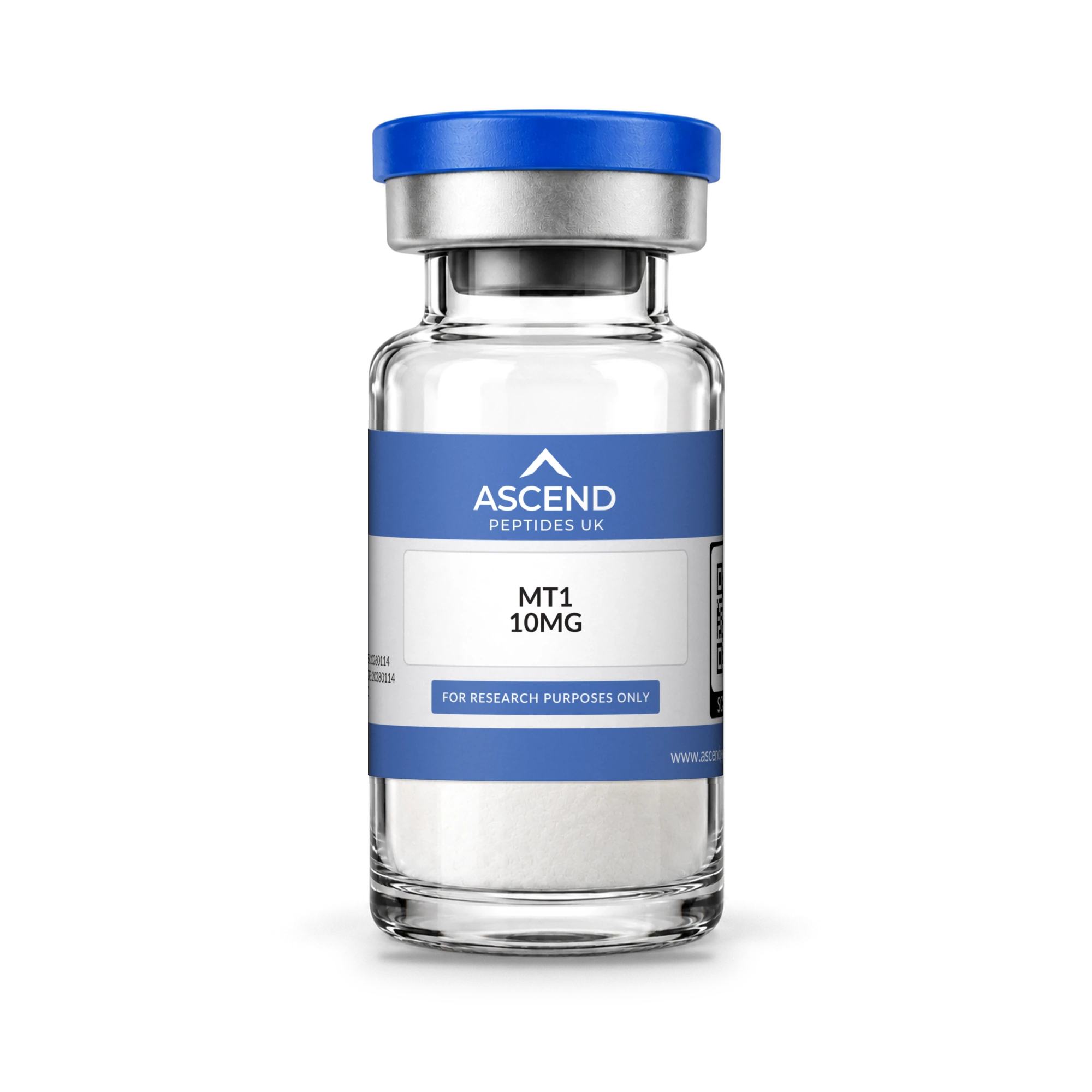
Chemically, afamelanotide is [Nle4, D-Phe7]-α-MSH, a linear 13-amino-acid peptide (Ac-Ser-Tyr-Ser-Nle-Glu-His-D-Phe-Arg-Trp-Gly-Lys-Pro-Val-NH2; C78H111N21O19; about 1,646.9 g/mol; CAS 75921-69-6). Norleucine at position 4 and D-phenylalanine at position 7 made it resistant to degradation by serum enzymes and longer-acting than native alpha-MSH in its original characterisation (Sawyer et al., 1980).
MC1R is expressed on melanocytes, keratinocytes, immune cells, and multiple other tissue types. In laboratory research models, MC1R activation by MT-1 initiates intracellular cAMP signalling, leading to MITF (microphthalmia-associated transcription factor) activation and downstream melanogenesis pathway regulation. Published preclinical literature documents MT-1 (afamelanotide) in melanocyte differentiation research, UV response modelling, pigmentation biology assays, and immune cell MC1R pharmacology studies.
Choosing between the two Melanotan research peptides is mainly a question of receptor profile. MT-1 binds predominantly to MC1R, but it is not exclusively MC1R-selective, so results should be attributed to MC1R only where receptor-specific controls support that. MT-2 10mg is a cyclic analogue with broad, non-selective activity at MC1R, MC3R, MC4R and MC5R, which complicates attribution to any single receptor subtype. For a side-by-side comparison, see the MT-1 10mg research guide and the MT-2 10mg research guide.
Regulatory note: Afamelanotide (the INN for MT-1) is approved under the brand name Scenesse by the EMA under assessment report EMA/CHMP/601433/2014 for a specific clinical indication. This clinical approval does not extend to the lyophilised research format supplied by Ascend Peptides UK, which is designated for in-vitro laboratory research only. Published clinical data for Scenesse concern that licensed implant and do not describe or validate research material.
Independent testing by Janoshik: the published Certificate of Analysis for a tested batch reports measured content and purity. LC-MS identity data is not separately reported on the published certificate. Verifiable CoA.
Ascend Peptides UK does not publish reconstitution or handling instructions for MT-1; preparation is a decision for your own validated laboratory protocol.