
⚠️ Research Use Only. MT2 10mg is supplied strictly for in-vitro laboratory research. It is not intended for human consumption, therapeutic, diagnostic, or clinical use. All information below reflects peer-reviewed preclinical and scientific literature only. This content is not medical advice. Ascend Peptides UK accepts no liability for misuse of this product
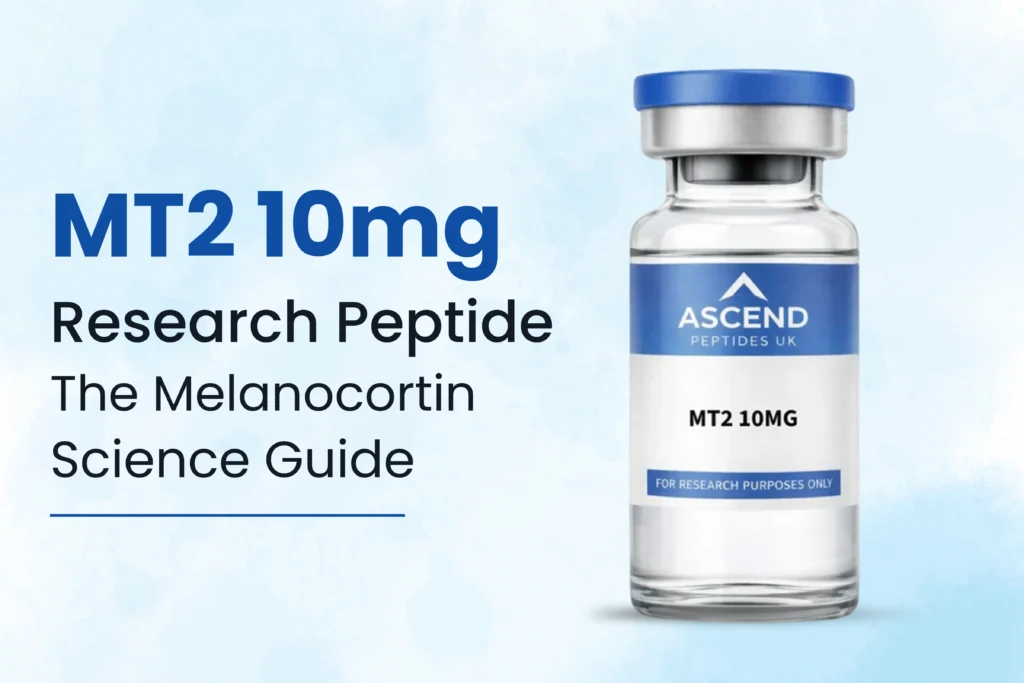
If you are involved in melanocortin receptor research, the MT2 10mg research peptide will already be on your radar. Formally known as Melanotan II, this synthetic cyclic heptapeptide is one of the most widely studied non-selective melanocortin agonists in preclinical science, and its multi-receptor engagement profile makes it a uniquely powerful tool for researchers investigating the broader melanocortin signalling system, rather than any single receptor subtype in isolation.
This guide is written for qualified researchers, laboratory professionals, and academic institutions who incorporate MT-2 into formal research programmes, and scientifically curious individuals who want to understand what this compound actually is, how it differs from closely related peptides, and why it occupies a distinct position in the melanocortin research landscape.
Everything discussed here relates strictly to laboratory research and scientific investigation. Ascend Peptides UK supplies the MT2 10mg research peptide and other high-purity research peptides exclusively for laboratory use, not for personal, veterinary, or clinical application. For a complete mechanism-level introduction to this compound, see our What Is MT-2? guide.
What Is the Melanocortin System and Why Does It Matter in Research?
To understand why the MT2 10mg research peptide is scientifically significant, you first need to understand its parent system: the melanocortin signalling network.
The melanocortin system is one of the most extensively studied receptor networks in biomedical science. It is built around five G-protein-coupled receptor subtypes, MC1R through MC5R, each distributed differently across tissues and associated with distinct biological processes. These receptors are activated by endogenous melanocortin peptides derived from the precursor protein proopiomelanocortin (POMC), the most important of which for receptor research is alpha-melanocyte-stimulating hormone (α-MSH).
From a research perspective, the melanocortin system sits at the intersection of several major scientific fields: pigmentation biology, energy homeostasis and metabolic regulation, immune modulation, central nervous system signalling, and exocrine gland function. No other peptide receptor family spans this breadth of research interest simultaneously, which is precisely why synthetic melanocortin agonists have become so important as laboratory research tools.
This is where MT-2 occupies its unique position. Unlike the more receptor-selective MT-1 (Afamelanotide), Melanotan II engages the full breadth of this system, binding MC1R, MC3R, MC4R, and MC5R, making it the compound of choice for researchers who need to study the integrated behaviour of the melanocortin network rather than a single receptor subtype in isolation.
What Makes MT-2 Different from Other Melanocortin Research Peptides?
The MT2 10mg research peptide Melanotan II is a synthetic analogue of α-MSH engineered with two critical structural features that distinguish it from both the endogenous peptide and from its closely related research counterpart, MT-1.
First, MT-2 is a cyclic heptapeptide. Unlike the linear structure of natural α-MSH or MT-1, MT-2 contains a lactam bridge between the aspartic acid and lysine residues in its chain, creating a ring structure. This cyclisation is not cosmetic; it fundamentally changes the compound’s three-dimensional conformation, its receptor binding geometry, and its metabolic stability compared to linear analogues.
The cyclic structure makes MT-2 more resistant to enzymatic degradation in research systems, providing more consistent receptor stimulation over the duration of an experiment.
Second, and most importantly for experimental design, MT-2 is a non-selective melanocortin agonist. Its binding profile spans MC1R, MC3R, MC4R, and MC5R simultaneously. This is the defining pharmacological feature that separates MT-2 from MT-1, which binds selectively and almost exclusively to MC1R.
For researchers studying how the melanocortin system functions as an integrated network, how activation across multiple receptor subtypes produces emergent signalling behaviour, MT-2 provides a research tool that MT-1 simply cannot replicate.
MT-2 Molecular Identity: Quick Reference
|
Identifier |
Value |
|---|---|
|
INN / Common name |
Melanotan II / MT-2 |
|
Peptide sequence |
Ac-Nle-c[Asp-His-D-Phe-Arg-Trp-Lys]-NH2 |
|
Molecular formula |
C50H69N15O9 |
|
Molecular weight |
1,024.18 g/mol |
|
PubChem CID |
92432 |
|
Structure type |
Cyclic heptapeptide (lactam bridge) |
|
Receptor activity |
Non-selective melanocortin agonist (MC1R, MC3R, MC4R, MC5R) |
|
Supplied form |
Lyophilised powder, white to off-white |
|
Research quantity |
10mg per vial |
|
Category |
Melanotan Research Peptide |
MT-2 vs MT-1: A Researcher’s Comparison
The two compounds most frequently compared in the Melanotan research peptide category are MT-2 and MT-1 (Afamelanotide). They are related; both are synthetic analogues of α-MSH, and both activate MC1R, but their structural differences produce meaningfully different experimental profiles. Selecting the wrong compound for your research objective will produce uninterpretable results.
|
Property |
MT-2 (Melanotan II) |
MT-1 (Afamelanotide) |
|---|---|---|
|
Amino acid length |
7 (heptapeptide) |
13 (tridecapeptide) |
|
Structure |
Cyclic heptapeptide |
Linear tridecapeptide |
|
Molecular weight |
1,024.18 g/mol |
1,647.88 g/mol |
|
Molecular formula |
C50H69N15O9 |
C78H111N21O19 |
|
PubChem CID |
92432 |
16197727 |
|
Receptor profile |
MC1R, MC3R, MC4R, MC5R (broad) |
MC1R only (selective) |
|
Research application |
Broad melanocortin system studies |
MC1R-specific pathway studies |
|
Regulatory note |
No EMA approval |
EMA approved (Scenesse, EPP only) |
The practical implications for experimental design are significant. MT-1 is the correct choice when researchers need clean, MC1R-specific data, for example, in studies isolating the contribution of MC1R to melanin synthesis or inflammatory signalling. MT-2 is the correct choice when the research objective is to study the broader melanocortin network, or when the interaction of multiple receptor subtypes is itself the variable of interest.
For a full scientific profile of MT-1 (Afamelanotide), including its EMA regulatory history and MC1R-specific pharmacology, see our dedicated MT1 10mg research peptide guide.

The Melanocortin Receptor System: Where MT-2 Binds
Understanding which receptors MT-2 engages and what each receptor is associated with in preclinical research is essential context for designing experiments with this compound. The table below maps each melanocortin receptor subtype, its primary tissue distribution, its associated research area, and whether MT-2 binds to it.
|
Receptor |
Primary Tissue Expression |
Key Research Area |
MT-2 Binds? |
|---|---|---|---|
|
MC1R |
Melanocytes, skin cells |
Pigmentation, UV response, inflammation |
✓ Yes |
|
MC2R |
Adrenal gland |
ACTH-specific signalling |
✗ No |
|
MC3R |
Brain, gut, immune cells |
Energy homeostasis, immune modulation |
✓ Yes |
|
MC4R |
Brain (hypothalamus) |
Appetite regulation, metabolic signalling |
✓ Yes |
|
MC5R |
Exocrine glands, immune tissue |
Exocrine secretion, immune response |
✓ Yes |
This receptor map has a critical implication for data interpretation: because MT-2 activates MC1R, MC3R, MC4R, and MC5R simultaneously, any experimental observation made with this compound reflects the combined contribution of all four receptor subtypes. It is not possible to attribute a specific outcome to one receptor in isolation when using MT-2. Researchers who need to isolate MC1R-specific effects must use MT-1 instead. This is not a limitation of MT-2 it is simply a fundamental property of non-selective agonists that must be accounted for in experimental design and result interpretation.
Source for the receptor-selectivity profile set out above, including MC2R’s selectivity for ACTH: Yuan X-C, Tao Y-X. Ligands for Melanocortin Receptors: Beyond Melanocyte-Stimulating Hormones and Adrenocorticotropin. Biomolecules. 2022;12(10):1407.
Who Uses the MT2 Research Peptide and For What Purpose?
The MT2 10mg research peptide is used across a range of scientific disciplines where its broad melanocortin receptor engagement profile is an advantage rather than a complication. Here are the primary research contexts in which this compound has a documented role:
Broad Melanocortin System Studies
For researchers investigating how the melanocortin network functions as an integrated system rather than isolating individual receptor contributions, MT-2 is the preferred research tool. Its simultaneous engagement of MC1R, MC3R, MC4R, and MC5R allows researchers to study emergent signalling behaviour that would not be observable with a selective compound. This type of network-level investigation is particularly relevant to research programmes examining how melanocortin signalling influences multiple biological systems in parallel.
Pigmentation and Melanin Synthesis Research
Via its MC1R activity, MT-2 participates in the same downstream signalling cascade studied with MT-1: MC1R activation → cAMP elevation → MITF upregulation → tyrosinase activation → melanin synthesis. Researchers investigating pigmentation biology who require broad melanocortin system engagement, alongside MC1R activation, for example, in studies examining how multiple receptor pathways interact in melanocyte biology, may select MT-2 over the more selective MT-1 for this reason.
Source for the MC1R → cAMP → MITF → tyrosinase melanin-synthesis cascade referred to above: Mun Y, Kim W, Shin D. Melanocortin 1 Receptor (MC1R): Pharmacological and Therapeutic Aspects. Int J Mol Sci. 2023;24(15):12152.
Researchers building skin biology programmes often complement their melanocortin work with other compounds studied in dermatological contexts. Our GHK-Cu 50mg research peptide guide covers a copper peptide widely studied for its role in cellular remodelling and skin biology a mechanistically distinct but thematically relevant compound for researchers active in this field.
Energy Homeostasis and Metabolic Research Models
MC4R, one of the receptor subtypes targeted by MT-2, is predominantly expressed in the hypothalamus and has been investigated in preclinical models in the context of appetite regulation and energy homeostasis at the cellular and systems level. Research using MT-2 in hypothalamic cell models and in vivo rodent studies has contributed to the understanding of melanocortin pathway contributions to metabolic signalling. This represents one of the most scientifically active research areas associated with non-selective melanocortin agonists in preclinical literature.
Researchers working in metabolic signalling often study multiple peptide compounds in parallel. Our AOD-9604 5mg research peptide guide covers a peptide widely investigated in metabolic and cellular activity research models — a useful context for laboratories building multi-compound metabolic research programmes.
Immune Modulation Research
MC3R and MC5R, both engaged by MT-2, are expressed in immune tissue and exocrine glands, respectively. Several preclinical studies have examined how activation of these receptor subtypes influences immune cell behaviour, cytokine profiles, and inflammatory signalling. MT-2’s ability to simultaneously engage these receptors alongside MC1R and MC4R makes it a useful tool for researchers studying how the melanocortin system contributes to immune regulation at a systems level.
Central Nervous System Research
The expression of MC3R and MC4R in brain tissue, particularly the hypothalamus and limbic regions, has made MT-2 a compound of interest in neuroscience research programmes investigating melanocortin contributions to neurological signalling. Preclinical studies using MT-2 in central nervous system models have explored how melanocortin receptor activation influences neuropeptide signalling, neuroinflammatory markers, and related CNS parameters in rodent models.
Independent and Scientifically Engaged Researchers
Beyond formal institutional settings, there is a growing community of scientifically minded individuals who follow peptide research with genuine intellectual curiosity. The melanocortin system’s involvement in such a breadth of biological processes, from pigmentation to appetite signalling to immune function, makes MT-2 one of the most scientifically fascinating research peptides available, and one that continues to attract serious academic attention internationally.
Ascend Peptides UK welcomes enquiries from all legitimate research interests. Our MT2 10mg research peptide is available to order directly from our website, supplied with full documentation and clearly labelled for research use only. Explore our full range of high-purity research peptides for melanocortin and related research.
How to Source MT2 10mg in the UK: What to Look For
The quality of your research compound directly determines the reliability of your experimental data. When searching for an MT-2 supplier in the UK, these are the quality indicators every researcher should verify before purchasing:
-
HPLC-verified purity: Purity should be confirmed via high-performance liquid chromatography, ideally exceeding 98% for research-grade compounds.
-
Mass spectrometry identity confirmation: Verifies the peptide’s molecular weight matches the expected structure of Melanotan II (C50H69N15O9, MW 1,024.18 g/mol) and confirms the cyclic lactam bridge is intact.
-
Lyophilised format: Freeze-dried peptides maintain structural integrity and stability far better than liquid formats during storage and transit.
-
Batch traceability: Essential for referencing specific production lots in published research and ensuring consistency across repeat experiments.
-
Third-party independent testing: A CoA from an independent analytical laboratory, not in-house testing, is the gold standard for research-grade verification.
-
Research-only labelling: All legitimate peptide research products should clearly state their intended use with no therapeutic or clinical claims.
At Ascend Peptides UK, our MT2 10mg research peptide meets all of these standards. Every batch is independently tested by Janoshik, a recognised third-party analytical laboratory, with a verifiable Certificate of Analysis available for every vial. We are a UK-based melanotan 2 supplier serving the research community with high-purity research peptides backed by full documentation.

Reconstituting MT2 10mg: A Laboratory Reference
MT-2 10mg is supplied as a lyophilised (freeze-dried) powder and must be reconstituted before use in laboratory assays. This section is provided for general laboratory reference and does not constitute dosing, medical, or clinical guidance.
Common reconstitution solvents referenced in published research include:
-
Sterile bacteriostatic water the most widely used option for research peptides, providing extended stability in laboratory storage conditions. Ascend Peptides UK also supplies bacteriostatic water for research, so you can source both from the same trusted UK supplier.
-
Sterile saline (0.9% NaCl) is suitable for experiments requiring physiologically compatible neutral pH conditions.
-
0.1M acetic acid is appropriate where mildly acidic reconstitution is compatible with the experimental design, particularly useful for peptides with limited aqueous solubility at neutral pH.
The cyclic structure of MT-2 provides somewhat greater inherent stability compared to linear peptides; however, standard peptide handling protocols still apply. Once reconstituted, solutions should be aliquoted into single-use volumes, stored at -20°C, and protected from direct light. Repeated freeze-thaw cycles degrade peptide integrity and will introduce variability across repeated experimental runs. All handling should be performed by qualified laboratory personnel under standard aseptic conditions.
Research Compliance: What UK Researchers Need to Know
The MT2 10mg research peptide is classified as a research chemical in the United Kingdom. It is not a licensed medicine, it is not approved for human consumption, and it must not be used in any clinical, veterinary, or diagnostic context outside properly regulated research frameworks.
Unlike MT-1, Melanotan II has not received any regulatory approval from the European Medicines Agency or any other major medicines authority. There is no licensed clinical formulation of MT-2. This distinction matters for researchers: while MT-1 benefits from an extensive published clinical pharmacokinetic dataset generated through the EMA-approved Scenesse programme, the evidence base for MT-2 is entirely preclinical and in vitro in nature.
Source for the Scenesse (afamelanotide) marketing authorisation referred to above: European Medicines Agency, Scenesse – European public assessment report.
Anti-doping status is determined by the World Anti-Doping Agency and the Prohibited List is revised annually. Ascend Peptides UK makes no claim about how MT-2 or any related melanocortin peptide is classified under anti-doping regulations. Anyone designing a research programme involving human subjects should check the current WADA Prohibited List directly.
For any in vivo animal research conducted in the UK, full compliance with the Animals (Scientific Procedures) Act 1986 (ASPA) is mandatory, requiring valid Home Office project and personal licences and full institutional ethical approval before any experimental work begins.
Source: Animals (Scientific Procedures) Act 1986, legislation.gov.uk.
All buyers, whether institutional researchers or individual purchasers, are responsible for ensuring their acquisition and use of this compound complies with applicable UK legislation and institutional ethics requirements. Ascend Peptides UK provides fully compliant, research-only labelled products and makes no health, performance, or clinical claims about any compound we supply.
Why Researchers Choose Ascend Peptides UK
Ascend Peptides UK is a dedicated research peptides company built specifically to serve the needs of laboratories, research institutions, and scientifically engaged individuals across the United Kingdom. Our MT2 10mg research peptide is one of over twenty independently verified compounds available directly from our UK-based operation.
-
High-purity research peptides: Every compound is independently tested by Janoshik before dispatch, with verifiable CoA documentation available for every batch.
-
UK-based melanotan 2 supplier: Fast, reliable delivery across the United Kingdom, with same-day dispatch for orders placed before 4 pm.
-
Comprehensive product range: Melanotan research peptides, including both MT-1 and MT-2, growth hormone peptides, mitochondrial compounds, skin research peptides, and essential laboratory supplies, including bacteriostatic water.
Researchers exploring growth factor pathways alongside melanocortin studies may also find our IGF-1 LR3 1mg research peptide guide a useful resource. IGF-1 LR3 operates through an entirely separate receptor pathway (IGF-1R) but is frequently incorporated into multi-compound research programmes studying cellular signalling systems.
-
Full documentation: Purity certificates, batch records, and clear research-use labelling on every product, no exceptions.
-
Accessible ordering: Buy directly from our website with straightforward product pages and transparent pricing.
Whether you are a laboratory scientist looking for a trusted MT2 research compound supplier in the UK, a research institution building a multi-receptor melanocortin study, or a scientifically engaged individual exploring the broader melanocortin system, Ascend Peptides UK is your reliable UK source for scientific research peptides.
Conclusion: MT2 10mg as a Research Tool
The MT2 10mg research peptide stands out within the Melanotan research peptide category for a reason that no other available compound can replicate: its simultaneous engagement of four melanocortin receptor subtypes. For researchers who need to study the melanocortin system as an integrated network examining how MC1R, MC3R, MC4R, and MC5R interact and contribute to emergent biological behaviour, MT-2 is simply the most appropriate molecular tool available. Its cyclic structure, metabolic stability, and well-characterised receptor pharmacology make it a reliable and scientifically substantiated reagent for a wide range of preclinical research applications.
As a trusted peptide supplier UK for the research community, Ascend Peptides UK is proud to provide the MT2 10mg research peptide and a full range of high-purity research compounds to support your scientific work, each backed by independent third-party analysis and dispatched from within the United Kingdom.
Frequently Asked Questions About MT2 10mg Research Peptide
Q: What is the MT2 10mg research peptide?
Q: What is the difference between MT-2 and MT-1?
Q: Which melanocortin receptors does MT-2 bind to?
Q: Is MT-2 legal to buy in the UK?
Q: Has MT-2 received any regulatory approval?
Q: What are the molecular identifiers for MT-2?
Q: How should MT-2 10mg be stored in a laboratory?
Q: How do you reconstitute MT-2 10mg for laboratory use?
Q: What is the molecular weight of MT-2?
Q: Where can I buy MT-2 10mg in the UK?
Q: Is MT-2 prohibited by WADA?
DISCLAIMER
All products supplied by Ascend Peptides UK are intended strictly for research purposes only. They are not intended for human consumption or for any therapeutic, diagnostic, or clinical use. None of the items offered are classified as medicinal products by the MHRA. It is the buyer’s responsibility to ensure all purchases comply with applicable laws and regulations. Ascend Peptides UK accepts no liability for misuse.