
📥 FREE DOWNLOAD
For research professionals only — instant download, no payment required
How We Test Research Peptides — The 4 Quality Control Standards Every Batch Must Pass
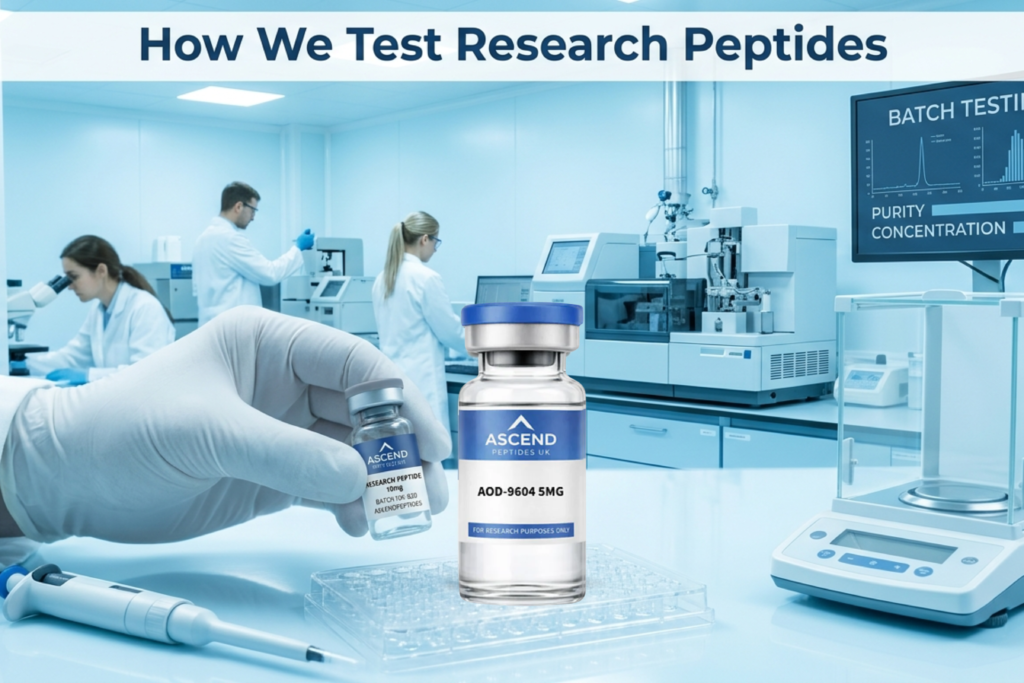
How we test research peptides UK suppliers should explain is the most important question a serious researcher asks before placing an order. The standard answer in the UK research peptide market is short and uninformative: “We test our products.” That answer tells the buyer nothing about who tests, what is tested, how it is tested, or what happens when a batch fails. This page sets out exactly how Ascend Peptides UK tests every research peptide through four operational quality control pillars that every batch must pass before it enters the live catalogue.
The four pillars are Independence, Traceability, Accuracy, and Transparency. Each pillar is independently verifiable by the buyer. Each is documented on the Janoshik Certificate of Analysis that accompanies every product. Each separates Ascend Peptides UK from the unverified UK research peptide market. The complete proof layer, which the testing confirms and which every CoA documents, is set out on the batch verification page. This page sets out the STANDARDS that the testing is performed to and the consequences when a batch fails to meet those standards.
📥 FREE DOWNLOAD
For research professionals only — instant download, no payment required
What Separates Real QC Testing from a Marketing Claim
“Tested” is the most commonly misused word in the UK research peptide market. Every supplier claims to test products, but the meaning of “tested” varies enormously between suppliers, and the differences are exactly what determine whether the buyer is receiving a verified compound or a marketing document. Three properties determine whether a QC test is real or theatrical:
- Who performed the test: supplier in-house? Manufacturer’s internal QC? Or an independent third-party laboratory with no commercial interest in the result?
- Which batch was tested? Was this specific batch tested separately, or is the result from a historical reference batch with the same product name?
- Can the buyer verify the test result: is the test method documented, the result accessible pre-purchase, the testing laboratory named, and the result independently checkable?
The Ascend Peptides UK quality control workflow is built around the strict version of each property: independent third-party testing by Janoshik laboratory, per-batch verification tied to the specific lot number on the buyer’s vial, and full method transparency on the publicly accessible Certificate of Analysis. The four pillars below define the operational QC framework that Ascend Peptides UK applies to every batch before release.
The 4 Quality Control Pillars Every Ascend Peptides UK Batch Must Pass
Why Independence Matters
In-house QC has a structural conflict of interest that cannot be resolved through better procedures. The QC function and the commercial function are in the same organisation, and the QC outcome affects whether a batch can be released for sale.
If the QC team reports a batch as failing the purity specification, the commercial team loses the revenue from that batch. This creates downward pressure on QC rigour that no internal procedure can fully eliminate.
Independent third-party testing removes the conflict at the structural level. Janoshik Laboratory is paid to test the sample submitted, with no commercial stake in the test result.
A failed batch costs Janoshik nothing. A passed batch earns Janoshik nothing additional. The test result is reported as the analytical methods measure it, not as the commercial interest would prefer.
Why Janoshik Specifically
Three properties distinguish Janoshik from in-house QC and from other testing options. First, established analytical methodology Janoshik uses consistent HPLC and LC-MS methods across all submitted samples, enabling like-for-like comparison across batches and across suppliers. Second, independence verifiable by the buyer, Janoshik certificates are publicly checkable, not internal documents.
Third, European research peptide market standard Janoshik is one of the most established independent peptide testing laboratories in Europe, with a substantial track record across the UK and European research peptide supplier market.
How Traceability Works in Practice
Traceability is the operational mechanism that ties a Janoshik test result to the specific vial the buyer receives. Without traceability, even genuine independent testing collapses into generic certification a single historical batch tested once, with the result applied generically to all subsequent production. Three operational steps create real traceability:
-
Step 1: Per-batch sample extraction. When a new manufacturing batch arrives at the Ascend Peptides UK facility, a representative sample is extracted from that specific batch and labelled with the manufacturing lot number. The sample is not pooled with previous batches.
-
Step 2: Documented submission to Janoshik. The sample is submitted to Janoshik with the manufacturing lot number recorded on the submission paperwork. Janoshik tests the sample under the recorded lot number, not under a generic product name.
-
Step 3: CoA matched to vial label. The resulting Janoshik Certificate of Analysis names the manufacturing lot number. The vial label in the buyer’s hand shows the same lot number. The buyer can verify the CoA applies to the specific vial by matching the lot numbers.
The published CoA archive organises every Janoshik certificate by lot number, making the matching step straightforward for the buyer to perform before or after purchase.
What HPLC and LC-MS Actually Confirm
Accuracy requires two analytical methods because each method detects what the other cannot. HPLC measures how PURE the supplied product is. LC-MS confirms WHAT the pure compound is. Either test alone leaves a verification gap that the other test closes.
What HPLC Catches
HPLC separates the target peptide from synthesis-related impurities, such as truncated sequences (peptides missing one or more amino acids), deletion products, modified sidechain compounds, and residual reagents from the synthesis process.
The integrated area under the target peptide peak, expressed as a percentage of the total chromatogram area, is the HPLC purity figure. For research-grade peptides, the standard is ≥98%. Below this threshold, synthesis impurities reach concentrations that can confound in-vitro research results.
What LC-MS Catches
LC-MS measures the molecular weight of the supplied compound and compares it to the theoretical molecular weight of the target peptide. A molecular weight match within instrument tolerance (typically ±0.5 Da) confirms identity.
A molecular weight mismatch indicates the supplied compound is structurally different from the target substitution, modification, or degradation. LC-MS is the analytical method that catches identity substitution in heavily counterfeited compounds like BPC-157, TB-500, and the melanocortin peptides.
What We Reject: Real Examples of Batches That Failed QC
The 4-pillar QC framework is not theoretical. It is the operational standard that batches must pass to enter the Ascend Peptides UK catalogue. The following four scenarios are the types of failure modes the QC system catches and the consequences when a batch fails. Failed batches do not reach the buyer.
The four scenarios above represent the four most common QC failure modes in the UK research peptide market. Each is caught by one or more of the 4-pillar standards. Failed batches do not reach the buyer, which is the operational reason that every product in the live Ascend Peptides UK catalogue carries a publicly verifiable Janoshik CoA confirming both HPLC purity and LC-MS molecular identity.
Free Download — Supplier Evaluation Checklist
The 4-pillar QC framework set out on this page is the standard a UK research buyer should expect from any peptide supplier, not just from Ascend Peptides UK. Run any supplier’s QC claims against the Supplier Evaluation Checklist before purchase. If any pillar fails, no independence, no traceability, no accuracy, or no transparency; the supplier does not meet the documented standard. This is the same checklist the Ascend Peptides UK QC team applies to its own supplier-side workflow.
📥 FREE DOWNLOAD
Supplier Evaluation Checklist
A practical 10-point checklist for UK research buyers. Compare any peptide supplier’s quality control standards against this checklist before purchase. The supplier evaluation framework Ascend Peptides UK uses for its own internal review.
Inside the checklist:
✓ Company transparency — legal name, UK address, and contact details publicly listed
✓ Research-use compliance — research-only positioning explicit, no human-use language
✓ Independent third-party testing — external lab named, no in-house QC accepted
✓ Per-batch verification — individual CoA per lot number, not a shared reference document
✓ Analytical method documentation — HPLC and LC-MS methods stated, not just a purity figure
✓ Purity standard — ≥98% HPLC independently confirmed on every batch
✓ Molecular identity — LC-MS weight match verified, substitution and degradation ruled out
✓ Pre-purchase CoA access — certificate available before payment, not issued after
✓ Storage and dispatch standards — cold chain handling documented, not assumed
✓ Failed batch and returns protocol — clear process for rejected, damaged, or disputed orders
For research professionals only — instant download, no payment required
How Transparency Works at Ascend Peptides UK
Transparency is the most important pillar because it is the one that the buyer can verify independently. Independence (Pillar 1), Traceability (Pillar 2), and Accuracy (Pillar 3) are operational properties the buyer cannot directly observe; they are claimed by the supplier and confirmed indirectly through documentation. Transparency (Pillar 4) is the documentation itself. Three transparency standards apply across every Ascend Peptides UK batch:
-
Pre-purchase CoA availability: the Janoshik Certificate of Analysis for every batch is published on the public CoA archive and accessible from the product page BEFORE the buyer commits to the order. The buyer reviews the test result, then decides whether to purchase.
-
Complete CoA documentation: Every published CoA includes eight specific documentation fields (product name, lot number, test date, HPLC purity, analytical method, LC-MS molecular weight, issuing laboratory, and authentication). A CoA missing any field is not a complete CoA.
-
Independent verification of Janoshik certificates is issued by an independent third-party laboratory whose document authenticity the buyer can verify separately from Ascend Peptides UK. The verification chain does not depend on Ascend Peptides UK self-confirming its own claims.
The complete CoA archive of every published certificate for every batch is available on the Certificates of Analysis page. The eight documentation fields included on every CoA, and how to read a Janoshik certificate step-by-step, are set out on the batch verification page.
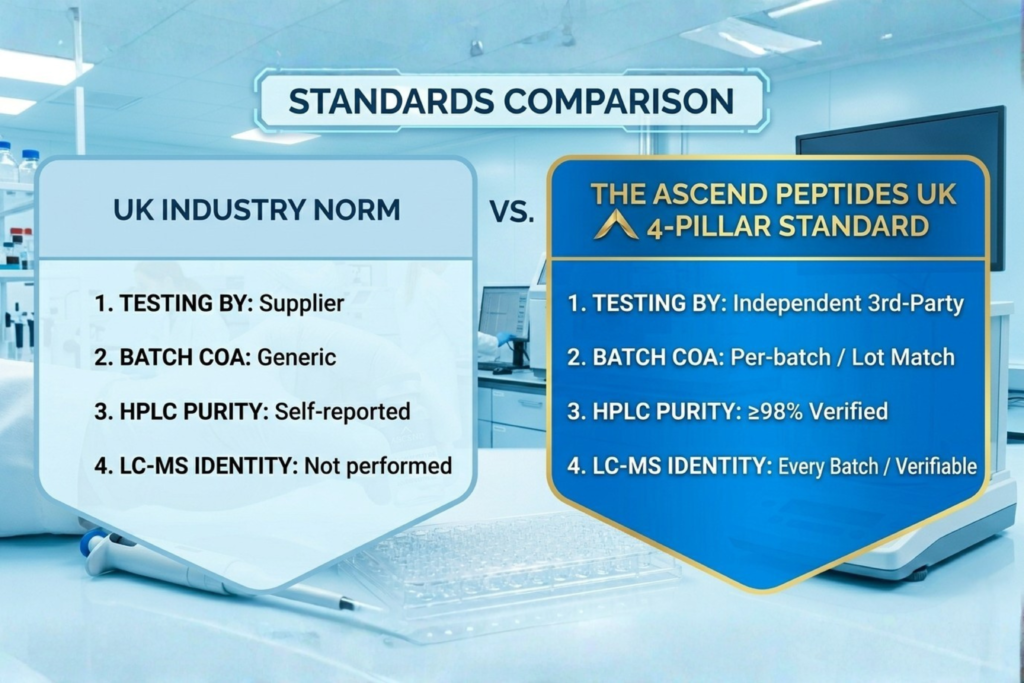
UK Industry Norm vs The Ascend Peptides UK 4-Pillar Standard
The substantive comparison between an unverified-QC supplier and the Ascend Peptides UK 4-pillar standard is operationally measurable. The table below maps the unverified industry norm against the 4-pillar standard, variable by variable. Each variable is independently checkable by the UK research buyer before purchase.
|
Quality Variable |
UK Industry Norm |
Ascend Peptides UK Standard |
|---|---|---|
|
Testing performed by |
Supplier in-house or manufacturer |
Janoshik — independent third-party laboratory |
|
Tied to a specific batch |
Generic CoA across multiple batches |
Per-batch CoA matching the vial lot number |
|
HPLC purity testing |
Self-reported figure, method undocumented |
≥98% verified by independent HPLC with a method named |
|
LC-MS identity testing |
Often not performed |
LC-MS confirmation on every batch |
|
CoA availability |
Sent after order, if at all |
Public pre-purchase access from the product page |
|
Method documentation |
Not provided |
HPLC and LC-MS methods are named on every CoA |
|
Failed batch policy |
Variable or undocumented |
Failed batches rejected — no CoA published, no stock added |
|
Independent verification |
Not possible without supplier cooperation |
Buyer can independently verify Janoshik CoA authenticity |
Every Ascend Peptides UK research peptide meets the right-hand column standard on every variable. The complete supplier model sourcing, testing partner, dispatch standards, and UK regulatory framework is set out on the About Us page and the main research peptides UK page.
Why Serious UK Researchers Trust the Ascend Peptides UK QC Standard
- 4-pillar QC framework: Independence, Traceability, Accuracy, Transparency
- Independent third-party testing by Janoshik laboratory established European testing partner
- Per-batch verification: every manufacturing batch is tested separately, CoA tied to lot number
- HPLC ≥98% purity verification analytical method is named on every CoA
- LC-MS confirmation helps detect molecular mismatch, substitution, and degradation. HPLC confirms PURITY — the percentage of the supplied product that is the target compound (≥98% standard)
- Pre-purchase CoA access buyer reviews the verification result before placing the order
- Failed batches rejected, no CoA published, no stock added, supplier batch history reviewed before future procurement
- Complete CoA archive, with publicly accessible historical verification available for every released batch
How We Test Research Peptides UK — Frequently Asked Questions
What are the four quality control pillars?
The four pillars are Independence (third-party Janoshik testing, not in-house QC), Traceability (per-batch CoA tied to the vial lot number), Accuracy (HPLC purity + LC-MS molecular identity confirmation), and Transparency (pre-purchase CoA availability on the public archive). Every Ascend Peptides UK batch must pass all four pillars before entering the live catalogue.
Who performs the actual testing?
Janoshik laboratory an independent European peptide testing partner. Testing is NOT performed in-house by Ascend Peptides UK. Independence is the qualifying property. Janoshik is not financially or operationally connected to any specific peptide supplier.
How do I know the CoA applies to the vial I receive?
The Janoshik Certificate of Analysis names the manufacturing lot number. The vial label in your hand shows the same lot number. Match the two lot numbers to confirm the CoA applies to your specific vial. The complete CoA archive organises every certificate by lot number for straightforward matching.
What is the difference between HPLC and LC-MS?
HPLC confirms PURITY, the percentage of the supplied product that is one compound (≥98% standard). LC-MS confirms IDENTITY; the molecular weight matches the expected target peptide. Both tests are required because each catches what the other cannot. HPLC alone does not catch identity substitution; LC-MS is the identity check.
What happens if a batch fails QC?
Failed batches are rejected and do not enter the Ascend Peptides UK catalogue. No Certificate of Analysis is published for a failed batch. Failed batches do not reach the buyer. The supplier responsible for the failed batch is flagged for QC review. The operational mechanism is what ensures every product in the live catalogue has passed all four pillars.
Can I verify the Janoshik certificate independently?
Yes. Janoshik certificates are issued by an independent third-party laboratory whose document authenticity can be verified separately. The verification chain does not depend on Ascend Peptides UK self-confirming its own claims. Independent verifiability is a defined property of Pillar 4 (Transparency).
What is the difference between this page and the batch verification page?
This page sets out the STANDARDS the testing is performed against (the 4 pillars and what happens when batches fail). The batch verification page sets out the PROOF that the testing is performed (the 8 CoA documentation fields, how to read a CoA, the published CoA archive). Both pages are companion trust pages read together for the complete picture of the Ascend Peptides UK QC standard.
Why does this matter for in-vitro research results?
Below ≥98% HPLC purity, synthesis-related impurities reach concentrations where they can confound in-vitro research results, particularly in receptor binding assays, signalling cascade research, and any experimental design where test compound concentration is a controlled variable.
LC-MS identity confirmation is equally important: a substituted compound mislabelled as the target peptide invalidates the experimental design. Both verification checks protect the integrity of downstream research results.
What are the limitations of HPLC and LC-MS testing?
HPLC and LC-MS are analytical chemistry methods used to assess purity and help verify molecular identity. They do not establish biological activity, safety or efficacy. Analytical results relate to the specific sample and batch tested and should be interpreted within the limitations of the methods used. Testing provides evidence about chemical identity and purity; it does not determine how a compound will behave in a biological or clinical setting.
Review the Ascend Peptides UK Quality Documentation
The complete operational standard for every research peptide in the Ascend Peptides UK catalogue is documented across three pages. This page sets out the 4 QC pillars. The batch verification page sets out the per-batch verification protocol. The CoA archive shows the actual published Certificates of Analysis. To browse the catalogue with confidence in the QC standards applied to every product, see the Ascend Peptides UK shop collection, or start with the main research peptides UK hub for the complete supplier model. For what “research-grade” means in operational terms, see our research-grade standards page. For a broader framework on evaluating any UK research peptide supplier, see our guide to choosing a peptide supplier.
RESEARCH USE ONLY
All products supplied by Ascend Peptides UK are intended strictly for in-vitro laboratory research purposes only. Compounds are not licensed as medicinal products under the UK Human Medicines Regulations 2012 and are not for human or veterinary use. Products are supplied to qualified research professionals only.
📥 FREE DOWNLOAD
For research professionals only — instant download, no payment required