
📥 FREE DOWNLOAD
DOWNLOAD THE FREE STARTER PACK
For research professionals only — instant download, no payment required
What Is Tesamorelin? Full-Length GHRH Research Peptide Guide for UK Laboratory Research
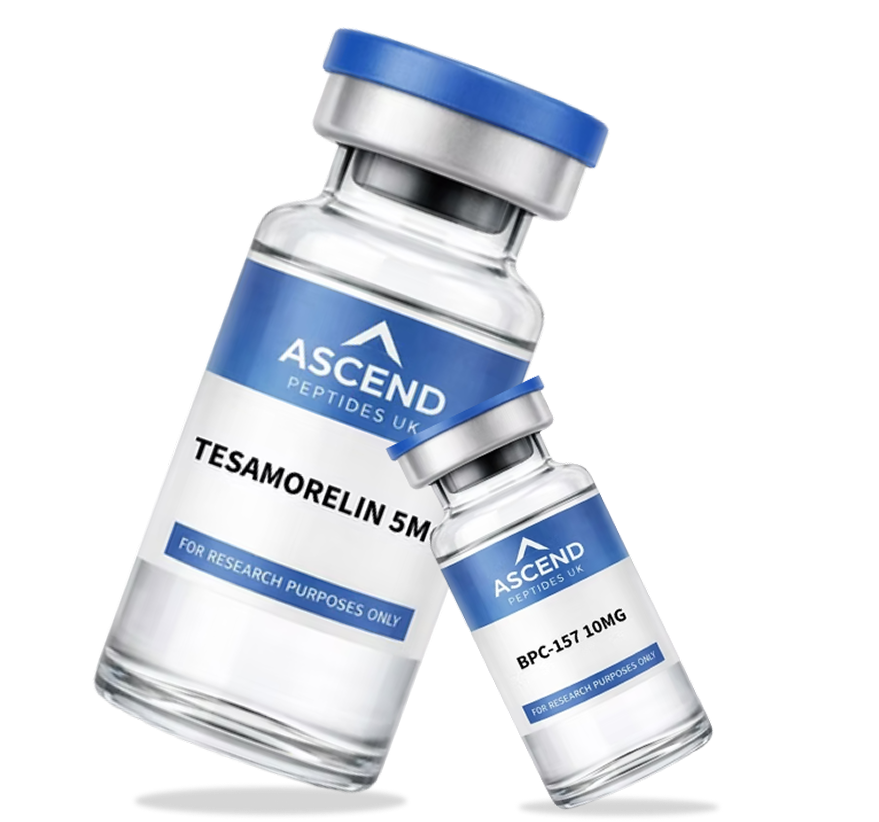
What is Tesamorelin? Tesamorelin is a synthetic analogue of Growth Hormone Releasing Hormone (GHRH) and the only research peptide in the Ascend Peptides UK catalogue that replicates the complete 44-amino acid native GHRH sequence, rather than a truncated 29-amino acid fragment. This full-length structure, combined with an N-terminal stabilising modification, gives Tesamorelin a receptor-engagement profile that is mechanistically distinct from every other GHRH analogue available for UK laboratory research.
Tesamorelin is supplied for in-vitro laboratory research only. It is not licensed by the MHRA as a general medicinal product for the lyophilised research format supplied by Ascend Peptides UK, and no dosing or administration guidance is provided in this guide or in any Ascend Peptides UK documentation. The compound is supplied for use by laboratories, academic institutions and research scientists for cellular and endocrine pathway research applications only.
Every batch of Tesamorelin supplied by Ascend Peptides UK is HPLC verified at ≥98% purity by Janoshik laboratory, LC-MS confirmed for molecular identity, and accompanied by a publicly verifiable Certificate of Analysis.
What Is Tesamorelin at the Molecular Level?
Tesamorelin is a stabilised synthetic analogue of endogenous Growth Hormone Releasing Hormone (GHRH). Unlike the truncated 29-amino acid GHRH fragments used by CJC-1295 Without DAC and Sermorelin, Tesamorelin replicates the full 44-amino acid native GHRH sequence with a trans-3-hexenoic acid group covalently bonded to the N-terminal tyrosine residue. The molecular identity is documented below.
|
Molecular Property |
Value |
|---|---|
|
Compound name |
Tesamorelin (INN); supplied as tesamorelin acetate |
|
Peptide class |
Full-length GHRH analogue, 44-amino-acid sequence |
|
N-terminal modification |
Trans-3-hexenoic acid group on N-terminal tyrosine |
|
Molecular formula (free base) |
C221H366N72O67S |
|
Molecular formula (acetate salt, as supplied) |
C221H366N72O67S · xC2H4O2 (x ≈ 7) |
|
Molecular weight |
≈ 5,135.9 Da (free base; the acetate salt form carries additional mass from the bound acetate and has no single fixed value) |
|
Receptor target |
GHRH receptor (GHRHR) — Gs-coupled GPCR |
|
Research category |
Growth Hormone Research Peptide (GHRH analogue class) |
|
Supplied format |
Lyophilised powder — white to off-white |
|
Third-party testing |
Janoshik — HPLC + LC-MS verified |
The defining structural property of Tesamorelin is the combination of full sequence length and N-terminal stabilisation. Most GHRH research peptides in commercial supply are based on only the first 29 amino acids of native GHRH; Tesamorelin is the exception. The trans-3-hexenoic acid modification is the source of its improved resistance to DPP-IV (dipeptidyl aminopeptidase IV) enzymatic degradation, the enzyme primarily responsible for the rapid breakdown of native GHRH in biological environments.
The full molecular identity of Tesamorelin is confirmed on every Ascend Peptides UK batch by independent LC-MS analysis through Janoshik laboratory, with the measured molecular weight matched against the theoretical free-base value (≈ 5,135.9 Da) to confirm structural identity. The complete laboratory quality control workflow is documented on the how we test peptides page.
Tesamorelin Within the GH Axis: Three Mechanistic Classes
Research peptides acting on the growth hormone axis fall into three mechanistically distinct groups, each intervening at a different point in the hypothalamic-pituitary-IGF cascade: GHRH analogues (acting at the GHRH receptor), GHRPs (acting at the ghrelin receptor, GHS-R1a), and IGF-1 axis compounds (acting downstream at the IGF-1 receptor). Tesamorelin sits in the first group, alongside CJC-1295 Without DAC and Sermorelin, but is structurally distinct from both.
|
Compound |
Compound Class |
Receptor Target |
Primary Research Distinction |
|---|---|---|---|
|
Tesamorelin |
Full-length GHRH analogue (44 AA) |
GHRHR |
Only full-length GHRH analogue in the Ascend Peptides UK GH axis range — complete receptor interface engagement |
|
CJC-1295 Without DAC |
Modified GHRH analogue (29 AA) |
GHRHR |
Most widely studied GHRH analogue; DPP-IV resistant via amino acid substitution |
|
Sermorelin |
Native GHRH analogue (29 AA) |
GHRHR |
Closest to native GHRH sequence; shortest in-vitro half-life |
|
Selective GHRP (pentapeptide) |
GHSR-1a (ghrelin receptor) |
Mechanistically independent pathway; standard combination partner for GHRH analogues |
|
|
IGF-1 LR3 |
IGF-1 variant (downstream) |
IGF-1 receptor |
Acts downstream of pituitary GH release, bypassing GHRHR/GHSR-1a entirely |
This three-class framework is why researchers sometimes combine a GHRH analogue with a GHRP (such as CJC-1295 Without DAC and Ipamorelin) as mechanistically independent variables within the same protocol — the two receptors signal through entirely different second-messenger cascades. Tesamorelin has not been established sitewide as part of a specific combined-protocol bundle in the way CJC-1295 and Ipamorelin have; where a full-length GHRH analogue is specifically the required variable, Tesamorelin is sourced as a standalone research compound. See the GH axis research peptides UK hub for the complete category framework across all five compounds.
GHRHR Signalling and the Downstream GH/IGF-1 Research Pathway
Tesamorelin acts as a selective agonist at the Growth Hormone Releasing Hormone Receptor (GHRHR), a Gs-coupled G-protein-coupled receptor expressed predominantly on anterior pituitary somatotroph cells. In laboratory research models, receptor binding initiates a well-characterised downstream cascade: Gs protein activation stimulates adenylyl cyclase, raising intracellular cAMP; elevated cAMP activates protein kinase A (PKA); PKA activation is associated with increased GH gene transcription and pulsatile GH secretion from somatotroph cells; secreted GH in turn stimulates hepatic IGF-1 production, the principal downstream mediator studied in GH-axis growth factor research.
Because Tesamorelin retains the complete 44-amino-acid GHRH sequence, it engages the full GHRHR binding interface — a mechanistically important distinction from CJC-1295 Without DAC and Sermorelin, both of which are based on only the first 29 residues. For researchers specifically investigating receptor structure-function relationships, binding-interface contact points, or comparing complete versus truncated GHRH engagement, this full-length profile is the primary reason to select Tesamorelin over a shorter analogue.
For the downstream portion of this signalling axis, the IGF-1 LR3 1mg research peptide provides a research tool for investigating IGF-1 receptor pathway effects independently of upstream pituitary GHRHR activation.
Regulatory and Clinical Research History
Tesamorelin occupies an unusual position among the GH axis research compounds Ascend Peptides UK supplies: it is the only one with a licensed clinical formulation approved in another regulatory context. A tesamorelin-based injectable product (marketed in the United States as Egrifta) received initial FDA approval in 2010 for a specific, narrow clinical indication — the reduction of excess abdominal visceral fat in HIV-associated lipodystrophy. The pivotal clinical trial supporting that approval was published in the New England Journal of Medicine (Falutz et al., 2007). A separate marketing-authorisation application for the same product was submitted to the European Medicines Agency; after review by the Committee for Medicinal Products for Human Use (CHMP), the applicant withdrew that application in 2012, stating that the CHMP could not conclude on a positive benefit-risk balance. Egrifta/tesamorelin has therefore never held a marketing authorisation in the EU.
This regulatory and clinical history is a genuine point of scientific interest, because it means a body of human pharmacokinetic and safety data exists for tesamorelin in a way that most research-only peptides do not have. However, this history applies specifically to a licensed, clinically-formulated injectable product administered under medical supervision for a defined indication — it does not extend any licensed or clinical status to the lyophilised research-grade material supplied by Ascend Peptides UK, which remains an unlicensed research chemical supplied strictly for in-vitro laboratory investigation. Researchers should not treat the existence of an approved clinical formulation elsewhere as authorisation, endorsement, or guidance for any human use of this research product.
Evidence Base and Research Limitations
Researchers designing experiments around Tesamorelin should be aware of some specific limits to the current evidence base:
-
The clinical trial data referenced above (Falutz et al., 2007) relates to a specific licensed formulation, patient population, and clinical administration protocol. It cannot be directly extrapolated to in-vitro or preclinical research using the lyophilised research-grade compound, which is a different product with a different regulatory status.
-
Because Tesamorelin’s full-length structure is less commonly used in commercial and academic peptide research than the shorter, more widely studied GHRH analogues, published in-vitro literature specifically comparing full-length versus truncated GHRH receptor engagement is comparatively less consolidated than the literature base for CJC-1295 Without DAC or Sermorelin.
-
GHRHR signalling cascade research (Gs-cAMP-PKA-GH transcription) is well established in the broader endocrinology literature (see Frohman & Jansson, Endocr Rev, 1986, for a foundational review of GHRH receptor physiology), but this general mechanism should not be conflated with compound-specific findings unique to the trans-3-hexenoic acid modification, which is a narrower and more recent area of structure-function research.
These limitations are a normal feature of an actively developing research field rather than a reason to dismiss Tesamorelin’s research relevance — they are simply the context a rigorous experimental design should account for.
Research-Grade Verification Standards for Tesamorelin
Tesamorelin is a structurally complex, high-molecular-weight peptide (≈5,135.9 Da free base) carrying a specific N-terminal modification, which makes analytical verification particularly important. Four documentation standards distinguish a verified UK supplier from an unverified one. The complete framework is set out on the batch verification page.
|
Documentation Standard |
Industry Norm |
Ascend Peptides UK |
|---|---|---|
|
HPLC purity verification |
Self-reported by the supplier |
Independent HPLC by Janoshik, ≥98% verified |
|
LC-MS molecular identity |
Often not performed |
LC-MS confirmation on every batch, including the N-terminal modification |
|
Batch-specific Certificate of Analysis |
Generic or unavailable |
Per batch CoA tied to vial lot number |
|
UK dispatch standards |
3 to 7 working days |
Same day UK dispatch before 16:00 GMT |
For the complete research grade standards framework that defines what “research grade” actually means in UK laboratory peptide supply, see the research grade standards page.
Storage Note
Tesamorelin follows the standard lyophilised-peptide storage protocol used across the Ascend Peptides UK catalogue. Full storage, reconstitution and handling detail — including solvent selection and aliquoting practice — is covered in depth in the peptide storage guide and the reconstitution guide, rather than repeated here.
Tesamorelin Research Formats at Ascend Peptides UK
Tesamorelin is supplied in two research formats, both to the same ≥98% HPLC-verified purity standard. This page covers the compound itself; for format selection, pricing, and dose-format-specific detail, see the dedicated guides below.
-
Tesamorelin 5mg — see the Tesamorelin 5mg research guide for the pilot/method-development format.
-
Tesamorelin 10mg — see the Tesamorelin 10mg research guide for the established-programme format.
Tesamorelin is one compound within the wider GH axis research peptides UK range, itself part of the complete research peptides UK catalogue.
What Is Tesamorelin? Frequently Asked Questions
What is Tesamorelin?
Tesamorelin is a synthetic analogue of Growth Hormone Releasing Hormone (GHRH) that replicates the complete 44-amino-acid native GHRH sequence, modified with a trans-3-hexenoic acid group at the N-terminus for improved resistance to enzymatic degradation. It is the only full-length GHRH research analogue in the Ascend Peptides UK catalogue.
What makes Tesamorelin different from CJC-1295 and Sermorelin?
Among the GHRH analogues in the Ascend Peptides UK research range, Tesamorelin is the only one built on the full 44-amino-acid native sequence. CJC-1295 Without DAC and Sermorelin are both based on only the first 29 amino acids of GHRH. The full-length sequence gives Tesamorelin a more complete GHRH receptor engagement profile in laboratory models, relevant to receptor structure-function research specifically.
Is Tesamorelin the same as native GHRH?
No. Tesamorelin replicates the full native GHRH sequence but adds a trans-3-hexenoic acid modification at the N-terminus that native GHRH does not carry. This modification is designed to improve resistance to DPP-IV enzymatic degradation compared with the unmodified native hormone.
Does Tesamorelin have any approved clinical use?
A tesamorelin-based injectable formulation (Egrifta) has been FDA-approved in the United States since 2010 for a specific, narrow clinical indication unrelated to general use. A separate EU marketing-authorisation application was reviewed by the European Medicines Agency’s CHMP but was withdrawn by the applicant in 2012 without approval being granted — Egrifta/tesamorelin has never held EU marketing authorisation. Neither approval status applies to the unlicensed research-grade material supplied by Ascend Peptides UK, which is intended strictly for in-vitro laboratory research and carries no human-use authorisation.
What is the WADA status of Tesamorelin?
Tesamorelin, along with all GHRH analogues, is listed on the World Anti-Doping Agency (WADA) Prohibited List under category S2 (Peptide Hormones, Growth Factors, Related Substances and Mimetics), prohibited at all times for athletes subject to WADA jurisdiction. Ascend Peptides UK supplies Tesamorelin for in-vitro laboratory research only.
What is the MHRA status of Tesamorelin in the UK?
The lyophilised research-grade Tesamorelin supplied by Ascend Peptides UK is not licensed as a medicinal product under the UK Human Medicines Regulations 2012. It is supplied strictly for in-vitro laboratory research. The Medicines and Healthcare products Regulatory Agency (MHRA) is the relevant UK medicines regulator.
How is Tesamorelin’s identity verified?
Every Ascend Peptides UK batch is independently HPLC verified at ≥98% purity and LC-MS confirmed for molecular identity, including confirmation that the N-terminal trans-3-hexenoic acid modification is intact. The Janoshik Certificate of Analysis is publicly accessible from the CoA archive before ordering.
Scientific References
Falutz, J., Allas, S., Blot, K., et al. (2007). “Metabolic effects of a growth hormone-releasing factor in patients with HIV.” New England Journal of Medicine, 357(23), 2359–2370. — pivotal clinical trial underlying the FDA approval of the licensed tesamorelin injectable formulation; cited here for regulatory-history context only, not as evidence relating to the unlicensed research-grade compound.
Frohman, L.A., & Jansson, J.O. (1986). “Growth hormone-releasing hormone.” Endocrine Reviews, 7(3), 223–253. — foundational review of GHRH receptor physiology and the GHRHR signalling cascade referenced above.
U.S. Food and Drug Administration (2010; label updated 2013). EGRIFTA (tesamorelin for injection) — Prescribing Information, NDA 022505. — source for the tesamorelin acetate molecular formula and free-base molecular weight in the molecular properties table above, and for the 2010 initial US approval date cited in the Regulatory and Clinical Research History section.
European Medicines Agency (2012). Ferrer Internacional, S.A. withdraws its marketing authorisation application for Egrifta (tesamorelin). EMA public statement, 26 June 2012. — source for the EU marketing-authorisation withdrawal cited in the Regulatory and Clinical Research History section.
RESEARCH USE ONLY
All products supplied by Ascend Peptides UK are intended strictly for in-vitro laboratory research purposes only. Tesamorelin is not a licensed medicinal product under the UK Human Medicines Regulations 2012 in the research-grade lyophilised format supplied here, and is not for human or veterinary use. No dosing or administration guidelines are provided. Purchasers must be 18 years of age or older and must confirm that products are being purchased solely for lawful laboratory research purposes. Ascend Peptides UK reserves the right to request additional information regarding intended research use and to decline orders where appropriate.
📥 FREE DOWNLOAD
DOWNLOAD THE FREE STARTER PACK
For research professionals only — instant download, no payment required