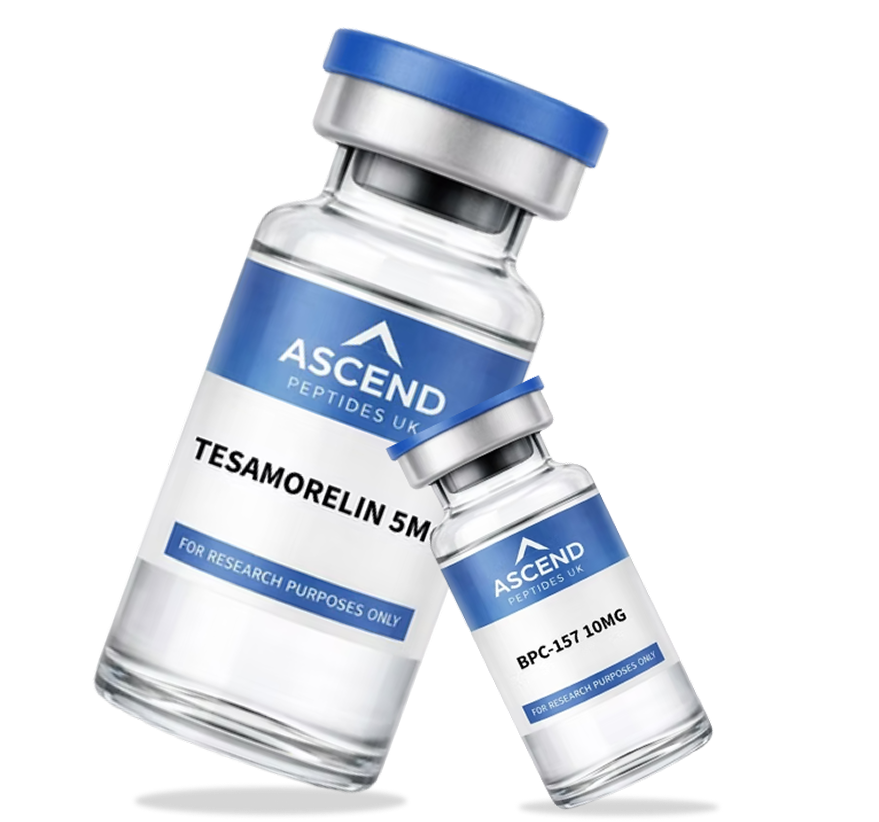

⚠️ Research Use Only. Tesamorelin 10mg is supplied strictly for in-vitro laboratory research. It is not intended for human consumption, therapeutic, diagnostic, or clinical use. All information below reflects peer-reviewed preclinical and scientific literature only. This content is not medical advice. Ascend Peptides UK accepts no liability for misuse of this product
Tesamorelin is a synthetic analogue of Growth Hormone Releasing Hormone (GHRH) that has attracted significant scientific interest within the peptide research community. Unlike many GHRH analogues, which are based on shortened sequences of the endogenous hormone, this compound is a full-length GHRH analogue modified with a specific trans-3-hexenoic acid group at its N-terminus to improve stability and resistance to enzymatic degradation.
This guide is designed for both laboratory scientists and research professionals seeking a thorough scientific overview of this compound, and for scientifically curious individuals (laboratory researchers, academic investigators, and scientific professionals) who want to understand what makes it unique among GHRH research peptides. Whether you are sourcing for an established research programme or exploring this compound for the first time, this guide covers everything you need to know.
All information here is provided strictly for scientific and educational purposes. Ascend Peptides UK supplies this and other research compounds for laboratory investigation only, not for human consumption, clinical application, or therapeutic use of any kind.
What Is Tesamorelin? Structure and Scientific Background
Tesamorelin is a stabilised synthetic analogue of endogenous GHRH. Unlike shorter GHRH analogues such as Sermorelin (which replicates only the first 29 amino acids of GHRH) or Modified GRF 1-29, this compound replicates the full 44-amino acid sequence of native GHRH with a single but significant structural modification: the addition of a trans-3-hexenoic acid group covalently bonded to the N-terminal tyrosine residue.
This modification is the defining structural feature of the compound and the source of its research significance. The trans-3-hexenoic acid group substantially increases resistance to DPP-IV (dipeptidyl aminopeptidase IV) enzymatic degradation — the primary enzyme responsible for the rapid breakdown of native GHRH in biological environments. As a result, this GHRH analogue maintains its receptor binding activity for considerably longer in research conditions than unmodified GHRH.
The full 44-amino acid sequence also distinguishes this compound from shorter GHRH research peptides. Because it retains the complete GHRH sequence, it interacts with the GHRH receptor (GHRHR) in a manner that more closely reflects the endogenous ligand, making it a valuable tool for research requiring greater physiological relevance than truncated GHRH analogues can provide. For the complete structural and mechanistic background, see our full guide, What Is Tesamorelin?
Tesamorelin vs Other GHRH Research Peptides: Key Differences
Understanding how tesamorelin compares to other GHRH analogues helps researchers select the most appropriate compound for their specific experimental design. Here is how this compound sits within the broader GHRH research peptide landscape:
CJC-1295 Without DAC (Modified GRF 1-29) is based on the first 29 amino acids of GHRH with four stabilising amino acid substitutions. It produces pulsatile GH stimulation in research models and has a shorter sequence than this compound. For a detailed overview of that peptide, see our CJC-1295 Without DAC research guide. Tesamorelin, by contrast, uses the full 44-amino acid GHRH sequence with N-terminal modification, offering a different structural profile for researchers requiring full-length GHRH receptor engagement.
Sermorelin is the unmodified GHRH(1-29) sequence, retaining structural closeness to native GHRH but with greater susceptibility to DPP-IV degradation. This compound’s N-terminal modification addresses this limitation whilst also preserving the complete GHRH receptor interaction surface.
Downstream of the GHRH-GH axis, growth hormone stimulates hepatic IGF-1 production. Researchers studying the full length of this signalling cascade from GHRH receptor activation through to IGF-1 pathway effects may combine GHRH analogue research with IGF-1 receptor studies. Our IGF-1 LR3 1mg research guide provides a detailed overview of how IGF-1 LR3 functions as a research tool for investigating the downstream growth factor signalling pathway.

Mechanism of Action in Laboratory Research Models
Tesamorelin acts as a selective GHRH receptor (GHRHR) agonist in laboratory research models. When the compound binds to GHRHR on anterior pituitary somatotroph cells, it activates the following downstream signalling cascade:
-
G-protein coupled receptor (GPCR) activation: GHRHR is a Gs-coupled receptor. Upon ligand binding, the activated Gs protein stimulates adenylyl cyclase, increasing intracellular cyclic AMP (cAMP) levels.
-
Protein kinase A (PKA) activation: Elevated cAMP activates PKA, which phosphorylates downstream transcription factors involved in GH gene expression.
-
Growth hormone synthesis and secretion: PKA activation leads to increased GH mRNA transcription and pulsatile GH secretion from pituitary somatotroph cells.
-
Downstream IGF-1 production: GH released following GHRHR activation stimulates hepatic IGF-1 synthesis, a key downstream mediator studied extensively in growth factor research.
Because this compound uses the full 44-amino acid GHRH sequence, it engages the GHRHR binding interface more completely than shorter analogues, an important consideration for researchers studying receptor structure-function relationships or designing experiments that require maximal receptor engagement.
Research Applications of Tesamorelin 10mg in Laboratory Settings
1. Growth Hormone Axis Research
The primary laboratory application of this GHRH analogue is the investigation of the hypothalamic-pituitary-somatotropic axis. Researchers studying GH secretion dynamics, pituitary somatotroph cell biology, and GHRH receptor signalling use this compound to stimulate controlled, reproducible GH pathway activation in experimental models. Its full-length GHRH sequence makes it particularly suited to studies requiring complete GHRH engagement.
2. Metabolic Pathway Research
Tesamorelin has been studied in the context of metabolic biology research, particularly in relation to the role of the GH-IGF-1 axis in lipid metabolism and adipose tissue regulation at the cellular level. Laboratory studies have used this compound to examine how GHRH receptor activation influences downstream metabolic signalling pathways in research models. This makes it relevant to researchers working in metabolic biology, adipocyte research, and GH-related metabolic pathway investigation.
3. GHRH Receptor Biology Research
Because of its full-length GHRH sequence and N-terminal stabilisation, this compound is particularly valuable for research examining GHRH receptor structure, binding kinetics, and receptor activation mechanisms. Studies investigating the molecular basis of GHRHR ligand recognition, conformational changes upon receptor binding, and downstream signal transduction have used this compound as a research tool due to its complete receptor engagement profile.
4. Comparative GHRH Analogue Studies
A significant body of laboratory research has compared various GHRH analogues to understand how structural differences translate into functional outcomes. This compound, with its full-length sequence and N-terminal modification, provides a distinct structural profile compared to truncated analogues, making it an important reference point in comparative studies examining GHRH receptor pharmacology and GH secretion dynamics.
5. GH-IGF-1 Axis Research
The GHRH-GH-IGF-1 signalling cascade is one of the most studied axes in endocrine research. Laboratories investigating how upstream GHRH receptor activation influences downstream IGF-1 production and its cellular effects use GHRH analogues as upstream stimulants in their experimental design. For researchers studying the downstream portion of this axis, our IGF-1 LR3 1mg research guide provides detailed information on how IGF-1 LR3 is used as a growth factor research tool in controlled laboratory settings.
6. Connective Tissue and Cellular Research
Some research programmes study multiple peptides involved in cellular signalling and tissue biology concurrently. Researchers examining how the GH axis signalling interacts with other cellular mechanisms may cross-reference compounds from different peptide categories. For those investigating cellular research peptides alongside GHRH analogues, our BPC-157 10mg research guide provides a detailed overview of how that pentadecapeptide is applied in connective tissue and cellular signalling research.
Why Tesamorelin 10mg Is the Standard Research Format
Tesamorelin is available in both 5mg and 10mg formats from Ascend Peptides UK. The 10mg format is preferred for most established research programmes for the following practical reasons:
-
Sufficient volume for multi-run studies: 10mg provides enough material to conduct multiple experimental assays, dose-response studies, or comparative investigations without frequent reordering, reducing batch-to-batch variability.
-
Better cost efficiency: For research programmes with confirmed demand, the 10mg format offers better value per milligram whilst remaining manageable in terms of storage and usage planning.
-
Aligns with published research quantities: The majority of laboratory protocols referencing this analogue use 10mg as a standard batch quantity, making it easier to align experimental designs with existing scientific literature.
-
Lyophilised stability: At 10mg, the freeze-dried format maintains excellent stability at -20°C across the duration of a typical research programme.
Sourcing Tesamorelin 10mg in the UK: Quality Standards
When sourcing tesamorelin from a peptide supplier UK, researchers should evaluate potential suppliers against the following quality benchmarks:
-
HPLC purity verification: Research-grade purity should be 98% or above, confirmed by High-Performance Liquid Chromatography with a batch-specific Certificate of Analysis.
-
Mass spectrometry identity confirmation: Molecular weight and sequence identity must be verified via LC-MS to confirm the full 44-amino acid structure with N-terminal modification.
-
Lyophilised format: Freeze-dried powder is the required format for research-grade stability during transit and long-term storage.
-
Batch traceability: Full batch documentation, including synthesis parameters, purification chromatograms, and QC release data, is essential for institutional procurement and published research referencing.
-
Research-only labelling: All legitimate growth hormone research peptide products must carry clear research-use-only designations with no clinical or therapeutic claims.
-
UK-based dispatch: Sourcing from a UK-based peptide distributor minimises transit time and stability risks.

Reconstituting Tesamorelin 10mg: Laboratory Reference
Tesamorelin 10mg is supplied in lyophilised (freeze-dried) powder form and requires reconstitution prior to use in laboratory assays. The following is provided for general laboratory reference and does not constitute dosing, medical, or clinical guidance.
Recommended reconstitution solvents referenced in published research include:
-
Sterile bacteriostatic water the most widely used solvent for research peptides, providing extended post-reconstitution stability when stored correctly at -20°C.
-
Sterile 0.9% saline is appropriate where a physiological salt concentration is required by the experimental design.
-
Phosphate-buffered saline (PBS) is suitable for short-term in vitro assays requiring a neutral, buffered pH environment.
Gently swirl or invert the vial to dissolve. Do not vortex or shake vigorously, as mechanical disruption can damage the peptide structure. Aliquot into single-use volumes immediately upon reconstitution and store at -20°C. Avoid repeated freeze-thaw cycles, which degrade peptide integrity and introduce experimental variability. Given the N-terminal modification of this compound, handling with standard peptide care protocols is recommended.
Regulatory Compliance and Research Responsibility
This compound is classified as a research chemical in the United Kingdom. It is not a licensed medicine, is not approved for human consumption, and must not be used in any clinical, therapeutic, or diagnostic context.
All purchasing researchers and institutions are fully responsible for ensuring their acquisition and use complies with applicable UK legislation and any institutional ethics or procurement requirements. Ascend Peptides UK provides fully compliant, research-only labelled products and makes no health, clinical, or performance-related claims about any compound in our range.
Conclusion
Tesamorelin 10mg occupies a unique position among GHRH research peptides. As a full-length GHRH analogue with N-terminal stabilisation, it provides a more complete GHRH receptor engagement profile than shorter truncated analogues, making it particularly valuable for research requiring physiological relevance, receptor structure-function studies, and comparative GHRH pharmacology investigations.
For UK laboratories and research institutions seeking a reliable tesamorelin supplier UK, Ascend Peptides UK provides this compound to research-grade purity standards with full batch documentation and same-day UK dispatch. Whether you are running a new research programme or continuing an established investigation, our team is ready to support your work with high-quality, fully documented growth hormone research peptides.
Frequently Asked Questions About Tesamorelin 10mg Research Peptide
Q: What is tesamorelin 10mg used for in research?
Q: What makes tesamorelin different from other GHRH analogues?
Q: Is tesamorelin the same as GHRH?
Q: Is Tesamorelin legal to buy in the UK?
Q: What is the difference between tesamorelin 5mg and 10mg?
Q: How does tesamorelin work in laboratory research models?
Q: How should Tesamorelin 10mg be stored?
Q: How do you reconstitute tesamorelin 10mg for laboratory use?
Q: What purity level is required for research-grade tesamorelin?
Q: Where can I buy Tesamorelin 10mg in the UK?
DISCLAIMER
All products supplied by Ascend Peptides UK are intended strictly for research purposes only. They are not intended for human consumption or for any therapeutic, diagnostic, or clinical use. None of the items offered are classified as medicinal products by the MHRA. It is the buyer’s responsibility to ensure all purchases comply with applicable laws and regulations. Ascend Peptides UK accepts no liability for misuse.