
⚠️ Research Use Only. CJC-1295 Without DAC is supplied strictly for in-vitro laboratory research. It is not intended for human consumption, therapeutic, diagnostic, or clinical use. All information below reflects peer-reviewed preclinical and scientific literature only. This content is not medical advice. Ascend Peptides UK accepts no liability for misuse of this product
If you work in peptide research or follow the science of growth hormone signalling, CJC-1295 without DAC is a name you will encounter frequently. It is one of the most studied growth hormone-releasing hormone (GHRH) analogues in the scientific community and for good reason. Its carefully engineered structure gives it distinct advantages over native GHRH in laboratory settings, making it a reliable and versatile tool for controlled research.
This guide is provided by Ascend Peptides UK for laboratory scientists and research professionals. It offers a detailed biochemical overview of this compound, its pharmacological profile, and its applications in the study of the somatotropic axis.
All information here relates strictly to scientific investigation. Ascend Peptides UK supplies this and other high-purity research peptides exclusively for laboratory use, not for human consumption, clinical application, or therapeutic purposes.
Key Takeaways
-
Scientific Identity: CJC-1295 Without DAC (frequently referred to as Modified GRF 1-29) is a synthetic, 29-amino-acid analogue of naturally occurring Growth Hormone-Releasing Hormone (GHRH).
-
Structural Advantage: The peptide features four strategic amino acid substitutions that provide robust resistance to enzymatic breakdown by DPP-IV, significantly extending its stability in laboratory models compared to native GHRH.
-
Release Profile: Unlike the DAC-bound variant, CJC-1295 Without DAC stimulates a time-limited, pulsatile release of growth hormone, making it the preferred reagent for studying natural, episodic secretion dynamics.
-
Research Applications: It is heavily utilised in in vitro and animal model studies focusing on the hypothalamic-pituitary-somatotropic axis, IGF-1 pathways, and GHRH receptor binding kinetics.
-
Handling and Storage: For optimal integrity, the lyophilised powder must be reconstituted with appropriate sterile solvents (such as bacteriostatic water) and stored in single-use aliquots at -20°C to avoid damaging freeze-thaw cycles.
-
Strict Regulatory Status: This compound is an experimental research chemical. It is not FDA or MHRA approved and is strictly prohibited for human consumption, therapeutic application, or clinical use.
Understanding Growth Hormone-Releasing Hormone — The Scientific Foundation
To appreciate the significance of this compound, it helps to first understand the molecule it is designed to mimic: Growth Hormone Releasing Hormone, or GHRH.
GHRH is a naturally occurring peptide hormone produced in the hypothalamus. Its primary role is to stimulate the anterior pituitary gland to synthesise and secrete growth hormone (GH). This process forms part of the hypothalamic-pituitary-somatotropic axis, one of the most studied regulatory systems in endocrine biology.
Growth hormone itself has wide-ranging downstream effects across biological systems, influencing cell growth, metabolism, body composition, and the production of Insulin-like Growth Factor 1 (IGF-1) in the liver. Understanding how GHRH drives GH secretion and how this process can be reliably modelled in research settings is the scientific foundation on which this research peptide category is built.
Native GHRH has a significant limitation as a laboratory tool: it is rapidly degraded by a serum enzyme called dipeptidyl aminopeptidase IV (DPP-IV), giving it a very short half-life in biological environments. This makes sustained research into its effects difficult. That is precisely the problem that synthetic GHRH analogues were developed to address.
What Is CJC-1295 Without DAC?
CJC-1295 Without DAC, also referred to as Modified GRF(1-29) or Mod GRF 1-29 is a synthetic analogue of the first 29 amino acids of GHRH, which is the biologically active portion of the molecule. The ‘Without DAC’ designation is important: it distinguishes this compound from its related counterpart, CJC-1295 With DAC, which uses a different modification to extend its half-life.
The modifications incorporated into this peptide are four strategic amino acid substitutions at specific positions in the chain. These substitutions achieve two research-relevant goals:
-
Increased resistance to DPP-IV degradation, the primary enzyme responsible for breaking down native GHRH in biological environments
-
Improved receptor binding stability, enhancing the compound’s potency and consistency in controlled laboratory assay conditions
The result is a growth hormone research peptide that retains the functional characteristics of native GHRH whilst offering significantly improved in vitro stability — making it a far more practical tool for systematic laboratory investigation of the GHRH-GH signalling axis.
CJC-1295 Without DAC vs CJC-1295 With DAC: Understanding the Difference
This is one of the most common questions in this research area, and understanding the distinction is essential when selecting the right compound for a given experimental design.
The key difference lies in the presence or absence of a Drug Affinity Complex (DAC), a modification that enables the peptide to bind covalently to albumin in the bloodstream, dramatically extending its half-life.
-
CJC-1295 without DAC produces a pulsatile pattern of GH stimulation in research models. Each administration generates a defined, time-limited pulse of GH receptor activation closely reflecting the natural episodic GH release seen in biological systems. This makes it particularly suited to research examining pulsatile GH secretion dynamics.
-
CJC-1295 with DAC binds to albumin via the DAC technology, producing sustained, continuous GH pathway activation over an extended period. This is preferred for studies requiring prolonged GH stimulation rather than pulsatile release.
For researchers studying natural GH physiology and pulsatile secretion, the Without DAC variant is generally the more appropriate research compound. Both are available from Ascend Peptides UK, and selecting between them depends entirely on the experimental design and research objectives. For a full structural and half-life comparison of the two variants, see CJC-1295 With DAC vs Without DAC.

Research Applications in Laboratory Settings
This peptide has been the subject of a substantial body of published research. The following summarises the primary laboratory contexts in which it is applied:
1. Growth Hormone Axis Research
The most direct application is the investigation of the GHRH-GH signalling axis itself. Researchers studying hypothalamic-pituitary function and GH secretion dynamics use this compound to reliably stimulate GHRH receptor activity in controlled experimental models, enabling systematic investigation of the somatotropic axis.
2. IGF-1 Pathway Studies
Growth hormone stimulates the liver to produce IGF-1, making GHRH analogue research indirectly relevant to IGF-1 pathway investigation as well. Laboratories studying the GH-IGF-1 axis frequently use this compound upstream in their experimental design, enabling controlled activation of the full signalling cascade.
3. Pulsatile GH Secretion Research
One of the most scientifically interesting properties of this compound is its ability to generate pulsatile GH receptor stimulation, reflecting the natural episodic pattern of growth hormone secretion in biological systems. Researchers examining the physiological significance of GH pulse frequency and amplitude use it to produce controlled, reproducible pulsatile stimulation in research models.
4. GHRH Receptor Binding Studies
The compound is also applied in studies examining GHRH receptor (GHRHR) binding and activation, including investigations into receptor expression levels, binding kinetics, and downstream signalling cascades. Its improved stability compared to native GHRH makes it a consistent and reproducible reagent for these assays.
5. Comparative GHRH Analogue Research
A significant body of research compares the activity profiles of various GHRH analogues, including Sermorelin, the DAC variant, and native GHRH(1-29). These comparative studies help researchers understand how structural modifications translate into functional differences, contributing to the broader field of peptide pharmacology and growth hormone research.
Who Uses This Research Peptide and Why?
Academic and Institutional Researchers
University research departments and institutional laboratories studying endocrinology, metabolic biology, and GH physiology are among the primary users of this compound. Sourcing from a reliable CJC1295 peptide supplier with verified purity and full documentation is essential for experimental integrity and institutional procurement compliance.
Private Research Laboratories
Private labs working in peptide science and biotechnology use GHRH analogues as part of broader research into growth hormone receptor pharmacology. Ascend Peptides UK serves as a trusted peptide supplier UK for these organisations, offering same-day UK dispatch, batch documentation, and full analytical records for every product.
Independent and Scientifically Engaged Individuals
The science of growth hormone-releasing peptides attracts genuine intellectual curiosity well beyond formal research settings. Understanding how GHRH analogues interact with the pituitary-somatotropic axis is a genuinely fascinating area of biochemistry that continues to generate active scientific discussion. Ascend Peptides UK provides highly purified compounds and transparent documentation to support independent researchers conducting legitimate scientific investigations.
Sourcing High-Purity Research Peptides in the UK
The quality of a research compound directly affects the reliability and reproducibility of experimental results. When evaluating any growth hormone research peptide supplier in the UK, the following quality standards should be considered non-negotiable:
-
HPLC purity verification: Purity should be confirmed at 98% or above via High-Performance Liquid Chromatography, with documentation available per batch.
-
Mass spectrometry identity confirmation: Verifies the peptide’s molecular weight and sequence matches the expected structure, essential for experimental reproducibility.
-
Lyophilised format: Freeze-dried powder maintains stability far more effectively than liquid formats during transit and long-term storage.
-
Batch traceability: Full batch records are important for referencing in published research and for meeting institutional procurement requirements.
-
Research-only labelling: All legitimate research peptide products should carry clear research-use-only designations with no therapeutic or clinical claims.
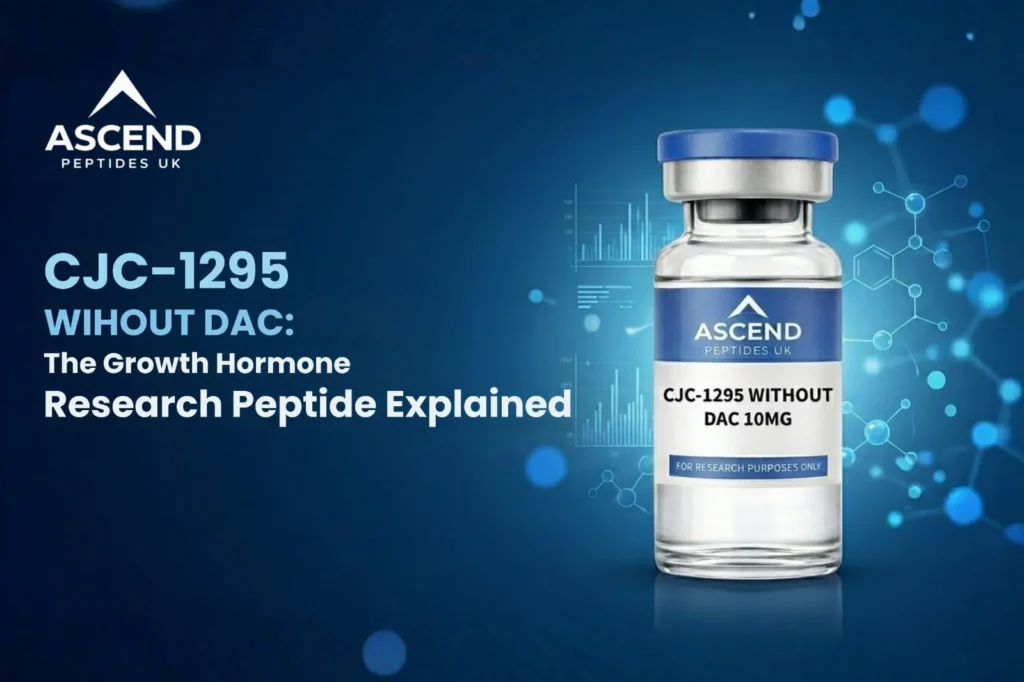
At Ascend Peptides UK, our CJC-1295 Without DAC 10mg is produced to meet all of these standards. We supply high-purity research peptides to laboratories, universities, and research institutions across the United Kingdom — with full analytical documentation, transparent product specifications, and reliable same-day dispatch.

Reconstituting CJC-1295 Without DAC 10mg: A Laboratory Reference
Supplied as a lyophilised powder, this compound must be reconstituted before use. Standard laboratory solvents include:
-
Sterile bacteriostatic water: The most widely used option, offering extended post-reconstitution stability.
-
0.9% sterile saline: Suitable for applications requiring physiological salt concentrations.
-
Phosphate-buffered saline (PBS): Appropriate for short-term in vitro assays requiring a neutral pH.
Storage Guidelines: Once reconstituted, solutions should be aliquoted into single-use volumes and stored at -20°C. Repeated freeze-thaw cycles must be strictly avoided to preserve peptide integrity.
Regulatory Compliance and Research Responsibility
This compound is classified as a research chemical in the United Kingdom. It is not a licensed medicine, is not approved for human consumption, and must not be used in clinical, therapeutic, or diagnostic contexts under any circumstances.
All buyers, whether institutional researchers, private laboratory operators, or independent (legitimate) scientists, are responsible for ensuring their acquisition and use complies with applicable UK legislation and any relevant institutional ethics requirements. Ascend Peptides UK provides fully compliant, research-only labelled products and makes no health, clinical, or performance-related claims about any compound in our range.
Conclusion
CJC-1295 Without DAC 10mg is one of the most well-characterised GHRH analogues available to the research community. Its four strategic amino acid substitutions, which improve DPP-IV resistance and receptor binding stability while preserving the pulsatile GH stimulation pattern, make it an invaluable tool across multiple laboratory disciplines, from GH axis biology and IGF-1 pathway research to receptor pharmacology and comparative peptide studies.
Ascend Peptides UK is proud to support the UK research community with high-purity, fully documented growth hormone research peptides and a comprehensive range of research compounds. Whether you represent an academic institution, a private laboratory, or you are a legitimate independent researcher with a verified scientific purpose, our team is here to help.
Frequently Asked Questions
Q: What is CJC-1295 Without DAC?
Q: What is the difference between the Without DAC and With DAC versions?
Q: Is Modified GRF 1-29 the same compound?
Q: Is this research peptide legal to buy in the UK?
Q: What is the 10mg version used for in research?
Q: How do you reconstitute this peptide for laboratory use?
Q: Where can I buy this growth hormone research peptide in the UK?
Q: What purity level is appropriate for research use?
Q: What is the molecular weight of this compound?
Q: How does this compound compare to Sermorelin in research settings?
References
-
Teichman, S. L., et al. (2006). Prolonged stimulation of growth hormone (GH) and insulin-like growth factor I secretion by CJC-1295, a long-acting analogue of GH-releasing hormone, in healthy adults—The Journal of Clinical Endocrinology & Metabolism.
-
Ionescu, M., & Frohman, L. A. (2006). Pulsatile secretion of growth hormone (GH) persists during continuous stimulation by CJC-1295, a long-acting GH-releasing hormone analogue—the Journal of Clinical Endocrinology & Metabolism.
-
Campbell, R. M., et al. (1991). Enhanced stability and potency of novel growth hormone-releasing factor (GRF) analogues derived from rodent and human sequences. Peptides.
DISCLAIMER
All products supplied by Ascend Peptides UK are intended strictly for research purposes only. They are not intended for human consumption or for any therapeutic, diagnostic, or clinical use. None of the items offered are classified as medicinal products by the MHRA. It is the buyer’s responsibility to ensure all purchases comply with applicable laws and regulations. Ascend Peptides UK accepts no liability for misuse.