
📥 FREE DOWNLOAD
For research professionals only — instant download, no payment required
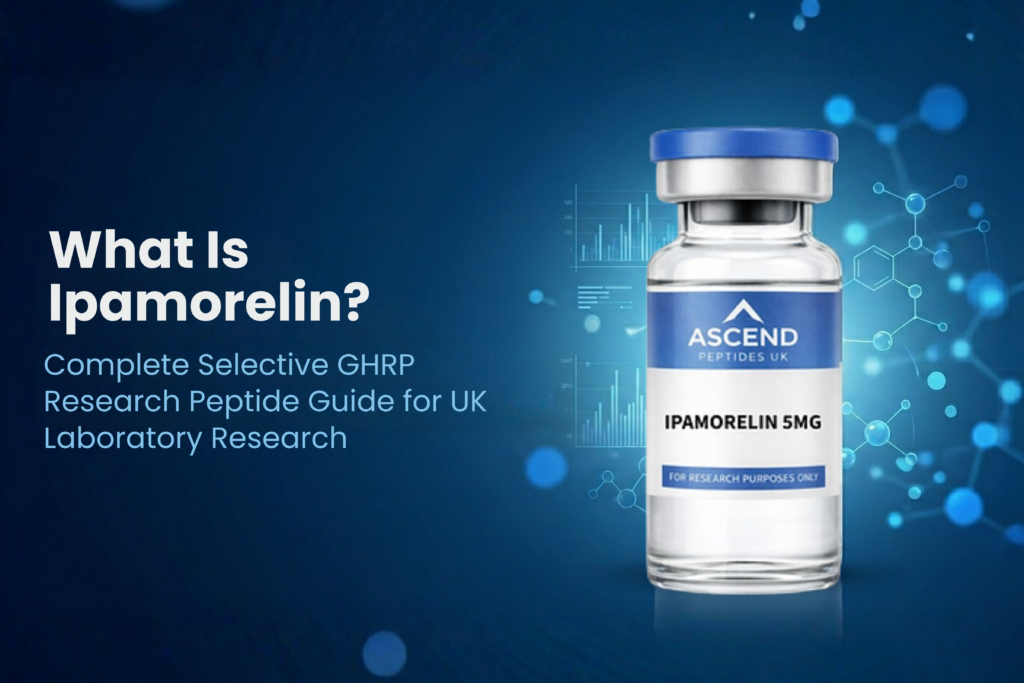
What Is Ipamorelin? Complete Selective GHRP Research Peptide Guide for UK Laboratory Research
What is Ipamorelin? Ipamorelin is a synthetic pentapeptide growth hormone secretagogue (GHRP) that acts as a highly selective agonist at the Growth Hormone Secretagogue Receptor 1a (GHSR-1a, also known as the ghrelin receptor). It is the most selective GHRP studied in published in-vitro research literature, with documented absence of activity at the parallel hormone pathways that other GHRPs commonly cross-activate.
This selectivity profile is the defining property that distinguishes Ipamorelin from the broader GHRP research compound family and is the reason Ipamorelin is the standard GHRP paired with CJC-1295 in the most extensively published combined GH axis research protocol.
Ipamorelin is supplied for in-vitro laboratory research only. It is not a licensed medicinal product under the UK Human Medicines Regulations 2012, and no dosing or administration guidelines are provided in this guide or in any Ascend Peptides UK documentation.
The compound is supplied to qualified research professionals (laboratories, academic institutions, research scientists) for in vitro cellular and endocrine pathway research applications. Every batch of Ipamorelin supplied by Ascend Peptides UK is HPLC verified at ≥98% purity by Janoshik laboratory, LC-MS confirmed for molecular identity, and accompanied by a publicly verifiable Certificate of Analysis.
📥 FREE DOWNLOAD
For research professionals only — instant download, no payment required
What Is Ipamorelin at the Molecular Level?
Ipamorelin is a synthetic 5-amino acid peptide (a pentapeptide) with two structurally distinctive features: Ipamorelin is a synthetic 5-amino acid peptide (a pentapeptide) with structurally distinctive non-natural amino acid substitutions, including Aib (2-aminoisobutyric acid) and D-2-naphthylalanine residues that contribute to receptor selectivity and improved in-vitro stability.
Both modifications are non-natural amino acid substitutions designed to confer GHSR-1a binding selectivity and improved in-vitro stability compared to native ghrelin or earlier-generation GHRPs. The compound is supplied to laboratories as a lyophilised (freeze-dried) white powder for reconstitution before in vitro research use. The molecular structure and key chemistry properties of Ipamorelin are documented below.
|
Molecular Property |
Value |
|---|---|
|
Compound name |
Ipamorelin (Selective GHRP, Growth Hormone Secretagogue) |
|
Peptide class |
Pentapeptide (5 amino acid sequence) |
|
Amino acid sequence |
Aib-His-D-2-Nal-D-Phe-Lys-NH2 |
|
Key modifications |
2-aminoisobutyric acid (Aib) position 2, D-2-naphthylalanine position 3, C-terminal amide |
|
Molecular formula |
C38H49N9O5 |
|
Molecular weight |
≈ 711.85 Da |
|
Receptor target |
GHSR-1a (Growth Hormone Secretagogue Receptor 1a, the ghrelin receptor) |
|
Selectivity |
Highly selective for GHSR-1a, minimal cross-activation of parallel pathways |
|
Supplied format |
Lyophilised white powder for reconstitution |
|
Storage |
−20°C lyophilised, 2 to 8°C reconstituted |
The defining structural property of Ipamorelin is the combination of non-natural amino acid substitutions that produce GHSR-1a binding selectivity. Earlier-generation GHRPs (such as GHRP-2 and GHRP-6) bind GHSR-1a but also cross-activate parallel hormone secretion pathways.
The substitutions in Ipamorelin (the Aib at position 2 and the D-naphthylalanine at position 3) confer high binding selectivity for GHSR-1a with substantially reduced cross-activation at the parallel pathway. This selectivity is what makes Ipamorelin analytically useful in research protocols where the experimental design requires isolating the GHSR-1a signalling pathway from cross-pathway effects.
The full molecular identity of Ipamorelin is confirmed on every Ascend Peptides UK batch by independent LC-MS analysis through Janoshik laboratory. The measured molecular weight is matched against the theoretical molecular weight (≈ 711.85 Da) to confirm structural identity. The complete laboratory quality control workflow is documented on the how we test peptides page.
How Does Ipamorelin Work in Cellular Research Models?
Ipamorelin acts as a selective agonist at the Growth Hormone Secretagogue Receptor 1a (GHSR-1a), which is the receptor for the endogenous peptide ghrelin. The GHSR-1a is expressed on pituitary somatotrophs (the growth hormone-producing cells of the anterior pituitary) and in several other tissues, including the hypothalamus. Receptor activation by Ipamorelin binding triggers the downstream signalling cascade, which in pituitary somatotroph research models stimulates growth hormone release through a pathway mechanistically distinct from the GHRHR pathway activated by CJC-1295.
The GHSR-1a Signalling Cascade
The GHSR-1a is a G protein-coupled receptor (GPCR) of the rhodopsin-like family, coupled primarily to Gq/11 proteins. Receptor activation by Ipamorelin binding triggers the following cellular signalling cascade in research models:
-
Ipamorelin binds the GHSR-1a with high affinity and selectivity.
-
Receptor activation couples to Gq/11 protein and activates phospholipase C (PLC).
-
PLC hydrolyses phosphatidylinositol 4,5-bisphosphate (PIP2) into inositol trisphosphate (IP3) and diacylglycerol (DAG).
-
IP3 triggers intracellular calcium release from the endoplasmic reticulum.
-
In pituitary somatotroph research models, the elevated intracellular calcium drives In pituitary somatotroph research models, elevated intracellular calcium is associated with downstream growth hormone signalling activity. .
Selectivity Profile: What Ipamorelin Does NOT Do
The defining research property of Ipamorelin is its selectivity. Earlier-generation GHRPs activate GHSR-1a but also cross-activate parallel hormone pathways. In published in-vitro research literature, Ipamorelin shows minimal to no cross-activation at these parallel pathways. This selectivity makes Ipamorelin the standard GHRP research compound when the experimental design requires isolating the GHSR-1a signalling pathway as an independent variable. It is also the reason Ipamorelin is the standard GHRP paired with CJC-1295 in one of the most extensively studied combined GH axis research protocols. For the complete mechanism-level comparison between GHRH analogues and GHRPs, see GHRH vs GHRP: Mechanism Comparison.
Ipamorelin and CJC-1295: The Most Studied Combined GH Axis Research Protocol
The combined CJC-1295 plus Ipamorelin research protocol is the most extensively studied multi-compound design in published GH axis research literature. The scientific rationale for the combination is receptor pathway independence. CJC-1295 acts at the Growth Hormone Releasing Hormone Receptor (GHRHR) through the Gs-cAMP-PKA pathway.
Ipamorelin acts at the GHSR-1a through the Gq-PLC-IP3-calcium pathway. The two receptors are expressed on the same pituitary somatotroph cells but signal through completely different second messenger cascades. Combined activation in research models produces additive effects in pituitary cell culture growth hormone release research.
Why Pathway Independence Is the Analytical Foundation
Multi-compound research protocols are most analytically useful when each compound acts on a mechanistically independent pathway. If two compounds in a research protocol both activate the same receptor or the same downstream signalling cascade, the experimental design cannot separate which compound contributes which effect.
The CJC-1295 plus Ipamorelin combination achieves the maximum mechanistic separation in the GH axis research category: different receptors (GHRHR vs GHSR-1a), different G proteins (Gs vs Gq/11), different second messengers (cAMP vs IP3-calcium). Each compound functions as a fully independent variable within the same research protocol. This is the analytical foundation of the combined research design and the reason this specific protocol dominates the published in-vitro GH axis literature.
|
Pathway Component |
CJC-1295 |
Ipamorelin |
|---|---|---|
|
Target receptor |
GHRH Receptor (GHRHR) |
GHSR-1a (ghrelin receptor) |
|
G protein |
Gs |
Gq/11 |
|
Effector enzyme |
Adenylyl cyclase |
Phospholipase C |
|
Second messenger |
cAMP |
IP3 + DAG |
|
Downstream kinase |
Protein kinase A (PKA) |
Intracellular Ca2+ release |
|
Mechanistic independence |
Confirmed in research models |
Confirmed in research models |
For UK research programmes running the CJC-1295 plus Ipamorelin combined protocol, the Somatic Axis Complex bundle from Ascend Peptides UK pairs both compounds at the reduced single bundle price of £50. Single supplier batch matching across both compounds (both tested by Janoshik on the same documentation standard) is the preferred sourcing model for the combined research protocol.
Ipamorelin Research Applications in UK Laboratory Research
UK laboratory researchers working with Ipamorelin typically apply the compound across four research application areas. The application chosen depends on the specific experimental focus of the research programme. Each application has a substantial published in-vitro literature base.
Application 1: Selective GHSR-1a Receptor Pharmacology Research
Ipamorelin is the standard reference compound for selective GHSR-1a pharmacology research in pituitary somatotroph cell line models. The high selectivity profile (minimal cross-activation of parallel pathways) makes Ipamorelin analytically useful when the experimental design requires isolating GHSR-1a signalling from other receptor pathways.
Documented in-vitro research applications include receptor binding affinity studies, downstream signalling cascade research (Gq-PLC-IP3-calcium), and structure-activity relationship research within the GHRP compound family.
Application 2: Combined CJC-1295 plus Ipamorelin Multi Compound Research
The most extensively published Ipamorelin research application is the combined protocol with CJC-1295. The combined GHRHR plus GHSR-1a activation in pituitary somatotroph cell culture research models produces additive effects on growth hormone release through mechanistically independent pathways. This research application accounts for a substantial proportion of published Ipamorelin literature and is the principal reason Ipamorelin appears alongside CJC-1295 in the Ascend Peptides UK bundle range.
Application 3: Three-Compound GH Axis Research with IGF-1 LR3
For research programmes covering the complete GH axis from upstream growth hormone secretion through downstream IGF receptor signalling, Ipamorelin appears in three compound research protocols alongside CJC-1295 and IGF-1 LR3 (Insulin-like Growth Factor 1, Long R3 variant).
sThe three compound design covers upstream GHRHR activation (CJC-1295), parallel GHSR-1a activation (Ipamorelin), and downstream IGF-1 receptor signalling (IGF-1 LR3). The Anabolic Signal Complex bundle pairs all three compounds at £90 for combined GH axis research programmes.
Application 4: Selective GHRP Comparator Research
Within the broader GHRP research compound family, Ipamorelin functions as the selectivity reference compound. Researchers studying structure-selectivity relationships across the GHRP family use Ipamorelin as the high selectivity comparator against earlier-generation GHRPs (which show broader receptor and cross-pathway activation). This comparator role appears in published structure-activity research and in selectivity-focused GHRP pharmacology studies.
Before Ordering Ipamorelin: Free Research Buyer Starter Pack
The Research Buyer Starter Pack is a free downloadable guide for UK research buyers evaluating peptide suppliers. It converts the documentation framework into a practical buyer checklist covering exactly what to verify before ordering Ipamorelin or any other research peptide. Run any supplier against the checklist, including Ascend Peptides UK, to confirm the documentation standard before purchase.
📥 FREE DOWNLOAD
Research Buyer Starter Pack
A practical guide for UK research buyers. What to check before ordering a metabolic research peptide. What documentation to request from any supplier? What storage and dispatch standards to expect.
Inside the checklist:
Inside the pack:
✓ What “research-use only” means under UK regulation
✓ How to evaluate a UK research peptide supplier — 9-point checklist
✓ What documentation to request before purchase (CoA, HPLC, LC-MS)
✓ What storage and reconstitution standards to verify
✓ Pre-order buyer checklist — 16 items to confirm
✓ How to spot a low-quality metabolic peptide supplier — 7 warning signs
For research professionals only — instant download, no payment required
Ipamorelin Compared to Other Growth Hormone Research Compounds
The Ascend Peptides UK catalogue stocks five research compounds in the GH axis category, each acting on a different intervention point in the hypothalamic-pituitary-IGF axis. The defining variable across the five compounds is the receptor target. Ipamorelin acts at GHSR-1a (the ghrelin receptor). The three GHRH analogues (Sermorelin, CJC-1295, and Tesamorelin) all act at GHRHR. IGF-1 LR3 acts at the IGF-1 receptor downstream of growth hormone. See the GH axis research peptides category hub for the complete category framework.
|
Compound |
Compound Class |
Receptor Target |
Primary Research Application |
|---|---|---|---|
|
Ipamorelin |
Selective GHRP (pentapeptide) |
GHSR-1a (ghrelin receptor) |
Selective GHSR-1a pharmacology, GHRP family comparator |
|
Sermorelin |
Native GHRH analogue (29 AA) |
GHRHR |
Pulsatile GH release pharmacokinetic studies |
|
CJC-1295 |
Modified GHRH analogue (29 AA) |
GHRHR |
Standard GHRHR pharmacology, paired with Ipamorelin |
|
Tesamorelin |
Full-length GHRH analogue (44 AA) |
GHRHR |
Complete GHRH receptor interface research |
|
IGF-1 LR3 |
IGF-1 variant (downstream) |
IGF-1 receptor |
Downstream IGF signalling research |
Ipamorelin UK Supplier Standards: What to Verify Before Purchase
Ipamorelin is among the heavily counterfeited GHRP research peptides in the UK research peptide market due to its commercial demand and structural complexity (non-natural amino acid substitutions are technically demanding to synthesise correctly). Four documentation standards distinguish a verified UK supplier of Ipamorelin from an unverified one. The complete framework is set out on the batch verification page.
|
Documentation Standard |
Industry Norm |
Ascend Peptides UK |
|---|---|---|
|
HPLC purity verification |
Self-reported by the supplier |
Independent HPLC by Janoshik, ≥98% verified |
|
LC-MS molecular identity |
Often not performed |
LC-MS confirmation on every batch (verifies Aib and D-Nal substitutions) |
|
Batch-specific Certificate of Analysis |
Generic or unavailable |
Per batch CoA tied to vial lot number |
|
UK dispatch standards |
3 to 7 working days |
Same day UK dispatch before 16:00 GMT |
Every Ipamorelin batch supplied by Ascend Peptides UK is independently HPLC verified at ≥98% purity and LC-MS confirmed for molecular identity, with the measured molecular weight (≈ 711.85 Da) confirming the intact pentapeptide structure including the non-natural Aib and D-naphthylalanine substitutions. The Janoshik Certificate of Analysis is publicly accessible from the CoA archive before the order is placed. For the complete research grade standards framework, see the research grade standards page.
Ipamorelin Storage and Reconstitution Protocol
Ipamorelin follows the standard storage protocol applied across the Ascend Peptides UK research peptide catalogue. Lyophilised Ipamorelin powder is supplied in a sealed glass vial and should be stored at −20°C until reconstitution.
Following reconstitution with BP-grade bacteriostatic water (water for injection with 0.9% benzyl alcohol preservative), the reconstituted solution should be stored at 2 to 8°C and used within the research literature-recommended in-use period. The complete storage protocol is set out on the peptide storage guide.
Key Storage Standards for Ipamorelin
-
Lyophilised Ipamorelin storage: −20°C in the original sealed vial until reconstitution.
-
Reconstitution medium: BP-grade bacteriostatic water (0.9% benzyl alcohol) for standard research protocols.
-
Reconstituted Ipamorelin storage: 2 to 8°C in the original vial with reconstitution date labelled.
-
In use period: typically 28 days at 2 to 8°C following reconstitution.
-
Avoid freezing reconstituted solutions where possible. Freeze-thaw cycles can drive aggregation and reduce stability.
Ipamorelin in Combined Research Bundles
Ipamorelin appears in four Ascend Peptides UK research bundles, each designed for a specific multi-compound research protocol. The bundle pricing offers single supplier batch matching (where all compounds in the research design come from the same verified supplier and are tested against the same documentation standard) at a reduced unit cost.
|
Bundle |
Compounds Included |
Price |
Research Application |
|---|---|---|---|
|
Somatic Axis Complex |
CJC-1295 (Without DAC) 10mg + Ipamorelin 10mg |
£50 |
Most studied GHRH + GHRP combined research protocol |
|
Anabolic Signal Complex |
IGF-1 LR3 1mg + CJC-1295 (Without DAC) 10mg + Ipamorelin 10mg |
£90 |
Three-compound GH axis + downstream IGF research |
|
Metabolic Pathway Complex |
AOD-9604 5mg + CJC-1295 (Without DAC) 10mg + Ipamorelin 10mg |
£85 |
GH axis + lipolytic metabolic combined research |
|
Full Stack |
BPC-157 10mg + TB-500 10mg + CJC-1295 (Without DAC) 10mg + Ipamorelin 10mg |
£100 |
Four-compound multi-pathway research design |
The Somatic Axis Complex is the most-purchased bundle in the Ascend Peptides UK GH axis range and pairs Ipamorelin with CJC-1295 for the standard combined research protocol. The Anabolic Signal Complex adds IGF-1 LR3 for research programmes covering the downstream IGF pathway.
The Metabolic Pathway Complex pairs Ipamorelin and CJC-1295 with AOD-9604 for combined GH axis and metabolic pathway research. The Full Stack bundle covers Ipamorelin and CJC-1295 alongside the recovery research compounds BPC-157 and TB-500 for comprehensive four-compound multi-pathway research designs.
Why UK Researchers Source Ipamorelin from Ascend Peptides UK
- ≥98% HPLC purity verified independently by Janoshik laboratory on every batch.
- LC-MS molecular identity confirmation on every batch, verifying the non-natural Aib and D-naphthylalanine substitutions that confer GHSR-1a selectivity.
- Publicly verifiable Certificate of Analysis tied to the specific vial lot number.
- Same day UK dispatch before 16:00 GMT via Royal Mail Tracked 24.
- FREE 10ml BP grade bacteriostatic water on orders over £75.
- Bundle options available: Somatic Axis Complex (£50), Anabolic Signal Complex (£90), Metabolic Pathway Complex (£85), Full Stack (£100).
- Complete GH axis research peptide range stocked together for single supplier batch matching across CJC-1295, Sermorelin, Tesamorelin, IGF-1 LR3, and Ipamorelin.
What Is Ipamorelin? Frequently Asked Questions
What is Ipamorelin?
Ipamorelin is a synthetic pentapeptide (5 amino acid sequence) growth hormone secretagogue (GHRP) that acts as a highly selective agonist at the Growth Hormone Secretagogue Receptor 1a (GHSR-1a, the ghrelin receptor). The amino acid sequence is Aib-His-D-2-Nal-D-Phe-Lys-NH2 with non-natural substitutions at positions 2 and 3. The molecular formula is C38H49N9O5, and the molecular weight is approximately 711.85 Da.
What makes Ipamorelin a “selective” GHRP?
Earlier-generation GHRPs (such as GHRP-2 and GHRP-6) bind GHSR-1a but also cross-activate parallel hormone pathways, including prolactin and cortisol secretion pathways. Ipamorelin shows minimal cross-activation at these parallel pathways in published in-vitro research, making it the high-selectivity reference compound in the GHRP research family. The selectivity makes Ipamorelin analytically useful for research protocols that require isolating GHSR-1a signalling as an independent variable.
How does Ipamorelin differ from CJC-1295?
Ipamorelin and CJC-1295 act on completely different receptors through different second messenger cascades. CJC-1295 is a GHRH analogue acting at the GHRH Receptor (GHRHR) through the Gs-cAMP-PKA pathway. Ipamorelin is a GHRP acting at GHSR-1a (the ghrelin receptor) through the Gq-PLC-IP3-calcium pathway. The mechanistic independence is what makes the combined CJC-1295 + Ipamorelin protocol analytically useful as a multi-compound research design.
Why are CJC-1295 and Ipamorelin combined in research protocols?
The combination is the most studied multi-compound research protocol in published GH axis literature because the two compounds achieve maximum mechanistic separation. Different receptors (GHRHR vs GHSR-1a), different G proteins (Gs vs Gq/11), different second messengers (cAMP vs IP3-calcium). Each compound functions as a fully independent variable. The combined activation has been studied for additive signalling responses in pituitary somatotroph research models. The Somatic Axis Complex bundle from Ascend Peptides UK pairs both compounds at £50.
Is Ipamorelin the same as ghrelin?
No. Ipamorelin and ghrelin both bind the same receptor (GHSR-1a) but are structurally different compounds. Ghrelin is a 28-amino acid native peptide hormone with a specific octanoyl modification at serine 3. Ipamorelin is a synthetic 5-amino acid pentapeptide designed to act selectively at GHSR-1a with improved in-vitro stability and minimal cross-activation of parallel hormone pathways. Both are research compounds in the GHRP / ghrelin receptor research category.
What is the WADA status of Ipamorelin?
Ipamorelin is listed on the World Anti-Doping Agency (WADA) Prohibited List under category S2 (Peptide Hormones, Growth Factors, Related Substances and Mimetics). It is prohibited at all times for athletes subject to WADA jurisdiction. Ipamorelin supplied by Ascend Peptides UK is for in-vitro laboratory research only and is not represented as a substance for use by athletes or in any human or veterinary application.
What is the MHRA status of Ipamorelin in the UK?
Ipamorelin is not licensed as a medicinal product under the UK Human Medicines Regulations 2012. It is supplied strictly for in vitro laboratory research. The Medicines and Healthcare products Regulatory Agency (MHRA) is the relevant medicines regulator in the UK post Brexit (replacing the previous European Medicines Agency route).
How much does Ipamorelin cost from Ascend Peptides UK?
Ipamorelin is supplied at the individual product price from Ascend Peptides UK. Bundle options offer reduced unit pricing: the Somatic Axis Complex bundle (CJC-1295 + Ipamorelin) is £50, the Anabolic Signal Complex (adds IGF-1 LR3) is £90, and the Metabolic Pathway Complex (with AOD-9604) is £85. All orders over £75 qualify for a free 10ml BP grade bacteriostatic water.
Order Ipamorelin from Ascend Peptides UK with Same Day Dispatch
Browse the Ipamorelin product page for batch-specific Certificate of Analysis documentation and same-day UK dispatch. For the most studied combined GH axis research protocol, the Somatic Axis Complex bundle (CJC-1295 + Ipamorelin, £50) offers single supplier batch matching at the reduced bundle price. For the complete GH axis research category framework, see the GH axis research peptides UK page, or start with the main research peptides UK hub for the complete supplier model.
RESEARCH USE ONLY
All products supplied by Ascend Peptides UK are intended strictly for in-vitro laboratory research purposes only. Ipamorelin is not a licensed medicinal product under the UK Human Medicines Regulations 2012 and is not for human or veterinary use. No dosing or administration guidelines are provided. Products are supplied to qualified research professionals only.
📥 FREE DOWNLOAD
For research professionals only — instant download, no payment required