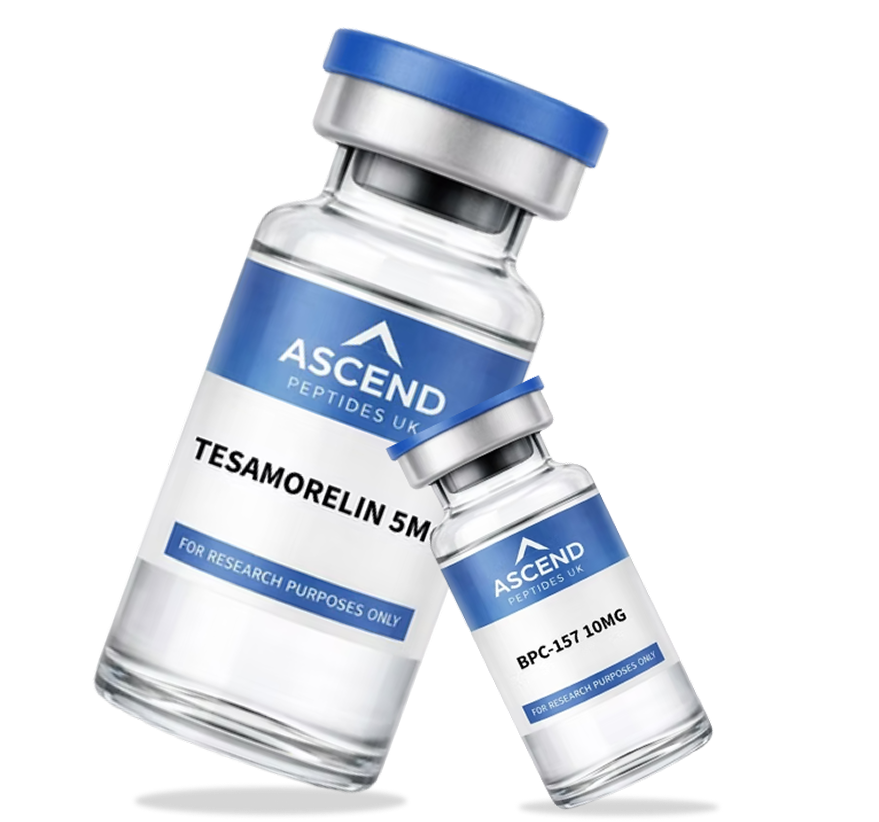

📥 FREE DOWNLOAD
DOWNLOAD THE FREE STARTER PACK
For research professionals only — instant download, no payment required
GHRH Analogues vs GHRPs: A Mechanism Comparison for Research
Growth hormone (GH) secretion can be studied from two mechanistically distinct entry points in the GH axis: growth hormone-releasing hormone (GHRH) analogues, and growth hormone-releasing peptides (GHRPs), also known as ghrelin-receptor agonists. Both classes are associated with increased GH release in research literature, and both are represented among the research peptides supplied by Ascend Peptides UK. However, they act on different receptors, engage different intracellular signalling cascades, and are not interchangeable from a mechanistic or experimental-design standpoint.
This guide is a scientific mechanism comparison, not a product recommendation or a guide to combining compounds. It exists to help researchers correctly distinguish GHRH-pathway compounds from GHRP/ghrelin-receptor-pathway compounds, and to clarify where IGF-1 axis peptides fit relative to both.
GHRH Analogues and GHRPs: Two Distinct Research Classes
| Class | Receptor Target | Ascend Research Examples | Endogenous Parallel |
|---|---|---|---|
| GHRH analogues | GHRH receptor (GHRHR) | Tesamorelin, Sermorelin, CJC-1295 (with and without DAC) | Growth hormone-releasing hormone (hypothalamic) |
| GHRPs / ghrelin-receptor agonists | Growth hormone secretagogue receptor 1a (GHSR-1a) | Ipamorelin | Ghrelin (gastric-derived) |
| IGF-1 axis compounds | IGF-1 receptor (downstream of GH, not a GH secretagogue receptor) | IGF-1 LR3 | Insulin-like growth factor 1 (hepatic-derived, GH-dependent) |
IGF-1 LR3 is included in this table only to place it correctly relative to the other two classes. It is neither a GHRH analogue nor a GHRP: it does not act on GHRHR or GHSR-1a and does not stimulate pituitary GH release. It is discussed further below, in the downstream signalling section.
GHRH Signalling: Receptor and Pathway
GHRH analogues act as agonists at the GHRH receptor (GHRHR), a class B G-protein-coupled receptor expressed on pituitary somatotrophs. The predominant, best-characterised signalling route involves a stimulatory G-protein (Gs), which activates adenylyl cyclase, raising intracellular cyclic AMP (cAMP); elevated cAMP activates protein kinase A (PKA), which is associated with both GH gene transcription and calcium-dependent exocytosis of stored GH from somatotroph secretory vesicles. This Gs–cAMP–PKA cascade is the principal GHRHR signalling pathway described in the literature, not an exhaustive account of every downstream event involved in GH exocytosis.
Because this pathway works by amplifying an existing, pulsatile physiological signal rather than substituting for it, GHRH analogues are generally described in the literature as working with the body’s endogenous pulsatile GH release pattern rather than overriding it. Ascend’s dedicated research resources for Tesamorelin, Sermorelin and CJC-1295 (With DAC and Without DAC) cover GHRHR signalling and half-life differences between these specific analogues in more detail.
GHRPs and Ghrelin-Receptor Agonists: Receptor and Pathway
GHRPs, including ghrelin-mimetic peptides such as Ipamorelin, act as agonists at a structurally and functionally distinct receptor: the growth hormone secretagogue receptor 1a (GHSR-1a), a rhodopsin-like class A GPCR. The predominant, best-characterised GHSR-1a signalling route couples to Gq/11 rather than Gs: activation stimulates phospholipase C (PLC), generating the second messengers inositol trisphosphate (IP3) and diacylglycerol (DAG), and IP3 triggers release of calcium from intracellular stores, with the resulting rise in intracellular Ca2+ central to GH secretion from the somatotroph. This is the principal signalling route reported for GHSR-1a rather than its only one — the receptor also shows documented constitutive (ligand-independent) activity and has been reported to engage additional signalling pathways beyond Gq/11 in some research contexts.
GHRP/ghrelin signalling also interacts with the hypothalamic GHRH–somatostatin regulatory network, and modulation of somatostatin tone (the hypothalamic signal that normally restrains GH release) has been implicated in the GH response to GHSR-1a activation. This should be read as an area of interaction with a broader regulatory network rather than a simple, universal “GHRPs directly suppress somatostatin” mechanism, and it is a separate research question from GHRH receptor activation itself, not a variant of it. Ascend’s What Is Ipamorelin? guide covers GHSR-1a signalling and Ipamorelin’s receptor selectivity relative to earlier, less selective GHRP compounds in more detail.
Mechanism Comparison Table
| Feature | GHRH Analogues | GHRPs / Ghrelin-Receptor Agonists |
|---|---|---|
| Receptor | GHRH receptor (GHRHR) | Growth hormone secretagogue receptor 1a (GHSR-1a) |
| Receptor class | Class B GPCR | Class A (rhodopsin-like) GPCR |
| Principal G-protein coupling | Gs | Gq/11 |
| Principal effector enzyme | Adenylyl cyclase | Phospholipase C |
| Principal second messenger(s) | Cyclic AMP (cAMP) | IP3 and DAG |
| Downstream kinase / trigger | Protein kinase A (PKA) | Intracellular calcium release |
| Endogenous ligand | Growth hormone-releasing hormone (hypothalamic) | Ghrelin (gastric-derived) |
| Interaction with somatostatin tone | Not a primary GHRHR mechanism | Modulation implicated in GH response; not a simple universal suppression mechanism |
| Research examples at Ascend | Tesamorelin, Sermorelin, CJC-1295 (both variants) | Ipamorelin |
This table summarises the predominant, best-characterised signalling route reported for each receptor. It is not an exhaustive account of every pathway either receptor can engage: GHSR-1a in particular shows documented constitutive activity and has been reported to signal through additional pathways beyond Gq/11 in some research contexts, and GHRHR signalling involves further downstream detail beyond the Gs-cAMP-PKA cascade summarised here.
Why the Two Classes Are Not Mechanistically Interchangeable
Because GHRH analogues and GHRPs act on different receptors and different intracellular signalling cascades, they cannot be treated as functionally equivalent or substituted for one another in experimental design. A GHRH analogue is not a GHRP, and a GHRP is not a GHRH analogue, regardless of the fact that both are studied for their association with GH release. Describing either class as “just increasing GH” collapses two mechanistically distinct receptor systems into one and obscures the actual pharmacology under study.
This is a scientific distinction, not a usage recommendation. This guide does not describe or recommend combining GHRH analogues with GHRPs, dosing protocols, administration schedules, or any research or clinical protocol. Researchers designing studies that involve both receptor systems should consult primary literature and appropriate institutional protocols rather than treating mechanism-comparison content as a stacking guide.
Downstream Relationship: GH Release and IGF-1 Signalling
Both GHRHR and GHSR-1a activation converge on the same downstream physiological outcome: pulsatile GH release from the pituitary somatotroph. Pituitary GH release promotes downstream IGF-1 production: the liver is the major source of circulating IGF-1, while IGF-1 is also produced in extrahepatic tissues. IGF-1 in turn mediates many of the downstream effects historically associated with GH activity.
IGF-1 LR3 is a long-arginine3 IGF-1 analogue. It sits downstream of the GHRH/GHRP-driven GH release step described above, and it acts through the IGF-1 receptor rather than through GHRHR or GHSR-1a. IGF-1 LR3 is not a GH secretagogue, is not a GHRH analogue, and does not stimulate pituitary GH release. It is referenced in this guide only to place it correctly relative to GHRH analogues and GHRPs within the broader GH/IGF-1 axis; researchers seeking detail on IGF-1 LR3 itself should consult Ascend’s dedicated IGF-1 LR3 research guide.
Research Limitations and Verification Considerations
Receptor and signalling pathway data summarised here reflect the general pharmacology described for each receptor class in the published literature. Researchers should be aware of the following limitations:
- Signalling descriptions are generalised from receptor pharmacology literature and may not capture every downstream modulator, cross-talk pathway, or tissue-specific variation reported in more specialised sources.
- Potency, selectivity and signalling bias can differ meaningfully between individual compounds within each class (for example, between different GHRPs), so class-level statements should not be assumed to apply identically to every compound without checking compound-specific literature.
- This guide does not report in vivo human dosing, efficacy, or outcome data for any compound, and none should be inferred from the mechanism descriptions above.
- As with all research peptides, identity and purity should be confirmed for the specific batch under study rather than assumed from class-level mechanism literature. See Ascend’s Batch Verification and How We Test Peptides pages for the third-party testing approach applied to products supplied by Ascend Peptides UK.
GHRH vs GHRP: Frequently Asked Questions
What is the main difference between a GHRH analogue and a GHRP?
They act on different receptors. GHRH analogues activate the GHRH receptor (GHRHR) via a Gs/cAMP/PKA pathway. GHRPs and ghrelin-receptor agonists activate the growth hormone secretagogue receptor (GHSR-1a) via a Gq/11/PLC/calcium pathway.
Is Ipamorelin a GHRH analogue?
No. Ipamorelin is a GHRP that acts as a ghrelin-receptor (GHSR-1a) agonist. It is mechanistically distinct from GHRH analogues such as Tesamorelin, Sermorelin, or CJC-1295.
Are Tesamorelin, Sermorelin and CJC-1295 GHRPs?
No. All three are GHRH analogues that act on the GHRH receptor (GHRHR). They are not ghrelin-receptor agonists and are mechanistically distinct from the GHRP class.
Does IGF-1 LR3 stimulate the pituitary to release growth hormone?
No. IGF-1 LR3 acts downstream of GH release, through the IGF-1 receptor. It does not act on GHRHR or GHSR-1a and is not a GH secretagogue.
Why do GHRH analogues and GHRPs both get described as “increasing GH”?
Because both pathways converge on the same downstream outcome — pituitary GH release — even though they reach it through different receptors and different intracellular signalling cascades. The shared outcome does not make the underlying mechanisms the same.
Can GHRH analogues and GHRPs be used together in research?
This guide does not provide dosing, administration, or combination-protocol guidance. It is limited to explaining the receptor and signalling differences between the two classes. Any study design questions should be directed to appropriate primary literature and institutional protocols.
Which receptor does ghrelin itself activate?
Ghrelin, the endogenous ligand that GHRPs mimic pharmacologically, is the natural agonist of GHSR-1a. This receptor–ligand relationship was first characterised by Kojima et al. (1999) — see references below.
Where can I read more about the individual compounds mentioned here?
See Ascend’s dedicated research guides: What Is Tesamorelin?, What Is Ipamorelin?, CJC-1295 With DAC vs Without DAC, and What Is IGF-1 LR3?, linked in the research resources section below.
Scientific References
- Frohman, L.A. & Jansson, J.O. (1986). “Growth Hormone-Releasing Hormone.” Endocrine Reviews, 7(3), 223–253.
- Kojima, M., Hosoda, H., Date, Y., Nakazato, M., Matsuo, H. & Kangawa, K. (1999). “Ghrelin is a growth-hormone-releasing acylated peptide from stomach.” Nature, 402(6762), 656–660. PMID: 10604470.
GH-Axis Research Resources at Ascend Peptides UK
- What Is Tesamorelin?
- What Is Ipamorelin?
- CJC-1295 With DAC vs Without DAC
- What Is IGF-1 LR3?
- GH Axis Research Peptides UK
- Sermorelin 2mg
- Batch Verification
- How We Test Peptides
- Research Grade Standards
- Research Peptides UK
Research Use Only. The compounds and mechanisms discussed on this page are intended solely for in-vitro laboratory and preclinical research use. Nothing on this page constitutes or should be interpreted as dosing information, administration guidance, medical advice, or an instruction for human or animal use. Ascend Peptides UK products are sold for research purposes only and are not for human consumption.
📥 FREE DOWNLOAD
DOWNLOAD THE FREE STARTER PACK
For research professionals only — instant download, no payment required