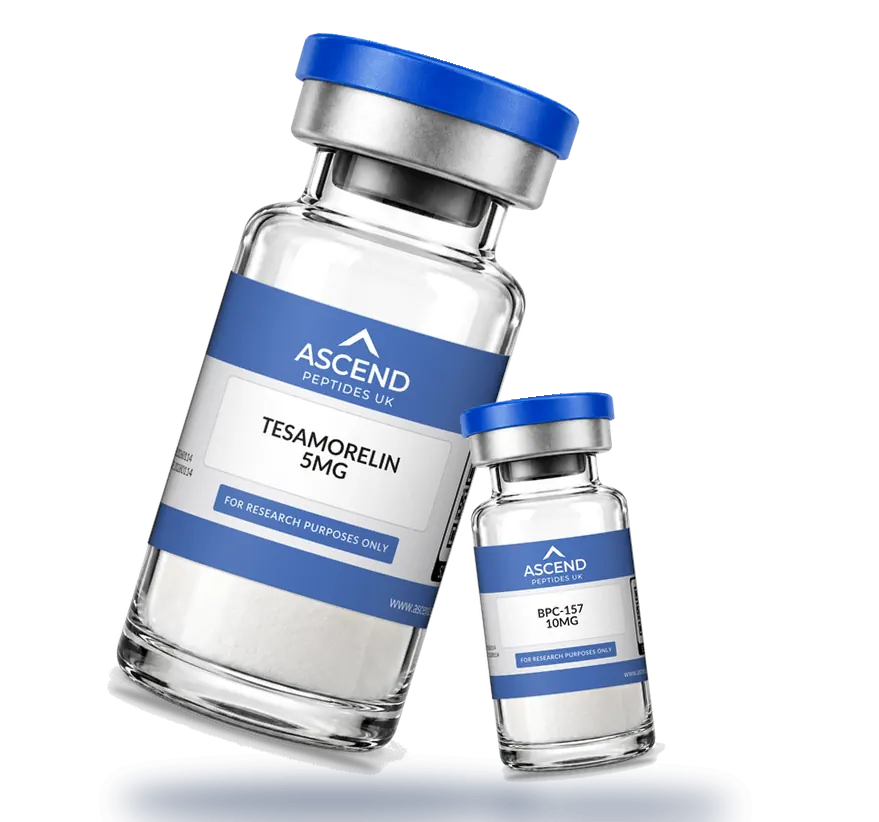


⚠️ Research Use Only. Products supplied by Ascend Peptides UK are for in-vitro laboratory research only. They are not intended for human or veterinary use, consumption, or any therapeutic, diagnostic or clinical application. This page is educational background; it is not a preparation protocol and not medical advice.
Research peptides are usually supplied as lyophilised (freeze-dried) powder. Before any laboratory work, someone has to decide how that material will be prepared: which solvent, what concentration, how it is handled and how long it can be kept. Those decisions are not the same for every peptide, and they cannot be made safely from a generic table.
This guide explains the science behind those decisions: why peptide identity matters, why different peptides behave differently, why solvent and stability choices need compound-specific validation, and what a Certificate of Analysis can and cannot tell you. Ascend Peptides UK does not publish reconstitution, solvent or in-use instructions for its products; preparation is a decision for your own validated laboratory protocol.
What Is a Lyophilised Research Peptide?
Lyophilisation removes water from a frozen peptide solution under vacuum, leaving a dry solid. Peptides are generally much more stable in this dry state than in solution; manufacturer handling documents describe peptide solutions as considerably less stable than the lyophilised powder (Thermo Fisher Scientific, peptide handling information). The powder in a vial is not pure peptide: it can also contain counterions from purification (for example acetate or trifluoroacetate), residual water and other components, which is why the weight of powder and the amount of peptide are not automatically the same.
Why Peptide Identity Matters Before Any Preparation
Every downstream decision assumes the vial contains the stated compound. If the sequence, modifications or salt form differ from what is expected, solubility, stability and concentration calculations will all be wrong. Identity is therefore the first question, not an afterthought.
Identity is normally established with methods that measure the molecule itself, such as mass spectrometry (comparing the measured mass with the expected mass) and, where needed, sequence analysis. A chromatographic purity figure does not do this on its own. For Ascend products, the reference identity data on product pages (sequence, formula, approximate molecular weight) are published reference properties of the compound, not analytical results for the supplied vial.
Why Different Peptides Behave Differently
Peptides are not one material. Their behaviour depends on sequence and structure:
Solubility: depends on amino acid composition, net charge and hydrophobicity. Manufacturer guidance notes that solubility varies with composition and that hydrophobic peptides may not dissolve in plain water or buffer.
Oxidation: peptides containing cysteine, methionine or tryptophan are particularly susceptible to oxidation.
Deamidation and hydrolysis: asparagine and glutamine residues can deamidate, and peptide bonds can hydrolyse, at rates that depend on sequence, pH and temperature (Manning et al., 2010).
Physical instability: peptides and proteins can aggregate or adsorb to surfaces, including air–liquid interfaces and container walls (Manning et al., 2010).
Salt form: the counterion affects the mass of material per vial and can affect solubility and assay behaviour.
Because these properties differ between compounds, a storage time, solvent or concentration that suits one peptide cannot be assumed for another.
Why Solvent Compatibility Needs Validation
There is no universal “correct” solvent for research peptides. Published handling information from reagent manufacturers recommends different approaches for different sequences, and a solvent that dissolves a peptide may still be unsuitable for a particular assay. Additives matter too: bacteriostatic water, for example, is water containing 0.9% benzyl alcohol as a preservative, and whether that preservative is acceptable depends on the experimental system.
A suitable solvent is therefore a property of the specific compound, its salt form, the intended concentration and the assay. It should come from compound-specific documentation and be confirmed in your own validation, not from a general list.
Why Concentration and Stability Claims Need Evidence
A concentration calculated from the label weight assumes the vial contains exactly that amount of peptide. Measured content can differ from the nominal amount, and counterions and water add to the weight of powder, so the true peptide concentration of a solution depends on documented content, not just the label.
Stability is equally compound-specific. General manufacturer guidance is that solutions are less stable than the dry powder and that repeated freezing and thawing should be avoided. Beyond those general principles, how long a particular peptide remains intact in a particular solvent at a particular temperature is an experimental result. It should be supported by data for that compound and formulation; it is not a fixed number that applies across a catalogue.
Foaming and Aggregation, Not Broken Peptide Bonds
Vigorous agitation is a concern in peptide handling, but not because liquid flow breaks covalent peptide bonds. The documented concern is physical: agitation creates air–liquid interfaces where peptides and proteins can adsorb, unfold and aggregate (Manning et al., 2010). Aggregation and adsorption can reduce the amount of usable, correctly folded material without any bond being cleaved.
Enzymes and Contamination
Some peptides are rapidly broken down by enzymes in biological matrices; for example, native GHRH is cleaved by dipeptidyl peptidase IV (DPP-IV) in plasma. Those enzymes are a feature of the biological environment. Their presence in a prepared laboratory solution has not been established and should not be assumed. The general handling concern is contamination: manufacturer guidance recommends avoiding contamination with enzymes or microorganisms during handling.
What a Certificate of Analysis Can and Cannot Show
A Certificate of Analysis reports the results of specific tests on a specific tested sample. Reading it correctly means separating four different questions:
Purity: an HPLC purity figure is the proportion of the detected signal in the main peak under that method. It does not confirm which molecule the main peak is. See Understanding HPLC testing.
Identity: requires a method that characterises the molecule, such as mass spectrometry. Analytical procedures for identity are validated separately (ICH Q2(R2)).
Content: the measured amount of peptide in the tested vial, which can differ from the nominal strength.
Sterility and endotoxin: separate tests. A purity or content result says nothing about either.
For Ascend products, the published Janoshik reports state measured content and purity for the tested batch. They do not separately report LC-MS identity, sterility or endotoxin results, and not every product currently has a published report. A certificate applies to the batch it names. The records that are published are listed on the Certificates of Analysis page, and the testing approach is described on how we test peptides.
Why Batch Traceability Matters
Analytical results describe one tested sample. To rely on them, a laboratory needs to know whether the material it holds comes from the same batch. Recording the batch reference of every vial received makes it possible to link results to documentation, compare batches and investigate unexpected findings.
Why Published Research Does Not Establish the Properties of Commercial Stock
Published studies describe the material the authors used: its source, salt form, formulation and handling. Their stability, solubility or activity findings do not automatically transfer to a different commercial sample, and literature reference values (such as molecular weight) are not test results for any particular vial.
What a Laboratory Needs Before Validating a Procedure
Before validating its own preparation conditions, a laboratory would normally want:
Evidence of identity for the material, not only a purity figure.
The salt form and measured peptide content, so concentrations can be calculated correctly.
Manufacturer storage and solubility information for the specific compound.
Confirmation that the chosen solvent and any additives are compatible with the assay.
Sterility or endotoxin data where the experimental system requires them.
Stability data in the intended solvent and storage conditions, or a plan to generate them.
The batch reference, linked to any analytical documentation.
For general storage science, see the peptide storage guide; for what to check in a supplier’s documentation, see how to verify peptide quality. Background on bacteriostatic water is in the bacteriostatic water laboratory guide.
Ascend Peptides UK’s Position
Ascend Peptides UK does not publish validated reconstitution protocols, solvent requirements or in-use storage periods for its products. Storage information for several products is being confirmed with the manufacturer, and the current position is shown on each product page. Laboratory solvents, including Bacteriostatic Water 10ml, are listed separately in the full catalogue; listing a solvent is not a recommendation that it suits any particular compound. For the information held on current stock, contact Ascend.
Frequently Asked Questions
Q: Why does peptide identity matter?
Q: What does a Certificate of Analysis show?
Q: Does a purity result prove identity?
Q: Does purity testing prove sterility?
Q: Why can storage conditions differ between compounds?
Q: Why should a laboratory validate its own preparation conditions?
Q: Why can published research not be applied automatically to a commercial sample?
References
- Thermo Fisher Scientific. Important information on your peptides (handling and storage of standard peptides). PDF
- Manning MC, Chou DK, Murphy BM, Payne RW, Katayama DS. Stability of protein pharmaceuticals: an update. Pharm Res. 2010;27(4):544-575. PMID 20143256
- ICH Q2(R2) Validation of analytical procedures. European Medicines Agency scientific guideline, effective 14 June 2024. EMA
DISCLAIMER
All products supplied by Ascend Peptides UK are intended strictly for in-vitro laboratory research. They are not intended for human or veterinary use, consumption, or any therapeutic, diagnostic or clinical application, and they are not MHRA-licensed medicines.