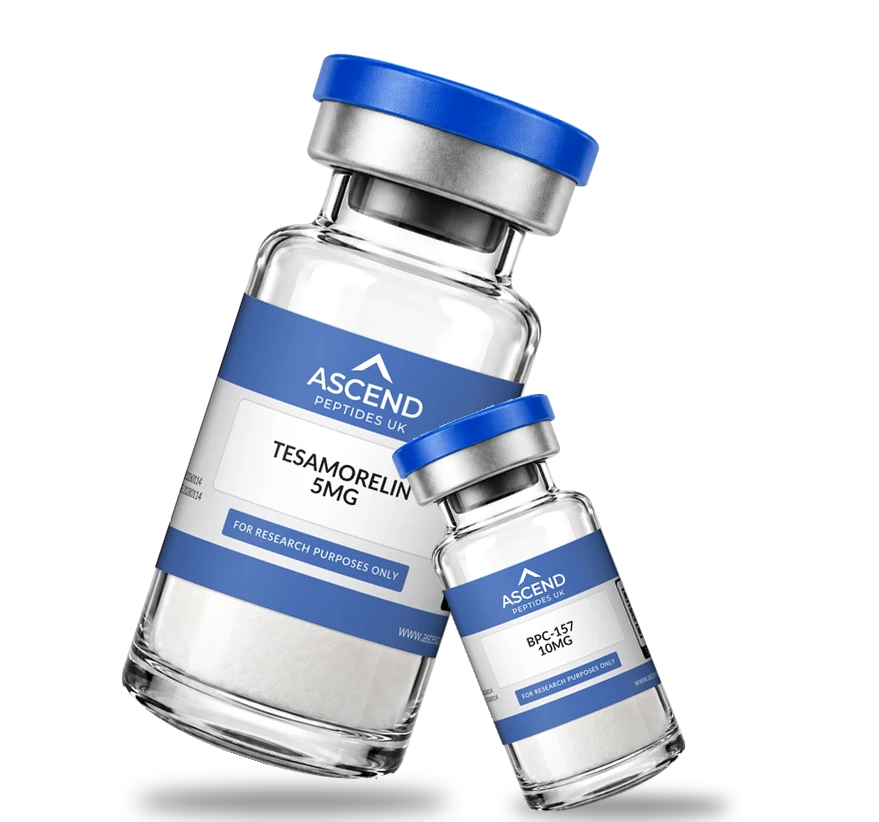

📥 FREE DOWNLOAD
For research professionals only — instant download, no payment required
GH Axis Research Peptides UK — Complete Category for UK Laboratory Research
GH axis research peptides UK suppliers serve a defined laboratory research category: compounds that act at one of three intervention points in the growth hormone axis, the hypothalamic GHRH receptor (GHRHR), the pituitary ghrelin receptor (GHS-R1a), or the downstream IGF-1 receptor.
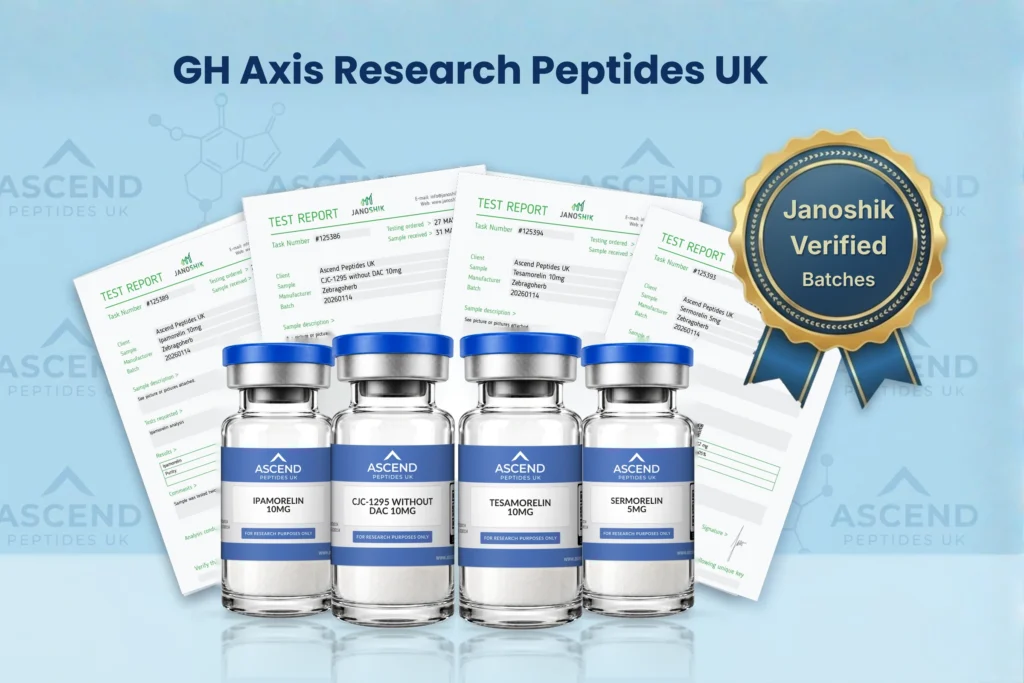
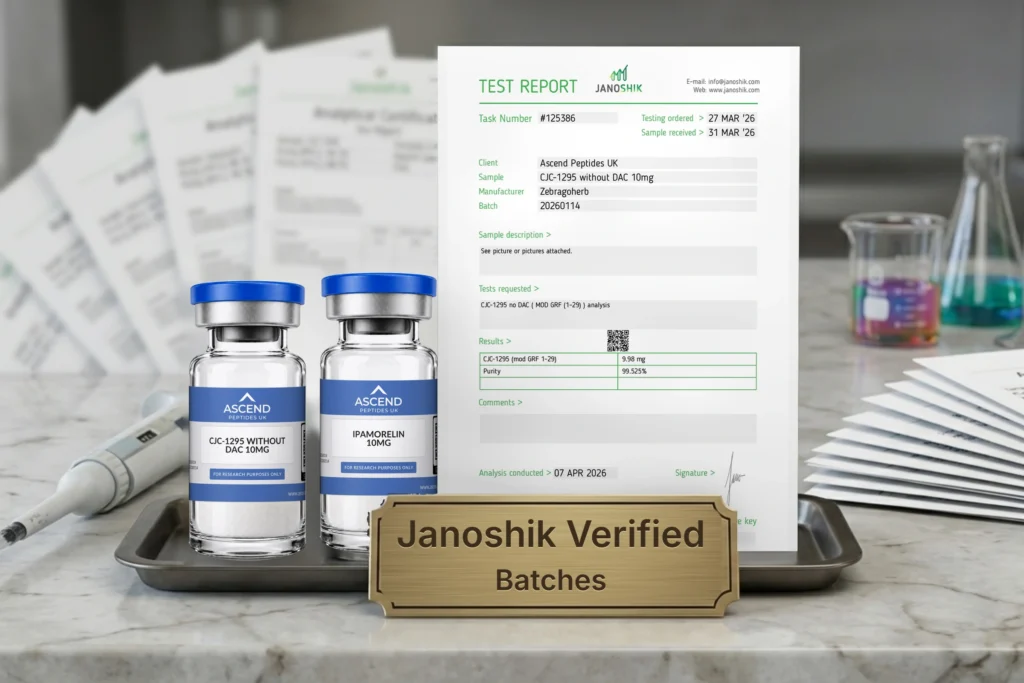
Ascend Peptides UK supplies the complete GH axis research peptide range to UK-based research scientists, private laboratories, and academic institutions. Tested batches are independently analysed by Janoshik, with a batch-specific Certificate of Analysis stating measured content and purity.
The growth hormone axis is the most extensively studied endocrine cascade in the research peptide literature, and the seven compounds covered in this category hub Ipamorelin (5mg and 10mg), CJC-1295 Without DAC, Tesamorelin (5mg and 10mg), Sermorelin 2mg, and IGF-1 LR3 1mg represent the broad range of structural and mechanistic toolkit available to UK researchers.
This page sets out exactly how each compound differs, which research applications each is suited to, and how to source GH axis research peptides in the UK with full documentation transparency. GH axis compounds are one category within our wider range of research peptides in the UK. To compare GH axis compounds side by side by mechanism, receptor target and available format, use the Research Peptide Explorer.
📥 FREE DOWNLOAD
For research professionals only — instant download, no payment required
What Are GH Axis Research Peptides?
GH axis research peptides are synthetic compounds that act at one of three discrete points along the hypothalamic-pituitary-IGF axis. The growth hormone axis itself is a tightly regulated endocrine cascade: hypothalamic Growth Hormone Releasing Hormone (GHRH) stimulates the anterior pituitary to release growth hormone, which in turn drives hepatic IGF-1 production, which then acts on peripheral tissues through the IGF-1 receptor. Each intervention point along this cascade is the target of a distinct research peptide class.
In UK laboratory research, GH axis research peptides are classified into three mechanistic groups:
- GHRH analogues peptides that bind the GHRH receptor (GHRHR) on pituitary somatotrophs. Includes Tesamorelin (full-length 44 amino acids), CJC-1295 Without DAC (modified 29 amino acids, DPP-IV resistant), and Sermorelin (native 29 amino acids).
- GHRPs (Growth Hormone Releasing Peptides) peptides that bind the ghrelin receptor (GHS-R1a) on pituitary somatotrophs. Includes Ipamorelin (selective GHRP, available in 5mg and 10mg research formats).
- IGF-1 axis compounds peptides that act downstream of growth hormone at the IGF-1 receptor. Includes IGF-1 LR3 (long-arginine-3 analogue, 1mg research format).
This three-tier classification is the foundation of how GH axis research peptides UK suppliers organise their catalogues, and it is the basis on which researchers select compounds for specific experimental designs. The mechanistic distinction matters because GHRH analogues and GHRPs act through completely different receptor pathways — researchers studying combined pathway activation use a GHRH analogue and a GHRP together as independent variables in the same protocol.
GHRH Research Peptides UK — Full-Length and Truncated Analogues
GHRH research peptides UK suppliers stock three structurally distinct GHRH analogues, each engineered for a different research application. The defining variable across this group is the sequence length and the presence or absence of N-terminal stabilisation. Ascend Peptides UK supplies all three formats with same-day UK dispatch and full third-party verification.
|
GHRH Analogue |
Sequence |
Half-Life (in vitro) |
Research Application |
|---|---|---|---|
|
Sermorelin 2mg |
Native 29 AA (no modification) |
≈ 12 minutes |
Pulsatile GH pharmacokinetic studies — most physiologically representative GHRH |
|
CJC-1295 Without DAC |
Modified 29 AA (DPP-IV resistant) |
≈ 30 minutes |
Most widely studied GHRH research analogue — extended half-life vs native |
|
Tesamorelin 5mg / 10mg |
Full-length 44 AA (N-terminal trans-3-hexenoic acid) |
≈ 26–38 minutes |
Complete GHRH receptor interface engagement — only full-length GHRH available |
Tesamorelin — The Only Full-Length GHRH Research Peptide
Tesamorelin is the only research peptide that replicates all 44 amino acids of native Growth Hormone Releasing Hormone, with an N-terminal trans-3-hexenoic acid modification for enhanced DPP-IV resistance. Molecular formula C221H366N72O67S, molecular weight approximately 5,135.94 Da. This full-length sequence is the defining scientific distinction between tesamorelin and the truncated 29-amino acid analogues. Tesamorelin engages the complete GHRH receptor binding interface — the full contact surface that native GHRH uses in vivo. For the complete structural and mechanistic background on this compound, see our full guide, What Is Tesamorelin?
Available in two formats: Tesamorelin 5mg for pilot studies and method development, and Tesamorelin 10mg for high-throughput research and multi-arm experimental designs. Tested batches are independently analysed by Janoshik, with a batch-specific Certificate of Analysis stating measured content and purity. Reconstitute with BP-grade bacteriostatic water and store at −20°C.
CJC-1295 Without DAC — The Most Studied GHRH Research Analogue
CJC-1295 Without DAC is a 29-amino acid modified GHRH analogue with four amino acid substitutions (D-Ala, Gln, Ala, Leu) that confer DPP-IV resistance. It is the most widely studied GHRH research peptide in the UK laboratory literature, particularly in combined research protocols with the GHRP Ipamorelin.
Half-life is approximately 30 minutes extended from native GHRH but without the long-acting DAC modification that would push it into the multi-day half-life range. This pharmacokinetic profile makes CJC-1295 without DAC the standard GHRH analogue in pulsatile GH research designs. For a full comparison of the DAC and non-DAC formats, see CJC-1295 With DAC vs Without DAC.
Sermorelin 2mg — The Native GHRH Reference Compound
Sermorelin (GRF 1-29, GHRH(1-29)NH2) is a synthetic 29-amino acid peptide corresponding to the first 29 amino acids of native Growth Hormone Releasing Hormone with no structural modifications. Molecular formula C149H246N44O42S, molecular weight 3,357.93 Da.
It is the most structurally conservative GHRH research analogue available and the only one in this category that carries no DPP-IV protection beyond the native peptide sequence. With an in vitro half-life of approximately 12 minutes, the shortest in the GHRH category, sermorelin is the appropriate research tool for pulsatile GH pharmacokinetic studies where rapid clearance is the experimental requirement. For the full structural and mechanistic background, including how the 2mg and 5mg formats differ, see our Sermorelin research peptide guide.
GHRP Research Peptides UK — Selective Ghrelin Receptor Agonists
GHRP research peptides UK suppliers serve a distinct mechanistic class: compounds that bind the GHS-R1a (ghrelin) receptor on pituitary somatotrophs, rather than the GHRH receptor.
Ipamorelin is the selective GHRP available in the Ascend Peptides UK research catalogue, supplied in two research formats: Ipamorelin 5mg for pilot studies and assay validation, and Ipamorelin 10mg for established research programmes and multi-arm experimental designs.
Ipamorelin 5mg and 10mg — Selective GHRP Research Peptide
Ipamorelin is a synthetic pentapeptide (C38H49N9O5, molecular weight 711.85 g/mol) and a selective GHS-R1a (ghrelin receptor) agonist. Its defining research characteristic is selectivity, unlike earlier GHRPs such as GHRP-2 and GHRP-6. Ipamorelin has been reported to show greater receptor selectivity and less stimulation of ACTH and cortisol release than earlier GHRPs such as GHRP-6 and GHRP-2 in some research settings,[1] making it a selective option for isolated GH-axis research applications.
This selectivity is why ipamorelin is the standard GHRP in combined research protocols with GHRH analogues like CJC-1295 without DAC.
The 5mg and 10mg formats are mechanistically identical compounds; the difference is research-stage. Ipamorelin 5mg is appropriate for pilot studies, dose-response method development, and assay validation.
Ipamorelin 10mg is the established research programme format, providing sufficient volume for multi-arm experimental designs and extended longitudinal studies under consistent single-batch conditions.
COMBINED GHRH + GHRP PROTOCOLS
The most extensively studied research protocol in the GH axis category is the combination of CJC-1295 without DAC (GHRHR pathway) with Ipamorelin (GHS-R1a pathway). The two compounds act through mechanistically distinct receptors and can function as independent variables within the same experimental protocol. Both are stocked together by Ascend Peptides UK with matched Certificate of Analysis documentation.
IGF-1 Axis Research Peptide UK — Downstream Growth Factor Research
The IGF-1 axis represents the downstream effector arm of the growth hormone cascade. While GHRH analogues and GHRPs act at the pituitary level to stimulate GH release, IGF-1 axis research peptides act directly at the IGF-1 receptor, bypassing the upstream pituitary signalling entirely.
This makes IGF-1 axis compounds the appropriate research tool for studying peripheral tissue effects of GH-axis activation independent of pituitary release variability.
IGF-1 LR3 1mg — Long-Arginine-3 IGF-1 Research Peptide
IGF-1 LR3 (Long Arginine 3 IGF-1) is a structurally modified IGF-1 analogue with a 13-amino acid N-terminal extension and an arginine substitution at position 3 of the IGF-1 sequence. These modifications reduce its interaction with IGF-binding proteins (IGFBPs), which increases its biological potency relative to native IGF-1 in cell systems that secrete IGFBPs.[2]
Supplied in 1mg research format and independently tested by Janoshik. For the complete structural and mechanistic background on this compound, see our full guide, What Is IGF-1 LR3?
Researchers studying the downstream growth factor component of the GH axis use IGF-1 LR3 1mg in combination with upstream GHRH or GHRP research peptides to dissect pituitary-mediated versus direct-receptor effects in multi-compound experimental designs.
References
- Raun K, et al. Ipamorelin, the first selective growth hormone secretagogue. Eur J Endocrinol. 1998.
- Francis GL, et al. Novel recombinant fusion protein analogues of insulin-like growth factor (IGF)-I indicate the relative importance of IGF-binding protein and receptor binding for enhanced biological potency. J Mol Endocrinol. 1992.
GH Axis Peptide Supplier UK — How Ascend Peptides UK Documents Every Batch
When sourcing GH axis research peptides, UK suppliers must meet four documentation standards to distinguish a verified supplier from an unverified one. These four standards are the basis on which UK research buyers should evaluate any GH axis peptide supplier, including Ascend Peptides UK, before placing an order. For the complete evaluation framework, see our guide to choosing a UK peptide supplier.
|
Documentation Standard |
Industry Norm |
Ascend Peptides UK |
|---|---|---|
|
HPLC purity verification |
Self-reported by the supplier |
Independent Janoshik analysis, purity stated per tested batch |
|
Molecular identity |
Often not tested |
Not separately reported on current Janoshik certificates |
|
Certificate of Analysis |
Generic or unavailable |
Batch-specific, publicly verifiable, pre-purchase |
|
Storage and dispatch |
3–7 working days |
Same-day UK dispatch before 3pm UK time, −20°C storage chain |
Published Janoshik Certificates of Analysis for Ascend Peptides UK GH axis research peptides state measured content and purity for each tested batch and carry a verification key; LC-MS identity data is not separately reported on current Janoshik certificates.
This pre-purchase documentation transparency is the standard a UK research peptide supplier should meet, and the standard that UK research buyers should require before placing an order.
Before You Order — Free Research Buyer Starter Pack
Before placing an order for any GH axis research peptide, UK research buyers should review the documentation and supplier evaluation checklist. The Research Buyer Starter Pack a free download from Ascend Peptides UK, covers exactly what to verify before ordering, including how to read a Certificate of Analysis, what HPLC and LC-MS results actually confirm, and how to evaluate a UK peptide supplier against measurable standards.
📥 FREE DOWNLOAD
Research Buyer Starter Pack
A practical guide for UK research buyers. What to check before ordering TB-500 or any research peptide. What documentation to request from any supplier? What storage and dispatch standards to expect.
Inside the checklist:
✓ Product name verification — confirm test was performed on the correct compound
✓ Batch / lot number check — must name the specific vial lot
✓ Date of testing — must be recent and apply to current stock
✓ HPLC purity result — must state ≥98% and the analytical method
✓ LC-MS molecular identity — must confirm molecular weight match
✓ Laboratory issuing CoA — must be an independent third-party testing lab
✓ Method transparency — analytical method documented and reproducible
✓ CoA authentication — reference, signature, or verifiable identifier
✓ Pre-purchase availability — CoA must be accessible BEFORE the order is placed
For research professionals only — instant download, no payment required
Buy GH Axis Research Peptides UK — Documentation Buyer Framework
The eight GH axis research peptides covered on this page are available individually with same-day UK dispatch and full third-party verification. Click any product below to view the detailed product page, batch-specific Certificate of Analysis, and complete scientific guide.
|
Compound |
Mechanism |
Format |
Product Link |
|---|---|---|---|
|
Ipamorelin 5mg |
GHS-R1a agonist (GHRP) |
5mg pilot research format |
|
|
Ipamorelin 10 mg |
GHS-R1a agonist (GHRP) |
10mg established research format |
|
|
CJC-1295 Without DAC |
GHRHR agonist (modified 29 AA GHRH) |
10mg standard format |
|
|
CJC-1295 With DAC |
GHRHR agonist (DAC-modified, extended half-life GHRH) |
10mg extended half-life format |
|
|
Tesamorelin 5mg |
GHRHR agonist (full-length 44 AA GHRH) |
5mg pilot research format |
|
|
Tesamorelin 10mg |
GHRHR agonist (full-length 44 AA GHRH) |
10mg established research format |
|
|
Sermorelin 2mg |
GHRHR agonist (native 29 AA GHRH) |
2mg native reference format |
|
|
IGF-1 LR3 1mg |
IGF-1 receptor agonist (downstream growth factor) |
1mg long-arginine-3 analogue |
GH Axis Research Peptides UK — Frequently Asked Questions
What is the GH axis in research peptide terminology?
The GH axis is the hypothalamic-pituitary-IGF endocrine cascade. Hypothalamic GHRH stimulates pituitary GH release; pituitary GH stimulates hepatic IGF-1 production; IGF-1 acts on peripheral tissues through the IGF-1 receptor. Research peptides intervene at one of three points: the GHRH receptor (GHRH analogues), the ghrelin receptor (GHRPs), or the IGF-1 receptor (IGF-1 LR3).
What is the difference between GHRH analogues and GHRPs?
GHRH analogues bind the GHRH receptor on pituitary somatotrophs. GHRPs bind the GHS-R1a (ghrelin) receptor on the same cells. They act through mechanistically distinct pathways and can be combined as independent variables in research protocols. The most studied combination is CJC-1295 without DAC (GHRH analogue) with Ipamorelin (selective GHRP). For a full mechanism-level comparison of GHRH analogues and GHRPs, see GHRH vs GHRP: Mechanism Comparison.
How is the GH axis research peptide purity verified?
Purity is verified by High Performance Liquid Chromatography (HPLC), which separates the target compound from contaminants and reports the percentage of the target compound in the supplied product. Industry standard is ≥98% HPLC purity. Ascend Peptides UK uses Janoshik laboratory for independent purity analysis, with the measured purity of each tested batch reported on a publicly verifiable Certificate of Analysis. See how we test research peptides for the complete quality control workflow.
What does LC-MS confirm that HPLC does not?
HPLC reports the purity percentage of the supplied product, but it does not by itself confirm what the main peak actually is. LC-MS (Liquid Chromatography Mass Spectrometry) confirms the molecular identity by measuring the molecular weight of the compound and matching it to the expected molecular weight of the target peptide. Together, HPLC and LC-MS confirm both purity (HPLC) and identity (LC-MS) the two pillars of analytical verification.
What is the WADA status of GH axis research peptides?
All GHRH analogues, all GHRPs, and all IGF-1 axis compounds are listed on the World Anti-Doping Agency (WADA) Prohibited List under category S2 (Peptide Hormones, Growth Factors, Related Substances and Mimetics). They are prohibited at all times, both in-competition and out-of-competition, for athletes subject to WADA jurisdiction. Ascend Peptides UK supplies these compounds strictly for in-vitro laboratory research.
What is the MHRA status of GH axis research peptides in the UK?
GH axis research peptides supplied by Ascend Peptides UK are not licensed as medicinal products under the UK Human Medicines Regulations 2012. They are supplied strictly for in-vitro laboratory research. The Medicines and Healthcare products Regulatory Agency (MHRA) is the relevant medicines regulator in the UK post-Brexit (replacing the previous EMA route).
Why UK Researchers Source GH Axis Research Peptides from Ascend Peptides UK
- Independent Janoshik testing — measured content and purity reported for each tested batch
- Publicly verifiable Certificate of Analysis — batch-specific, available pre-purchase
- Same-day UK dispatch before 3pm UK time — Royal Mail Tracked 24
- Free UK shipping from £50 — the lowest threshold in the UK research peptide market
- Temperature-controlled storage chain — lyophilised powder, −20°C storage
- Complete GH axis range stocked together — single-supplier batch matching for multi-compound research
Order GH Axis Research Peptides UK — Same-Day Dispatch
Browse the complete GH axis research peptide range, review batch-specific Certificate of Analysis documentation, and place your research order for same-day UK dispatch.
RESEARCH USE ONLY
All products supplied by Ascend Peptides UK are intended strictly for in-vitro laboratory research purposes only. Compounds are not licensed as medicinal products under the Human Medicines Regulations 2012 and are not for human consumption, veterinary use, or any therapeutic application. Products are supplied to qualified research professionals only.
📥 FREE DOWNLOAD
For research professionals only — instant download, no payment required