
📥 FREE DOWNLOAD
For research professionals only — instant download, no payment required
Research Grade Standards UK — What "Research-Grade" Actually Means in UK Laboratory Peptide Supply
Research-grade peptides UK standards are the most poorly defined concept in the UK research peptide market. The phrase “research grade” appears on the website of nearly every UK peptide supplier, but the operational meaning of the term varies enormously between suppliers, and the differences are exactly what determine whether a compound is genuinely fit for laboratory research or whether the label is a marketing claim with no underlying substance.
This page sets out the six operational standards that define research-grade quality in UK laboratory peptide supply, against which every supplier, including Ascend Peptides UK should be evaluated.
The Ascend Peptides UK brand position is built on meeting all six standards on every batch of every research peptide supplied. The standards are deliberately UK-specific: they reference British Pharmacopoeia (BP) grade reconstitution media, the Medicines and Healthcare products Regulatory Agency (MHRA) post-Brexit regulatory framework, and the laboratory documentation expectations of UK research institutions.
The companion batch verification page sets out how every batch is verified; this page sets out what “research-grade” actually means, against which the verification is performed.
📥 FREE DOWNLOAD
For research professionals only — instant download, no payment required
Why "Research Grade" Needs a Real Definition
The UK research peptide market is unregulated at the supplier level. There is no central registry, no mandatory certification body, and no enforced standard for what “research grade” must mean. Every supplier defines the term internally which means in practice that the term has no consistent meaning at all. Three failure modes commonly result from the undefined use of “research grade”:
- Failure mode 1: Cosmetic-grade compounds sold as research-grade. Compounds manufactured for non-laboratory use (typically at lower purity specifications) are labelled “research grade” because there is no enforced definition preventing the relabelling.
- Failure mode 2: Self-reported purity with no independent verification. A supplier claims ≥98% purity based on the manufacturer’s synthesis specification, without independent post-production HPLC verification of the actual batch supplied.
- Failure mode 3: No batch-level documentation. A single historical Certificate of Analysis is applied generically to all subsequent batches with the same product name, meaning the buyer has no documentation tied to the specific vial received.
A real definition of research-grade quality must address each failure mode explicitly. The six standards set out below are the operational expression of that definition. Every standard is independently verifiable by the buyer before purchase, and every standard is met on every batch of every research peptide supplied by Ascend Peptides UK. The complete proof framework is set out on the batch verification page and the how we test peptides page.
The 6 Standards That Define Research-Grade in UK Laboratory Peptide Supply
Standard 1 — Why ≥98% HPLC Purity Is the Research-Grade Threshold
≥98% HPLC purity is the operational threshold above which synthesis-related impurities are sufficiently minor that they are not expected to materially affect downstream research results. Below this threshold, truncated peptides, deletion products, modified sidechain compounds, and residual reagents from the synthesis process reach concentrations that can confound receptor binding assays, signalling cascade research, and any experimental design where test compound concentration is a controlled variable.
The ≥98% standard is meaningful only when verified by independent post-production HPLC analysis not by self-reported synthesis specifications.
A peptide synthesised to a ≥98% target specification can still be supplied at lower actual purity if the manufacturing batch had production issues that were not caught by manufacturer-side internal QC. Independent verification by Janoshik laboratory confirms the actual delivered purity for the specific batch the buyer receives.
Standard 2 — Why LC-MS Molecular Identity Confirmation Is Non-Negotiable
HPLC tells the buyer how PURE the supplied product is, but it does not tell the buyer what that pure compound actually is. A different peptide of comparable chromatographic behaviour could pass an HPLC purity test at the same retention time as the target peptide.
The buyer would receive a ≥98% pure compound, just not the compound they thought they were purchasing. This is the verification gap that LC-MS closes.
Liquid Chromatography Mass Spectrometry (LC-MS) measures the molecular weight of the supplied compound directly and compares it to the theoretical molecular weight of the target peptide.
The theoretical molecular weight is calculated from the amino acid sequence and any modifications specified in the synthesis specification. A measured molecular weight match within instrument tolerance strongly supports the expected molecular identity. . A mismatch indicates substitution, modification, or degradation and the batch is rejected before the Certificate of Analysis is published.
LC-MS is the analytical method that catches identity substitution in heavily counterfeited research peptides, particularly BPC-157, TB-500, and the melanocortin compounds (MT1 and MT2). In the UK research peptide market, these are widely counterfeited compounds within the research peptide market because their molecular structures are sufficiently complex that cheaper substituted compounds can sometimes pass HPLC purity testing without LC-MS detection. LC-MS confirmation closes the gap. Both HPLC and LC-MS, together or alone, are the operational research-grade standard.
Standard 3 — Why Every Certificate of Analysis Must Be Batch-Specific
A Certificate of Analysis that does not name the specific lot number of the product the buyer is receiving is not a real CoA.
It is a marketing document carrying historical test data that cannot be tied to the specific vial held in the buyer’s hand. Generic CoAs are the most common documentation failure mode in the UK research peptide market. A single historical batch is tested once, the CoA is generated, and the same document is applied generically to all subsequent production batches with the same product name.
The buyer cannot distinguish between a verified current batch and an unverified subsequent batch because the documentation is identical for both. The complete batch-level documentation framework is set out on the batch verification page.
A batch-specific Certificate of Analysis is operationally different. The test result documented on the CoA is tied to a specific manufacturing lot number, the same lot number that appears on the vial label the buyer receives.
The buyer can match the lot number on the CoA to the lot number on the vial and confirm the documentation applies to the specific product purchased. This single operational property is what distinguishes per-batch verification from generic certification.
Every Janoshik Certificate of Analysis issued for an Ascend Peptides UK research peptide names the specific manufacturing lot number that matches the vial label. The complete CoA archive organises every published certificate by lot number, making the batch-level verification step straightforward for the buyer to perform before or after purchase.
Standard 4 — Why BP-Grade Reconstitution Media Matter for UK Research
British Pharmacopoeia (BP) grade is the UK-specific pharmaceutical reference standard for analytical purity and excipient specifications. BP-grade bacteriostatic water (10ml) meets defined specifications for water purity, bacteriostatic preservative concentration (0.9% benzyl alcohol), particulate contamination limits, and pyrogenic content. BP grade is the UK-specific pharmacopoeial reference framework, although USP and European Pharmacopoeia standards overlap substantially in many analytical specifications.
The reason the UK research-grade designation requires BP-grade reconstitution media is structural. A research peptide verified at ≥98% HPLC purity by Janoshik can be reconstituted with substandard bacteriostatic water carrying analytical impurities or insufficient preservative concentration, and the working solution that results no longer represents the verified peptide. The research-grade chain runs from synthesis through verification through reconstitution to use; substandard media at the reconstitution step break the chain.
Ascend Peptides UK stocks BP-grade bacteriostatic water and BP-grade acetic acid alongside the research peptide range, with FREE 10ml bacteriostatic water on orders over £75 designed to ensure UK buyers have the correct reconstitution medium available immediately on product arrival. See the peptide storage guide for the complete reconstitution protocol.
Standard 5 — The MHRA Regulatory Framework for UK Research Peptide Supply
Post-Brexit, the Medicines and Healthcare products Regulatory Agency (MHRA) is the UK’s independent regulator for medicines and medical devices, having taken over the regulatory functions previously performed by the European Medicines Agency (EMA) for UK-supplied products.
Research peptides supplied for in-vitro laboratory research are NOT licensed medicinal products under the UK Human Medicines Regulations 2012; they are research compounds supplied to qualified research professionals for laboratory use only.
Three regulatory framings distinguish a UK research-grade supplier from an unverified one operating outside the UK framework:
-
UK-specific regulatory positioning: explicit reference to UK Human Medicines Regulations 2012 and MHRA as the relevant regulator, not US FDA or EU EMA. Post-Brexit, US and EU regulatory frameworks do not directly apply to UK research peptide supply.
-
Research-use-only product representation: no therapeutic claims, no human-use claims, no veterinary claims, no dosing or administration guidance. Products are represented as in-vitro laboratory research compounds only.
-
Qualified buyer pre-qualification: products supplied to research professionals only, with age verification (18+) and research-use confirmation at point of order.
The MHRA framework is the UK regulatory anchor that distinguishes a UK research-grade supplier from a generic international supplier shipping to UK addresses. Ascend Peptides UK operates under the full UK regulatory framework, UK contact details, UK dispatch, UK customer support, and UK regulatory positioning. See the about us page for the complete supplier model.
Standard 6 — Why UK Cold Chain Dispatch Integrity Is Part of Research-Grade
A research peptide verified at ≥98% HPLC purity at dispatch may undergo degradation during transit if exposed to unsuitable temperature or humidity conditions. Lyophilised peptides are relatively stable at ambient temperature for short windows, but extended exposure to heat, humidity, or temperature cycling during shipping can drive degradation that compromises the research-grade designation of the product the buyer receives.
Cold chain dispatch integrity from the supplier to the UK research address is part of the quality assurance chain, and breaks at this stage invalidate the verification performed earlier in the chain. The complete UK dispatch protocol is documented on the payment and shipping page.
Three operational properties define the UK cold chain dispatch standard at the research-grade level:
-
Same-day UK dispatch: orders placed before 16:00 GMT leave the warehouse the same working day. Extended order-to-dispatch delays at the supplier end add temperature exposure time before the product even enters the courier network.
-
Temperature-controlled packaging: lyophilised peptides are packed in insulated packaging that buffers against extreme transit temperatures. The packaging is part of the dispatch standard, not an optional upgrade.
-
UK dispatch from a UK address: UK same-day dispatch via Royal Mail Tracked 24 reaches UK research addresses within 1-2 working days. International dispatch from non-UK addresses extends transit time, increases temperature exposure, and adds customs delays all of which compromise cold chain integrity.
The Ascend Peptides UK dispatch model is UK same-day Royal Mail Tracked 24 from a UK warehouse designed to protect the cold chain at the dispatch stage. The buyer-side storage protocol once the product arrives is documented on the peptide storage guide. For all six standards to apply to the product the buyer receives, the dispatch chain must protect the supplier-side verification through to UK arrival.
Free Download — Research Buyer Starter Pack
The six research-grade standards set out on this page are the framework against which UK research buyers should evaluate every peptide supplier, including Ascend Peptides UK. The Research Buyer Starter Pack converts the six-standard framework into a practical buyer evaluation guide, with checklists, document templates, and a step-by-step supplier assessment workflow. It is the same framework the Ascend Peptides UK QC team applies to its own internal supplier review.
📥 FREE DOWNLOAD
Research Buyer Starter Pack
A practical guide for UK research buyers. What to check before ordering a metabolic research peptide. What documentation to request from any supplier? What storage and dispatch standards to expect.
Inside the checklist:
Inside the pack:
✓ What “research-use only” means under UK regulation
✓ How to evaluate a UK research peptide supplier — 9-point checklist
✓ What documentation to request before purchase (CoA, HPLC, LC-MS)
✓ What storage and reconstitution standards to verify
✓ Pre-order buyer checklist — 16 items to confirm
✓ How to spot a low-quality metabolic peptide supplier — 7 warning signs
For research professionals only — instant download, no payment required
UK Industry Norm vs Research-Grade Standard
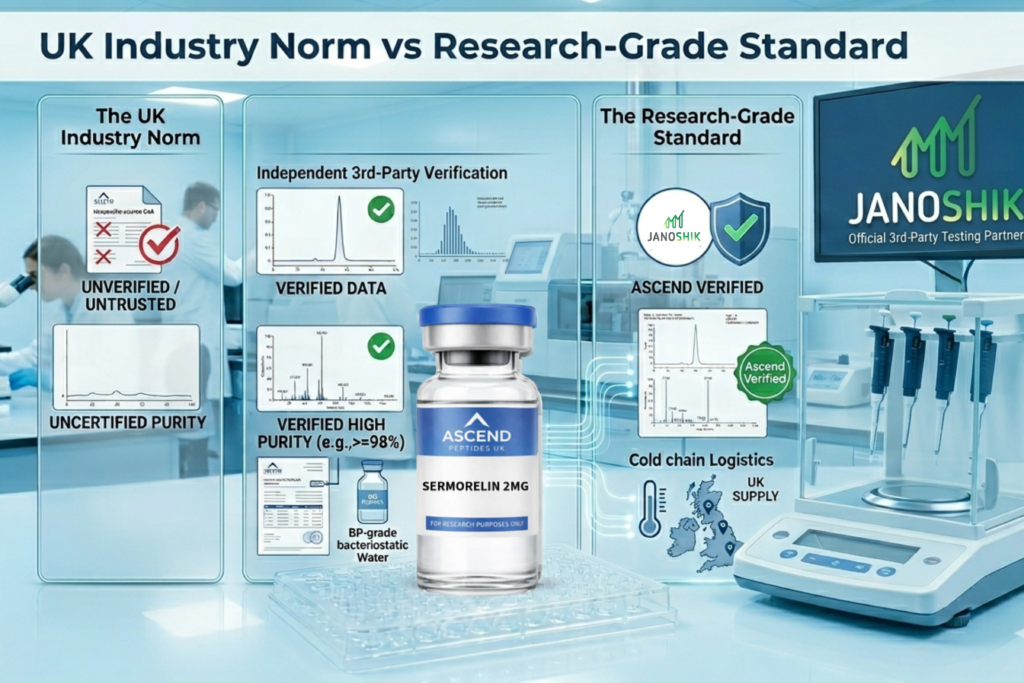
The substantive comparison between an unverified supplier and the research-grade standard is operationally measurable across the six standards. The table below maps the unverified industry norm against the Ascend Peptides UK research-grade standard variable by variable. Each is independently checkable by the UK research buyer before purchase.
|
Research-Grade Standard |
UK Industry Norm |
Ascend Peptides UK Standard |
|---|---|---|
|
HPLC purity verification |
Self-reported from synthesis spec |
≥98% verified by independent Janoshik HPLC |
|
LC-MS molecular identity |
Often not performed |
LC-MS confirmation on every batch |
|
Batch-specific CoA |
Generic CoA across multiple batches |
Per-batch CoA tied to lot number |
|
Reconstitution media grade |
Unspecified or non-BP |
BP-grade bacteriostatic water and acetic acid |
|
Regulatory framework |
Unclear or non-UK-specific |
MHRA-aware, UK Human Medicines Regulations 2012 |
|
Cold chain dispatch |
Variable, often non-UK |
UK same-day dispatch, temperature-controlled |
Every research peptide supplied by Ascend Peptides UK meets the right-hand column standard on every variable. The standards are the Ascend Peptides UK operational framework, not a generic marketing claim. Every product in the live catalogue is verified against the framework before release. Browse the Ascend Peptides UK shop collection to apply the standards to the actual product range, or review the documentation transparency standard on the CoA archive.
UK Pharmacopoeia Standards — Why BP Grade, Not USP
Three principal pharmacopoeia standards apply globally to laboratory and pharmaceutical reference materials: British Pharmacopoeia (BP) for the UK, United States Pharmacopeia (USP) for the United States, and European Pharmacopoeia (EP/Ph. Eur.) for the European Union.
The three standards overlap substantially in most analytical specifications but are not identical and the choice of reference standard signals which regulatory framework a supplier is operating under.
|
Pharmacopoeia Standard |
Jurisdiction |
UK Research Relevance |
|---|---|---|
|
British Pharmacopoeia (BP) |
United Kingdom |
The UK reference standard — applies post-Brexit |
|
United States Pharmacopoeia (USP) |
United States |
US reference — not the UK regulatory anchor |
|
European Pharmacopoeia (Ph. Eur.) |
European Union |
EU reference — applied pre-Brexit, less directly relevant post-2021 |
For UK research peptide supply, BP grade is the relevant pharmacopoeia standard for reconstitution media and excipient specifications. A supplier stocking BP-grade media signals operational alignment with UK regulatory and quality frameworks. Suppliers referring exclusively to USP-grade media are operating under US framings, which is not incorrect, but is not UK-aligned. Ascend Peptides UK uses BP-grade reconstitution media as the UK-specific operational standard.
Why the Ascend Peptides UK Research-Grade Standard Is the UK Brand Reference
- All 6 research-grade standards were met on every batch verified, not claimed
- ≥98% HPLC purity verified independently by Janoshik laboratory
- LC-MS molecular identity confirmation on every batch
- Batch-specific Certificate of Analysis tied to vial lot number
- BP-grade reconstitution media, bacteriostatic water and acetic acid are stocked alongside peptides
- MHRA-aware UK regulatory positioning, UK Human Medicines Regulations 2012 framework
- Cold chain UK same-day dispatch temperature-controlled packaging via Royal Mail Tracked 24
- UK contact details, UK dispatch, UK customer support, full UK operational footprint
Research Grade Peptides UK Standards — Frequently Asked Questions
What does “research-grade” actually mean for the UK peptide supply?
Research-grade in UK laboratory peptide supply means meeting six specific operational standards: ≥98% HPLC purity (independently verified), LC-MS molecular identity confirmation, batch-specific Certificate of Analysis, BP-grade reconstitution media, MHRA-aware UK regulatory positioning, and cold chain UK dispatch integrity. The phrase is not regulated at the supplier level in the UK — meaning each supplier defines the term internally. Ascend Peptides UK defines it against the six standards set out on this page.
Why does BP grade matter for research peptide reconstitution?
British Pharmacopoeia (BP) grade is the UK-specific pharmaceutical reference standard for analytical purity, bacteriostatic preservative concentration, particulate contamination limits, and pyrogenic content. A ≥98% HPLC-verified research peptide reconstituted with non-BP-grade bacteriostatic water no longer represents the verified peptide, as substandard reconstitution media break the verification chain. BP-grade bacteriostatic water is stocked alongside the Ascend Peptides UK research peptide range.
What is the difference between BP grade and USP grade?
BP (British Pharmacopoeia) is the UK reference standard. USP (United States Pharmacopoeia) is the US reference standard. The two overlap substantially but are not identical. For UK research peptide supply post-Brexit, BP grade is the UK-aligned standard. Suppliers referring exclusively to USP grade are operating under US frameworks, which is not incorrect, but is not UK-aligned to the same operational standard.
Who is the MHRA, and why does it matter for research peptides?
The Medicines and Healthcare products Regulatory Agency (MHRA) is the UK’s independent regulator for medicines and medical devices, taking over the UK regulatory functions previously performed by the European Medicines Agency (EMA) after Brexit. UK research peptides supplied for in-vitro laboratory research are not licensed medicinal products under the MHRA framework — they are research compounds supplied to qualified research professionals under the UK Human Medicines Regulations 2012. The MHRA framework defines the UK regulatory anchor for research peptide supply.
Are these standards regulated by a UK body?
No. The UK research peptide market is unregulated at the supplier level; there is no central registry, no mandatory certification body, and no enforced standard for “research grade.” The six standards set out on this page are the operational definition applied by Ascend Peptides UK, derived from UK regulatory frameworks (MHRA, BP) and UK laboratory practice. Every standard is independently verifiable by the buyer, which is a substitute for centralised regulation.
How do I verify a supplier meets the research-grade standard?
Apply the six standards as a buyer checklist. The Research Buyer Starter Pack (downloadable on this page) converts the framework into a practical evaluation tool. The companion batch verification page sets out how to read a Certificate of Analysis. The ” How we test peptides page sets out the QC standards behind the testing. Together, the three pages document the complete framework.
Why does cold chain dispatch matter for research-grade?
Lyophilised peptides verified at ≥98% HPLC purity at the point of dispatch can degrade substantially during transit if temperature control fails. Cold chain integrity from supplier to buyer is part of the research-grade chain. Ascend Peptides UK dispatches same-day from the UK before 16:00 GMT in temperature-controlled packaging via Royal Mail Tracked 24. The complete dispatch protocol is documented on the payment and shipping page.
What is the relationship between this page and the batch verification page?
This page defines what “research-grade” means against six UK-specific standards. The batch verification page documents how Ascend Peptides UK proves each batch meets the standards. The how we test peptides page explains the analytical methods used. Together, the three trust pages document the complete Ascend Peptides UK quality framework — what we mean by research-grade, what we test for, and what the buyer receives as proof.
What does “premium” mean when comparing research peptides in the UK?
“Premium” is a descriptive term rather than a substitute for analytical evidence. Research buyers should assess measurable factors such as independent HPLC purity testing, LC-MS identity confirmation, batch-specific Certificates of Analysis, documentation transparency, appropriate research-use positioning and clearly documented storage and dispatch information. On this page, Ascend Peptides UK uses the term “research-grade” to describe peptides assessed against defined, buyer-verifiable standards rather than relying on marketing terminology alone.
Review the Ascend Peptides UK Research-Grade Catalogue
Every research peptide supplied by Ascend Peptides UK is verified against the six research-grade standards set out on this page. Browse the complete Ascend Peptides UK research peptide catalogue, review the CoA archive for batch-specific documentation on every product, or start with the main research peptides UK hub for the complete supplier model. For the operational proof framework, see the companion batch verification page and the ” How we test peptides page. For a broader framework on evaluating any UK research peptide supplier, see our guide to choosing a peptide supplier.
RESEARCH USE ONLY
All products supplied by Ascend Peptides UK are intended strictly for in-vitro laboratory research purposes only. Compounds are not licensed as medicinal products under the UK Human Medicines Regulations 2012 and are not for human or veterinary use. Products are supplied to qualified research professionals only.
📥 FREE DOWNLOAD
For research professionals only — instant download, no payment required