
📥 FREE DOWNLOAD
For research professionals only — instant download, no payment required
Metabolic Research Peptides UK — AOD-9604 and MOTS-C for UK Laboratory Research
Metabolic research peptides UK suppliers serve one of the most scientifically active research categories in current laboratory literature. The compounds in this category act on pathways involved in adipocyte biology and mitochondrial signalling, two widely studied research areas in cellular metabolism.
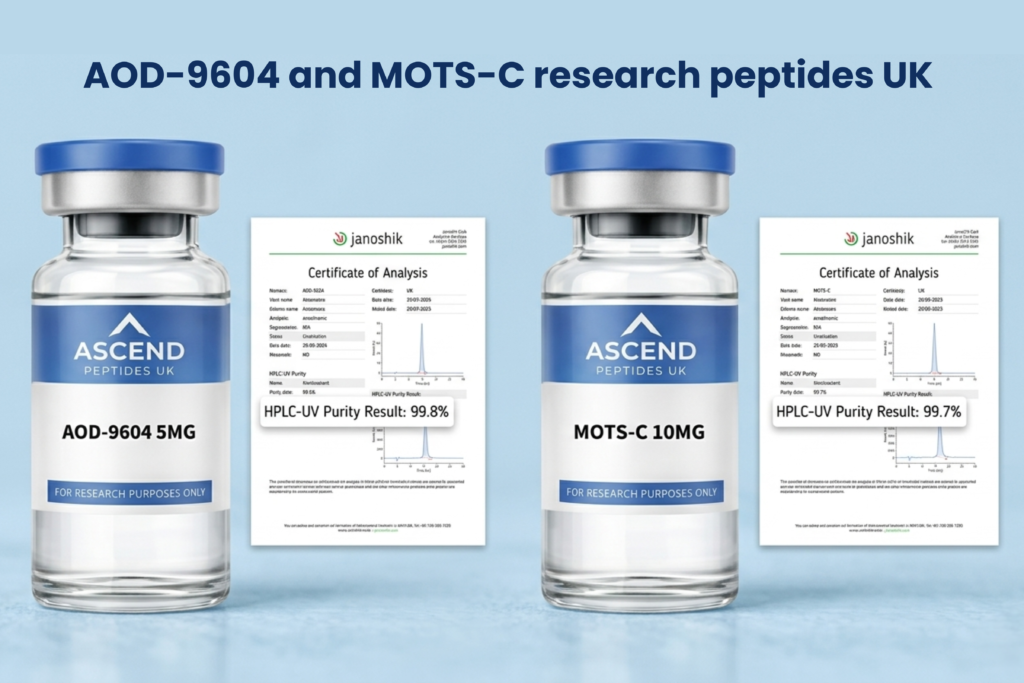
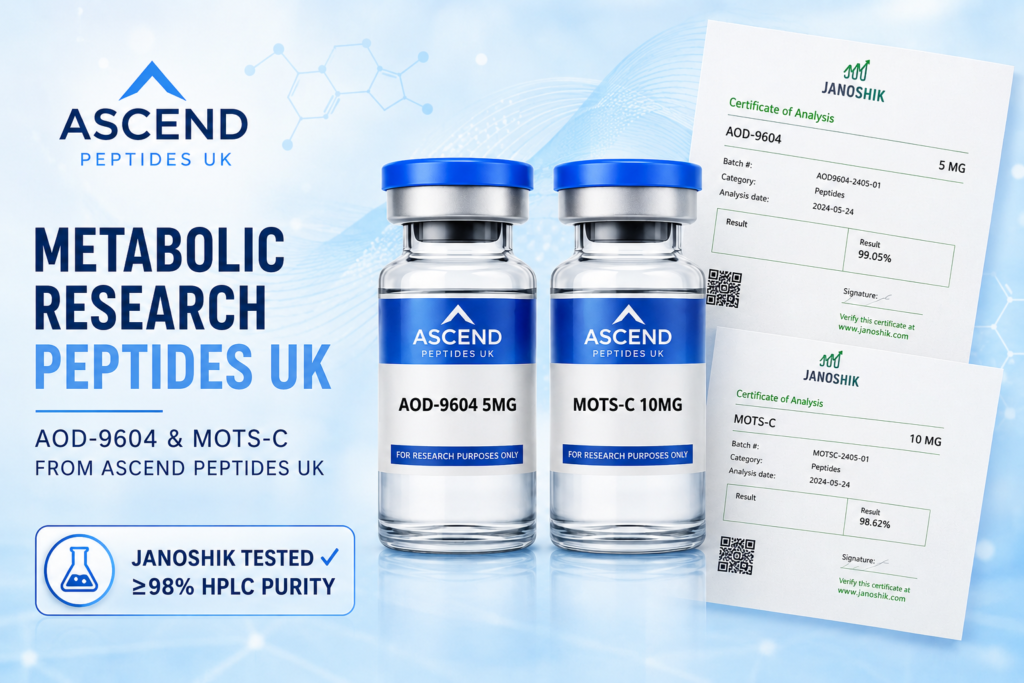
Ascend Peptides UK supplies the two principal metabolic research peptides in the UK catalogue: AOD-9604 (a lipolytic growth hormone fragment) and MOTS-C (a mitochondrial-derived signalling peptide). Both compounds are HPLC-verified at ≥98% purity, LC-MS confirmed for molecular identity, and independently tested by Janoshik with a publicly verifiable Certificate of Analysis on every batch.
This page sets out the scientific and procurement details for both compounds, what each is, how they differ mechanistically, how they are used in UK laboratory research, and how to source metabolic research peptides that UK suppliers offer with full documentation transparency.
The two compounds cover the two principal intervention points in laboratory metabolic research: adipocyte and lipolytic activity research (AOD-9604) and mitochondrial-nuclear signalling research (MOTS-C). Researchers running multi-compound metabolic programmes typically use both together as independent variables within the same experimental design. Metabolic compounds sit alongside the rest of our research peptides in the UK catalogue.
📥 FREE DOWNLOAD
For research professionals only — instant download, no payment required
What Are Metabolic Research Peptides?
Metabolic research peptides are synthetic compounds used in laboratory research to study pathways involved in lipid metabolism, adipocyte biology, and mitochondrial signalling. In the Ascend Peptides UK catalogue, the metabolic research peptide category covers two compounds, each representing a distinct mechanistic class:
- Lipolytic growth hormone fragments peptides derived from the C-terminal region of human growth hormone with selective effects on adipocyte biology. AOD-9604 (Anti-Obesity Drug 9604) is the standard research compound in this class, a 16-amino acid fragment of human growth hormone covering residues 177–191.
- Mitochondrial-derived signalling peptides are encoded within the mitochondrial genome and participate in metabolic signalling. MOTS-C (Mitochondrial Open Reading Frame of the 12S rRNA-c) is the standard research compound in this class, a 16-amino acid peptide encoded within the mitochondrial 12S rRNA gene.
The mechanistic distinction matters because each compound represents a different point of intervention in metabolic biology. AOD-9604 acts at the adipocyte level on lipolytic pathways. MOTS-C acts on mitochondrial-nuclear signalling and AMPK pathway activation.
Researchers select compounds based on which pathway is the experimental focus or use both together when the research design covers multiple intervention points within the same metabolic cascade.
AOD-9604 Research Peptide UK Lipolytic Growth Hormone Fragment
AOD-9604 (Anti-Obesity Drug 9604) is a 16-amino acid synthetic peptide corresponding to the C-terminal region of human growth hormone, covering residues 177–191, with a tyrosine residue added at the N-terminus for analytical and synthetic stability. Molecular formula C78H123N23O23S2, molecular weight approximately 1815.06 Da.
AOD-9604 is a structurally distinct lipolytic peptide research compound in the metabolic category, which carries the lipolytic activity associated with the C-terminal portion of growth hormone with reduced growth hormone receptor signalling activity compared with full-length hGH. This selectivity is the defining research property of AOD-9604. For a complete mechanistic background, see the AOD-9604 research peptide guide on the Ascend Peptides UK research blog.
Research Applications of AOD-9604
In UK metabolic research literature, AOD-9604 is the standard reference compound for lipolytic activity research in adipocyte cell culture models. Documented research applications include adipocyte triglyceride mobilisation research, fatty acid release research, lipolytic enzyme expression research, and growth hormone fragment selectivity research all in in-vitro cellular research models.
AOD-9604 is also studied alongside MOTS-C in research programmes that examine both the adipocyte-level and the mitochondrial-level components of metabolic signalling within a single experimental design.
AOD-9604 is supplied by Ascend Peptides UK with HPLC purity verified at ≥98% by Janoshik laboratory, LC-MS molecular identity confirmation, and a batch-specific Certificate of Analysis available pre-purchase.
Reconstitute with BP-grade bacteriostatic water and store at −20°C. Browse the live AOD-9604 product page for batch documentation and same-day UK dispatch.
MOTS-C Research Peptide UK — Mitochondrial-Derived Metabolic Signalling Peptide
MOTS-C (Mitochondrial Open Reading Frame of the 12S rRNA-c) is a 16-amino acid peptide encoded within the mitochondrial 12S rRNA gene, one of the first identified mitochondrial-derived peptides (MDPs) in published research literature. Molecular formula C100H152N28O22S2, molecular weight approximately 2174.55 Da.
MOTS-C is the most extensively characterised member of the mitochondrial-derived peptide class and the standard research compound for studies of mitochondrial-nuclear signalling and AMPK pathway activation. For complete scientific detail, see the MOTS-C research peptide guide on the Ascend Peptides UK research blog.
Research Applications of MOTS-C
Research applications of MOTS-C in published UK and international literature include AMPK pathway activation studies, mitochondrial-nuclear signalling research, metabolic regulation research at the cellular level, and ageing biology research at the mitochondrial level. MOTS-C is the standard research compound when the experimental focus is the mitochondrial signalling component of metabolic biology.
It is structurally and mechanistically distinct from lipolytic fragments such as AOD-9604, which act at the adipocyte level rather than the mitochondrial level, making the two compounds complementary research tools within the same metabolic research programme.
MOTS-C is supplied by Ascend Peptides UK with HPLC purity verified at ≥98% by Janoshik laboratory, LC-MS molecular identity confirmation, and a batch-specific Certificate of Analysis, and is also available in a higher-mass 40mg format. Browse the live MOTS-C product page for batch documentation and same-day UK dispatch.
Metabolic Peptide Supplier UK — How Ascend Peptides UK Documents Every Batch
When sourcing metabolic research peptides, UK suppliers must meet four documentation standards to distinguish a verified supplier from an unverified one. These standards apply to every compound in the Ascend Peptides UK metabolic catalogue, and form part of our wider guide to choosing a UK peptide supplier.
|
Documentation Standard |
Industry Norm |
Ascend Peptides UK |
|---|---|---|
|
HPLC purity verification |
Self-reported by the supplier |
Independent HPLC by Janoshik laboratory, ≥98% verified |
|
Molecular identity |
Often not tested |
LC-MS confirmation on every batch |
|
Certificate of Analysis |
Generic or unavailable |
Batch-specific, publicly verifiable, pre-purchase |
|
Storage and dispatch |
3–7 working days |
Same-day UK dispatch before 16:00 GMT, −20°C cold chain |
Every metabolic research peptide supplied by Ascend Peptides UK carries a publicly verifiable Janoshik Certificate of Analysis. The full archive of batch documentation is available on the Certificates of Analysis page, and the complete quality control workflow is set out on our ” How We Test Peptides ” page.
Before You Order — Free Research Buyer Starter Pack
Before placing an order for any metabolic research peptide, UK research buyers should review the supplier evaluation checklist. The Research Buyer Starter Pack is a free download from Ascend Peptides UK covering exactly what to verify before ordering, including how to read a Certificate of Analysis, what HPLC and LC-MS results actually confirm, and how to evaluate a UK peptide supplier against measurable standards.
📥 FREE DOWNLOAD
Research Buyer Starter Pack
A practical guide for UK research buyers. What to check before ordering a metabolic research peptide. What documentation to request from any supplier? What storage and dispatch standards to expect.
Inside the checklist:
Inside the pack:
✓ What “research-use only” means under UK regulation
✓ How to evaluate a UK research peptide supplier — 9-point checklist
✓ What documentation to request before purchase (CoA, HPLC, LC-MS)
✓ What storage and reconstitution standards to verify
✓ Pre-order buyer checklist — 16 items to confirm
✓ How to spot a low-quality metabolic peptide supplier — 7 warning signs
For research professionals only — instant download, no payment required
Buy Metabolic Research Peptides UK — Documentation Buyer Framework
UK researchers buying metabolic research peptides should apply the same documentation framework to every supplier, every batch, and every order. The framework has four steps:
- Step 1 — Verify the Certificate of Analysis is batch-specific and publicly accessible. A generic CoA that does not name the specific lot number is not a real CoA.
- Step 2 — Confirm the HPLC purity result is ≥98% and the analytical method is named. “HPLC tested” without a specific purity figure is not a result.
- Step 3 — Confirm LC-MS molecular identity is reported. HPLC alone confirms purity but does not confirm that the compound is the expected molecule. LC-MS is the identity confirmation step.
- Step 4 — Confirm storage and dispatch standards. Lyophilised powder format, −20°C cold chain storage, and same-day or next-day UK dispatch with insulated packaging.
Ascend Peptides UK meets all four standards on every batch of AOD-9604 and MOTS-C supplied. The Janoshik Certificate of Analysis is publicly accessible, the HPLC purity figure is stated on every batch, the LC-MS molecular identity is reported, and all compounds are dispatched same-day before 16:00 GMT in temperature-controlled packaging.
Order Metabolic Research Peptides UK — Same-Day Dispatch
The Ascend Peptides UK metabolic research peptide range is available for direct order with same-day UK dispatch before 16:00 GMT and free UK shipping on orders over £75. For lipolytic growth hormone fragment research, AOD-9604 is the commonly studied research compound, a 16-amino acid fragment of human growth hormone covering residues 177–191, supplied at £40 per vial with HPLC purity verified at ≥98% and Janoshik’s third-party Certificate of Analysis on every batch.
AOD-9604 is the appropriate research peptide for adipocyte biology research and lipolytic activity research in in-vitro cellular models.
For mitochondrial-derived peptide signalling research, MOTS-C is the widely studied research compound, a 16-amino acid peptide encoded within the mitochondrial 12S rRNA gene, supplied at £15 per vial with the same documentation standard applied across the Ascend Peptides UK metabolic range. MOTS-C is the appropriate research peptide for AMPK pathway research, mitochondrial-nuclear signalling research, and metabolic regulation research at the cellular level.
Researchers running multi-compound metabolic research programmes that examine both adipocyte-level and mitochondrial-level intervention points benefit from single-supplier batch matching the standard model applied across the Ascend Peptides UK metabolic range. Both compounds can be ordered together along with BP-grade bacteriostatic water for reconstitution. Browse the complete range on the Ascend Peptides UK shop collection, or review the documentation transparency standard applied to every batch on the batch verification page and the how we test peptides workflow. All orders placed before 16:00 GMT are dispatched same-day via Royal Mail Tracked 24 to UK research addresses.
Metabolic Research Peptides UK — Frequently Asked Questions
What are metabolic research peptides?
Metabolic research peptides are synthetic compounds used in laboratory research to study pathways involved in adipocyte biology, lipid metabolism, and mitochondrial signalling. In the Ascend Peptides UK catalogue, the category covers AOD-9604 (a lipolytic growth hormone fragment) and MOTS-C (a mitochondrial-derived signalling peptide).
What is AOD-9604, and what makes it different from full-length hGH?
AOD-9604 is a 16-amino acid fragment of human growth hormone covering residues 177–191, with a tyrosine residue added at the N-terminus. The defining research property of AOD-9604 is selectivity — it carries the lipolytic activity associated with the C-terminal portion of hGH without engaging the growth hormone receptor signalling pathway. This makes it the standard research compound for isolated lipolytic activity research in adipocyte cell models.
What is MOTS-C, and why is it studied?
MOTS-C (Mitochondrial Open Reading Frame of the 12S rRNA-c) is a 16-amino acid peptide encoded within the mitochondrial 12S rRNA gene — one of the first identified mitochondrial-derived peptides. MOTS-C is studied for its role in mitochondrial-nuclear signalling, AMPK pathway activation, and metabolic regulation. It is the most characterised member of the mitochondrial-derived peptide class.
Can AOD-9604 and MOTS-C be studied together?
Yes — they target mechanistically distinct intervention points within the metabolic cascade. AOD-9604 acts at the adipocyte level on lipolytic pathways, while MOTS-C acts at the mitochondrial level on signalling pathways. The two compounds are routinely used together as independent variables in multi-compound metabolic research programmes covering both adipocyte and mitochondrial intervention points.
What is the WADA status of metabolic research peptides?
AOD-9604 is subject to WADA monitoring under categories covering growth hormone fragments and metabolic modulators. MOTS-C is not currently a WADA-prohibited substance but is supplied strictly for in-vitro laboratory research. Researchers should consult the current WADA Prohibited List for the most up-to-date classification of any specific compound.
What is the MHRA status of metabolic research peptides in the UK?
Metabolic research peptides supplied by Ascend Peptides UK are not licensed as medicinal products under the UK Human Medicines Regulations 2012. They are supplied strictly for in-vitro laboratory research. The Medicines and Healthcare products Regulatory Agency (MHRA) is the relevant medicines regulator in the UK post-Brexit.
How should metabolic research peptides be stored?
Lyophilised metabolic research peptides should be stored at −20°C in the original sealed container. Following reconstitution with BP-grade bacteriostatic water, the reconstituted compound should be stored at 2–8°C and used within the research literature-recommended timeframe for each specific compound.
Why UK Researchers Source Metabolic Research Peptides from Ascend Peptides UK
- ≥98% HPLC purity on every batch — independently verified by Janoshik laboratory
- LC-MS molecular identity confirmation — both purity and identity verified
- Publicly verifiable Certificate of Analysis — batch-specific, available pre-purchase
- Same-day UK dispatch before 16:00 GMT — Royal Mail Tracked 24
- Free UK shipping on orders over £75 — plus a free 10ml bacteriostatic water with orders over £75
- Temperature-controlled storage chain — lyophilised powder, −20°C cold chain
- Both metabolic compounds stocked together — single-supplier batch matching for multi-compound research
RESEARCH USE ONLY
All products supplied by Ascend Peptides UK are intended strictly for in-vitro laboratory research purposes only. Compounds are not licensed as medicinal products under the UK Human Medicines Regulations 2012 and are not for human or veterinary use. Products are supplied to qualified research professionals only. No dosing guidelines are provided.
📥 FREE DOWNLOAD
For research professionals only — instant download, no payment required