

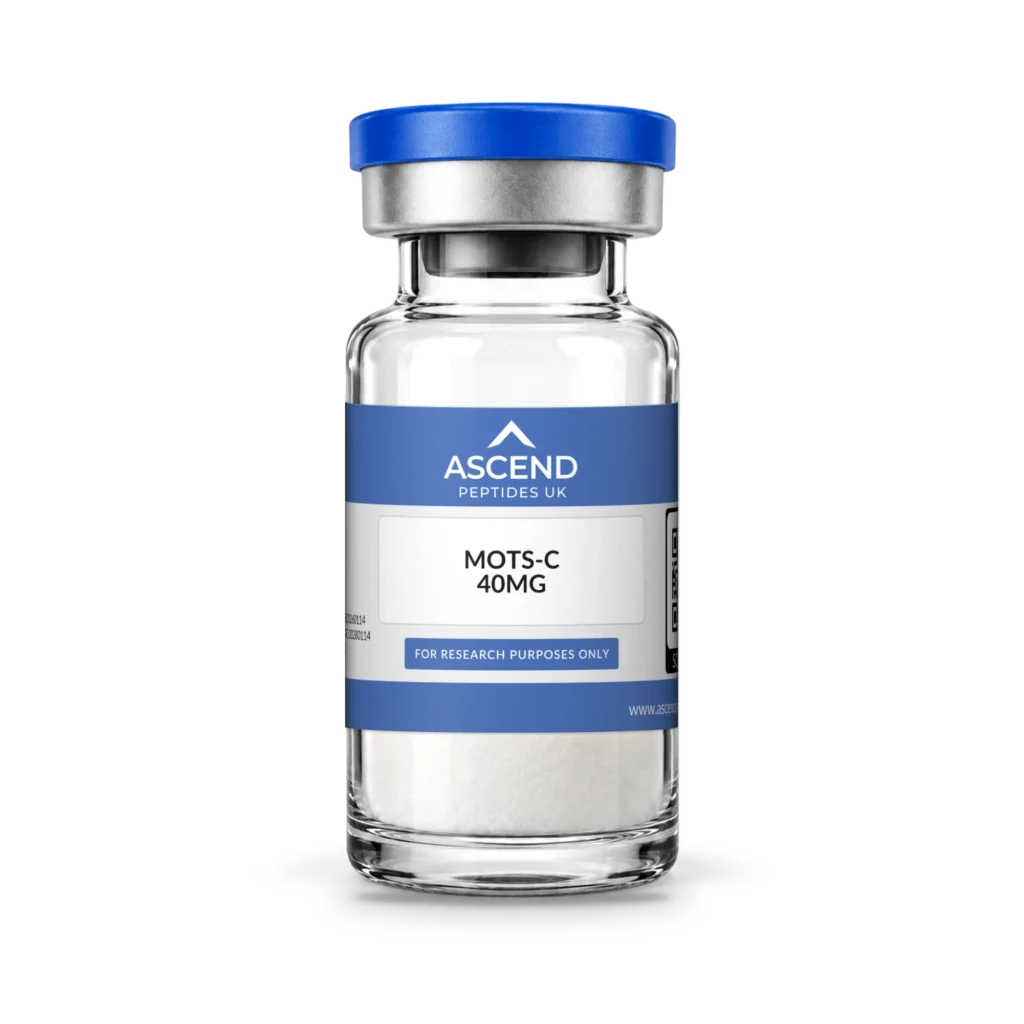
Research use only. MOTS-C products from Ascend Peptides UK are supplied strictly for in-vitro laboratory research. They are not for human consumption or for therapeutic, diagnostic or clinical use. This guide summarises published laboratory research; it is not medical advice.
MOTS-c is a 16-amino-acid peptide encoded in mitochondrial DNA, not in the cell nucleus. Its name stands for mitochondrial open reading frame of the 12S rRNA type-c: the short gene sequence that codes for it sits inside the mitochondrial 12S ribosomal RNA gene. It was first described in 2015 and has since been studied mainly in cultured cells and mice, as a signalling peptide linked to cellular energy metabolism (Lee et al., 2015).
This guide covers what MOTS-c is, how it is identified, what laboratory studies report, and where the evidence stops. Product details for the two Ascend vials are on the MOTS-C 10mg and MOTS-C 40mg pages.
MOTS-c at a Glance
| Property | Reference value |
|---|---|
| Name | MOTS-c (mitochondria-derived peptide MOTS-c) |
| Full name | Mitochondrial open reading frame of the 12S rRNA type-c |
| Origin | Short open reading frame within the mitochondrial 12S rRNA gene (MT-RNR1) |
| Length | 16 amino acids |
| Sequence | MRWQEMGYIFYPRKLR (Met-Arg-Trp-Gln-Glu-Met-Gly-Tyr-Ile-Phe-Tyr-Pro-Arg-Lys-Leu-Arg) |
| Molecular formula | C101H152N28O22S2 (free peptide) |
| Molecular weight | 2174.6 g/mol |
| CAS number | 1627580-64-6 |
| Identifiers | UNII A5CV6JFB78; PubChem CID 146675088; UniProt A0A0C5B5G6 |
These are reference values from PubChem, the NCATS Global Substance Registration System and UniProt. They describe the peptide itself. Research peptides are often supplied as salts (for example acetate or trifluoroacetate), which changes the weight of the material in a vial without changing the peptide sequence.
Where Does MOTS-c Come From?
Mitochondria carry their own small genome. Most of it codes for parts of the energy-producing machinery and for the RNA that mitochondria use to build proteins. Researchers looking for short, previously overlooked coding sequences in mitochondrial DNA identified MOTS-c in the gene for 12S rRNA, following the earlier discovery of humanin in a similar way (Lee et al., 2015). Peptides found like this are grouped as mitochondrial-derived peptides.
This origin is what sets MOTS-c apart from most peptides used in laboratory research, which are encoded in the nuclear genome. It is also why MOTS-c is studied as an example of mitochondria signalling to the rest of the cell, sometimes described as mitonuclear communication.
What Do Laboratory Studies Report?
Metabolic signalling in cells (2015). In cultured cells, MOTS-c inhibited the folate cycle and the de novo purine synthesis linked to it, which led to activation of AMPK, an enzyme that senses cellular energy status. In mice, skeletal muscle appeared to be its main target tissue, and MOTS-c treatment prevented diet-induced obesity and insulin resistance in the conditions tested (Lee et al., 2015).
Movement to the nucleus (2018). Under metabolic stress such as glucose restriction, MOTS-c was reported to move into the nucleus in an AMPK-dependent way and to regulate a broad set of nuclear genes, including genes with antioxidant response elements. It interacted with stress-responsive transcription factors such as NRF2 (Kim et al., 2018).
Physical capacity in mice (2021). MOTS-c treatment improved physical performance in young, middle-aged and old mice. The same study found that exercise raised endogenous MOTS-c levels in human skeletal muscle and blood; it did not give MOTS-c to people (Reynolds et al., 2021).
Taken together, these studies describe MOTS-c as a peptide that responds to metabolic stress and influences energy-related signalling in cell and animal models. They are an active research area, not settled biology: mechanisms reported in one model have not all been confirmed independently or in humans.
What Is Not Known
Human evidence on MOTS-c is limited and mostly observational. Studies have measured the body’s own MOTS-c levels, for example in blood before and after an exercise programme (Dieli-Conwright et al., 2021), rather than testing MOTS-c as a treatment. MOTS-c is not an approved medicine in the UK or elsewhere, and results in cells or mice should not be read as effects in people.
MOTS-c has also been named on the World Anti-Doping Agency Prohibited List, in section S4 (hormone and metabolic modulators), since 2024 (USADA, 2023).
Reference Chemistry and Batch Testing
The sequence, formula and identifiers above are published reference data for MOTS-c. They are not test results for any particular vial. What a specific vial contains is shown only by testing that vial or its batch.
For Ascend’s MOTS-C, one certificate has been published so far. Janoshik test #125392 analysed one vial labelled MOTS-C 40mg from batch 20260114 (analysis dated 7 April 2026) and reported a purity of 99.391% and a measured MOTS-c content of 43.66 mg. Purity is the share of detected material that is MOTS-c; content is the amount measured in the vial. The report applies to that vial; it does not verify 10mg vials or other batches, it does not state the analytical method used, and it lists no separate mass-spectrometry identity test. Certificates are listed on the CoA page.
Manufacturer information still being confirmed: storage conditions, the salt form supplied, and what the batch reference identifies and whether it matches current stock. Each product page states the current position.
Scientific references
- Lee C, Zeng J, Drew BG, Sallam T, Martin-Montalvo A, Wan J, Kim SJ, Mehta H, Hevener AL, de Cabo R, Cohen P. (2015). The mitochondrial-derived peptide MOTS-c promotes metabolic homeostasis and reduces obesity and insulin resistance. Cell Metab. 21(3):443–454.
- Kim KH, Son JM, Benayoun BA, Lee C. (2018). The Mitochondrial-Encoded Peptide MOTS-c Translocates to the Nucleus to Regulate Nuclear Gene Expression in Response to Metabolic Stress. Cell Metab. 28(3):516–524.e7.
- Reynolds JC, Lai RW, Woodhead JST, et al. (2021). MOTS-c is an exercise-induced mitochondrial-encoded regulator of age-dependent physical decline and muscle homeostasis. Nat Commun. 12(1):470.
- Dieli-Conwright CM, Sami N, Norris MK, et al. (2021). Effect of aerobic and resistance exercise on the mitochondrial peptide MOTS-c in Hispanic and Non-Hispanic White breast cancer survivors. Sci Rep. 11(1):16916.
- PubChem. MOTS-c, CID 146675088. National Library of Medicine.
- NCATS Global Substance Registration System. Mitochondria-derived peptide MOTS-c, UNII A5CV6JFB78.
- UniProt. A0A0C5B5G6: Mitochondrial-derived peptide MOTS-c (human).
- USADA. (2023). Explanation of key changes on the 2024 WADA Prohibited List.
DISCLAIMER
All products supplied by Ascend Peptides UK are intended strictly for in-vitro laboratory research. They are not intended for human consumption or for any therapeutic, diagnostic or clinical use, and are not MHRA-licensed medicines. Buyers are responsible for ensuring their purchase and use comply with applicable laws and regulations.