
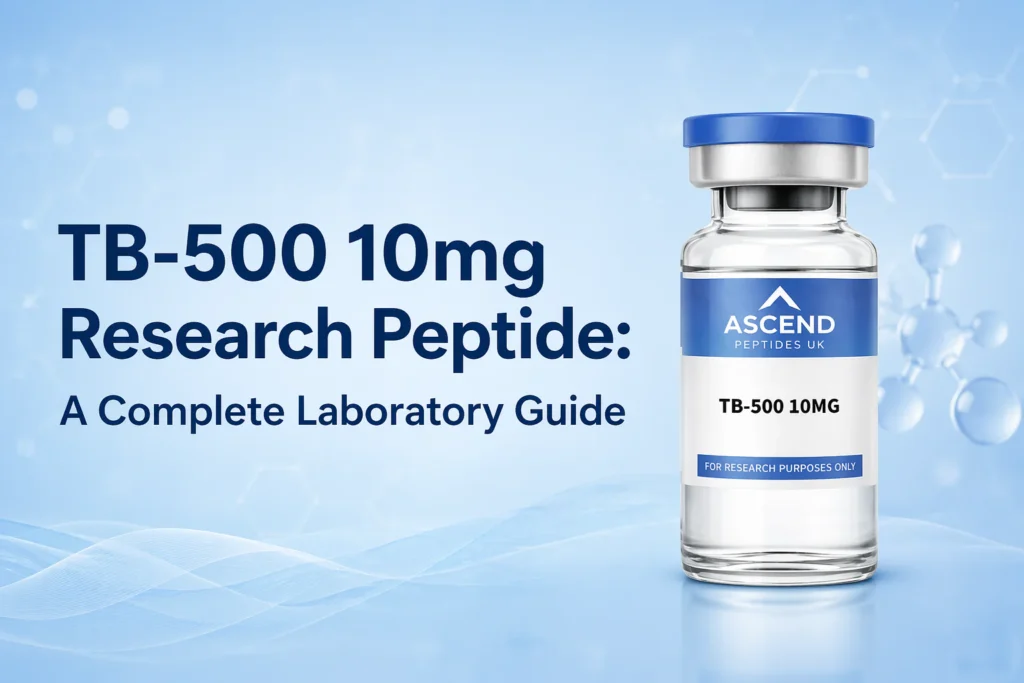
TB-500 10mg is a synthetic research peptide derived from Thymosin Beta-4 (Tβ4), a naturally occurring protein involved in cellular structure, actin regulation, and intracellular organisation. Within controlled laboratory environments, this compound has become an important subject of investigation due to its interaction with cytoskeletal dynamics, cellular migration pathways, and structural signalling mechanisms.
For laboratories, research institutions, and scientifically engaged buyers laboratory researchers, academic institutions, and scientific professionals In the United Kingdom, TB-500 10mg provides a practical and scalable format for structured experimental work. Its targeted design allows researchers to isolate specific biological processes in experimental models to explore specific biological processes related to cytoskeletal dynamics, making it a valuable tool in both foundational and advanced peptide research programmes.
This guide explores TB-500 10mg in detail, covering its molecular structure, mechanism of action, laboratory applications, and sourcing considerations while maintaining strict compliance with UK research standards.
Scientific Background: The Role of Thymosin Beta-4
To understand the relevance of TB-500, it is essential to begin with its biological foundation, Thymosin Beta-4 (Tβ4). This naturally occurring peptide is widely distributed across human tissues and is known for its role in regulating actin, a protein that forms the structural framework of cells.
Actin is responsible for maintaining cell shape, enabling movement, and supporting intracellular transport. It exists in two forms:
-
G-actin (globular form)
-
F-actin (filamentous form)
The transition between these forms is a dynamic process that determines how cells behave under different conditions. Thymosin Beta-4 regulates this process by binding to actin monomers and controlling their availability for polymerisation.
TB-500 is a synthetic peptide designed to replicate functional aspects of Thymosin Beta-4 Tβ4 (parent molecule), a naturally occurring actin-binding protein, allowing researchers to focus specifically on the region responsible for actin interaction. This targeted approach simplifies experimental models and improves consistency across studies.
Structural Identity and Functional Properties
TB-500 is a short-chain peptide engineered to replicate the biologically active region of Thymosin Beta-4. Its structure is intentionally simplified, making it easier to handle and integrate into laboratory experiments.
Unlike full-length proteins, which may introduce additional variables, TB-500 provides a more controlled way to study actin-related processes. It is typically supplied as a lyophilised (freeze-dried) powder, which helps maintain stability during storage and transport.
Core structural advantages:
-
Focused amino acid sequence targeting actin interaction
-
High solubility in standard laboratory solvents
-
Stability in lyophilised form
-
Compatibility with multiple experimental models
-
Scalable 10mg format for extended research use
These properties make TB-500 particularly suitable for reproducible and controlled research environments.
TB-500 in the Broader Peptide Landscape
In peptide research, each compound is typically associated with a specific biological pathway. TB-500 stands out because it operates at the intracellular structural level, rather than through receptor-mediated signalling.
For example, peptides discussed in the Without DAC research guide are primarily involved in growth hormone signalling pathways. These compounds interact with receptors and influence endocrine responses in laboratory models.
Similarly, compounds covered in the research peptide guide operate within growth factor pathways, focusing on receptor activation and downstream signalling cascades.
TB-500 differs by working directly within the cell, influencing structural proteins such as actin. Because of this, it is often used in combination with other peptides to explore how structural and signalling systems interact.
Key distinctions:
-
TB-500 → Cytoskeletal and structural focus
-
GHRH analogues → Hormone signalling pathways
-
Growth factors → Receptor-driven pathways
This positioning makes TB-500 a complementary tool in multi-pathway research programmes.

Research Use Only: TB-500 is a research-use compound. Research is ongoing, and no medical, therapeutic, or performance claims are intended. This is a schematic illustration only and not proof of mechanism, safety, or clinical use.
Mechanism of Action: A Closer Look
The mechanism of TB-500 is centred on its interaction with actin and its ability to influence cytoskeletal organisation. This process plays a fundamental role in determining how cells behave in controlled laboratory models.
Step-by-step mechanism:
Research Applications of TB-500 10mg
TB-500 10mg has been explored across multiple areas of laboratory research due to its targeted mechanism and versatility.
Primary research applications:
Cytoskeletal studies
Researchers use TB-500 to examine how actin filaments form and reorganise under different conditions.
Cellular migration models
It is widely used in experiments analysing how cells move and respond to environmental changes.
Angiogenic pathway research
TB-500 is included in studies focused on endothelial cell behaviour and vascular signalling mechanisms.
Multi-peptide interaction studies
In advanced research programmes, TB-500 is combined with other peptides to explore pathway interactions.
Gene expression analysis
Some studies investigate how TB-500 influences transcription pathways related to structural proteins.
These applications demonstrate the compound’s relevance across a broad range of research disciplines.
Why the 10mg Format Matters
The 10mg format of TB-500 is widely used because it provides both flexibility and consistency in laboratory settings. Researchers conducting multi-phase experiments require sufficient material to maintain uniform conditions across trials.
Benefits of the 10mg format:
-
Supports extended research protocols
-
Enables comparative and multi-variable studies
-
Reduces variability between batches
-
Aligns with commonly used research quantities
-
Improves efficiency in long-term projects
For laboratories in the UK, sourcing TB-500 10mg from a reliable supplier such as Ascend Peptides UK helps ensure consistency and quality across experiments.
Sourcing TB-500 10mg in the United Kingdom
Sourcing high-quality research peptides is essential for ensuring reliable and reproducible results. In the UK, researchers prioritise suppliers that meet strict quality standards and provide full transparency.
When reviewing the TB-500 product, researchers can assess specifications, batch information, and availability within a research-focused framework. This level of transparency is critical for maintaining experimental integrity.
Many laboratories also explore additional compounds when designing research protocols. The collection provides access to a wide range of peptides used in multi-pathway studies. For a broader understanding of available products and sourcing standards, visiting Ascend Peptides UK offers a complete overview of the platform and its research-driven approach.
Ascend Peptides UK provides peptides with full analytical documentation, supporting researchers who require consistent quality and traceability.
Key quality indicators:
-
HPLC purity ≥98%
-
LC-MS verification
-
Batch-specific Certificate of Analysis
-
Lyophilised format
-
Clear research-use-only labelling

Reconstitution and Storage Guidelines
TB-500 10mg is supplied as a lyophilised powder and must be reconstituted before use in laboratory assays. Proper handling is essential to preserve peptide stability.
Common solvents:
-
Sterile bacteriostatic water
-
Sterile saline
-
Phosphate-buffered saline (PBS)
Best practices:
-
Add solvent slowly to the vial
-
Gently swirl, avoid shaking
-
Aliquot into smaller volumes after mixing
-
Store at -20°C
-
Avoid repeated freeze-thaw cycles
These practices help maintain the structural integrity of the peptide and ensure consistent experimental results.
Regulatory Compliance and Responsible Research
In the United Kingdom, TB-500 10mg is classified as a research chemical. It is not approved for human consumption and must only be used within laboratory environments.
Both institutional buyers and individual researchers are responsible for ensuring compliance with UK regulations. Suppliers such as Ascend Peptides UK clearly label their products for research use only, supporting responsible sourcing and usage.
Conclusion
TB-500 10mg remains a valuable tool in peptide laboratory research to investigate actin‑related cytoskeletal dynamics. Its compatibility with multi-pathway studies makes it particularly useful for researchers exploring complex biological systems.
For UK-based laboratories and research-focused buyers, sourcing high-quality TB-500 from a trusted provider such as Ascend Peptides UK ensures consistency, transparency, and reliability in experimental work.
Frequently Asked Questions (FAQs)
What is TB-500 10mg used for in research?
What is TB-500 derived from?
How is TB-500 different from other peptides?
Why is the 10mg format commonly used?
Is TB-500 legal in the UK?
What purity level is required?
How should TB-500 be stored?
Can TB-500 be used in multi-peptide studies?
Where can TB-500 10mg be sourced in the UK?
What format is TB-500 supplied in?
DISCLAIMER
All products supplied by Ascend Peptides UK are intended strictly for research purposes only. They are not intended for human consumption or for any therapeutic, diagnostic, or clinical use. None of the items offered are classified as medicinal products by the MHRA. It is the buyer’s responsibility to ensure all purchases comply with applicable laws and regulations. Ascend Peptides UK accepts no liability for misuse.