
📥 FREE DOWNLOAD
For research professionals only — instant download, no payment required
Understanding HPLC Testing for Research Peptides — Complete Quality-Method Guide
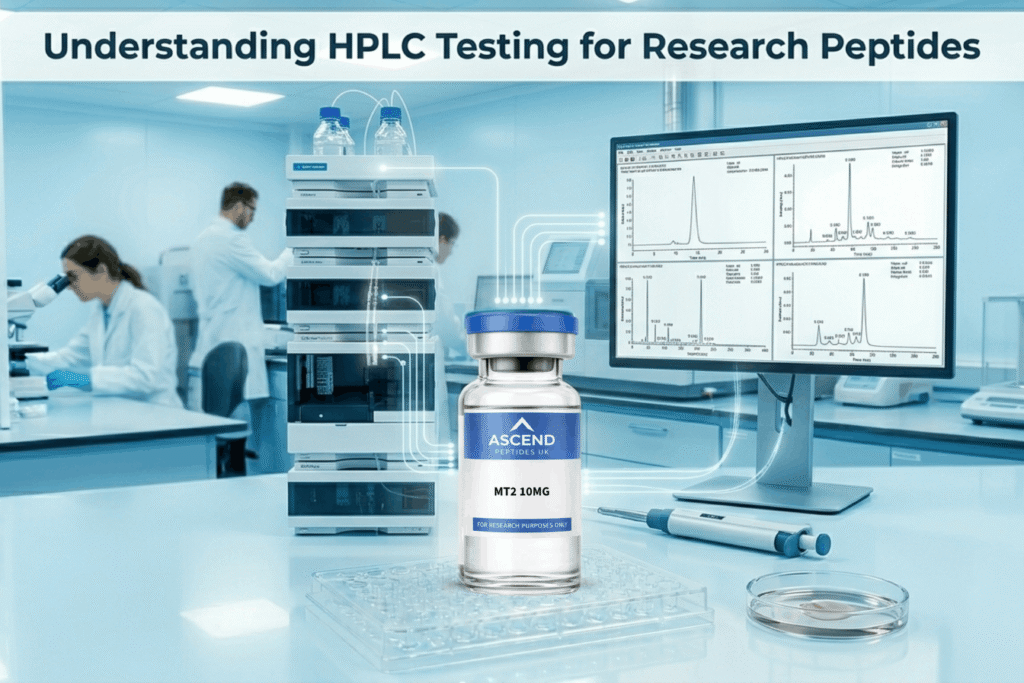
HPLC testing for peptides, which UK research suppliers should perform, is one of the core analytical methods used to assess research-grade peptide quality and purity. HPLC High Performance Liquid Chromatography is a laboratory technique that measures the purity of a synthetic peptide by separating the target compound from synthesis-related impurities.
The result, reported as the percentage of the chromatogram represented by the dominant compound peak, is a core component of peptide purity assessment. This guide sets out exactly how HPLC works, what the result means, and how to read an HPLC chromatogram on the Janoshik Certificate of Analysis that accompanies every Ascend Peptides UK research peptide.
For UK researchers evaluating peptide suppliers, understanding HPLC methodology is the bridge between marketing language (“tested products”) and verifiable quality. A supplier claiming “HPLC tested” without explaining the analytical method, the result, or how to interpret it is making a marketing statement, not documenting a verification result.
This page sets out the technical foundation so the buyer can evaluate any supplier’s HPLC claims against a real understanding of what the method actually measures. The companion batch verification page shows what every Janoshik CoA documents; this page explains the analytical method behind the result.
📥 FREE DOWNLOAD
For research professionals only — instant download, no payment required
What Is HPLC and Why Is It Used for Research Peptides?
HPLC (High Performance Liquid Chromatography, sometimes called High Pressure Liquid Chromatography) is an analytical separation technique used to separate, identify, and quantify the components of a mixture.
In research peptide analysis, HPLC is used specifically to verify the purity of a synthetic peptide to confirm what percentage of the supplied product is the target compound versus what percentage is made up of synthesis-related impurities.
The technique works on a simple principle: different compounds in a mixture interact with a stationary phase (typically a packed chromatography column) and a mobile phase (a liquid solvent system) at different rates. Compounds that interact more strongly with the stationary phase move through the column more slowly.
Compounds that interact less strongly move through more quickly. By measuring the time each compound takes to traverse the column (the “retention time”) and detecting the compounds as they elute from the column outlet, HPLC produces a chromatogram, a graphical record showing each compound as a peak at its characteristic retention time.
For research peptides specifically, HPLC is the analytical method of choice for three reasons: it can separate the target peptide from structurally similar synthesis impurities (truncated sequences, deletion products, modified sidechain compounds); it is quantitatively reproducible across different testing laboratories; and it produces a documented chromatogram that can be included on a Certificate of Analysis for independent review.
Every Ascend Peptides UK research peptide is HPLC-tested by Janoshik laboratory before release. See the how we test peptides page for the complete quality control framework.
How HPLC Works — The 5-Step Analytical Process
HPLC analysis follows the same 5-step process across every laboratory testing research peptides. Understanding the process is the foundation for understanding what the result actually means — and for evaluating whether a supplier’s HPLC claim is genuine or marketing language. The complete 5-step analytical sequence is set out below.
STEP 1
Sample Preparation
A small quantity of the research peptide is dissolved in a defined solvent (typically water or a water/acetonitrile mixture) at a known concentration. The prepared sample must be sufficiently dilute to avoid column overloading but sufficiently concentrated for accurate detection. This step is the analytical starting point; sample preparation errors invalidate the entire downstream result.
STEP 2
Sample Injection
A precise volume of the prepared sample (typically 10–50 microlitres) is injected into the HPLC system through an injection valve. The injection volume is documented in the analytical method on the Certificate of Analysis. Different injection volumes can affect peak area integration, so consistency between batches enables like-for-like comparison.
STEP 3
Chromatographic Separation
The injected sample enters the chromatography column, where it is pushed through by a high-pressure mobile phase pump. For research peptides, reversed-phase HPLC is the standard technique — the stationary phase is a non-polar material (typically C18-bonded silica) and the mobile phase is a gradient transitioning from polar (water with 0.1% trifluoroacetic acid) to less polar (acetonitrile with 0.1% trifluoroacetic acid) over the analytical run. Peptides interact with the stationary phase based on their hydrophobicity, eluting at different retention times.
STEP 4
Detection
As compounds elute from the column outlet, they pass through a UV detector measuring absorbance at 214 nm or 220 nm, the wavelengths at which peptide bonds absorb UV light. Each compound is detected as a peak at its characteristic retention time. The detector output is recorded by the HPLC software, generating the chromatogram a graphical plot of detector signal (y-axis) against retention time (x-axis).
STEP 5
Peak Integration
The HPLC software integrates the area under each peak in the chromatogram. The target peptide peak is identified by its expected retention time. The integrated area under the target peptide peak, expressed as a percentage of the total integrated area across all peaks in the chromatogram, is the HPLC purity figure. For research-grade peptides, this percentage must be ≥98%. The figure is the result that appears on the Certificate of Analysis.
What ≥98% HPLC Purity Actually Means
The ≥98% HPLC purity figure is the result that appears on every Janoshik Certificate of Analysis. The figure is straightforward to read but easy to misinterpret. Three operational meanings of the result are worth setting out explicitly:
- What ≥98% MEANS: the dominant chromatographic peak accounts for at least 98% of the integrated HPLC peak area under the analytical conditions used. The integrated area under the target peptide peak in the HPLC chromatogram accounts for 98% or more of the total integrated chromatogram area.
- What ≥98% DOES NOT MEAN: the supplied product is ≥98% the target peptide. HPLC confirms purity (the supplied product is one compound at ≥98%) but does NOT confirm identity (that the one compound is specifically the target peptide). Identity confirmation requires LC-MS, which is the analytical method covered in the companion guide page.
- What ≤2% REPRESENTS: synthesis-related impurities accounting for the remaining ≤2% of the chromatogram area. These include truncated peptides (peptides missing one or more amino acids), deletion products (peptides with missed amino acid additions during synthesis), modified sidechain compounds (peptides with unintended modifications), and residual reagents from the synthesis process.
The ≥98% threshold is the industry standard for research-grade peptides because below this threshold, synthesis-related impurities may increase the risk of affecting sensitive in-vitro research results, depending on the assay design and impurity profile, particularly in receptor binding assays and signalling cascade research, where test compound concentration is a controlled variable. The complete research-grade framework, including the role of ≥98% HPLC purity as one of six standards, is set out on the research-grade standards page.
How to Read an HPLC Chromatogram on a Janoshik CoA
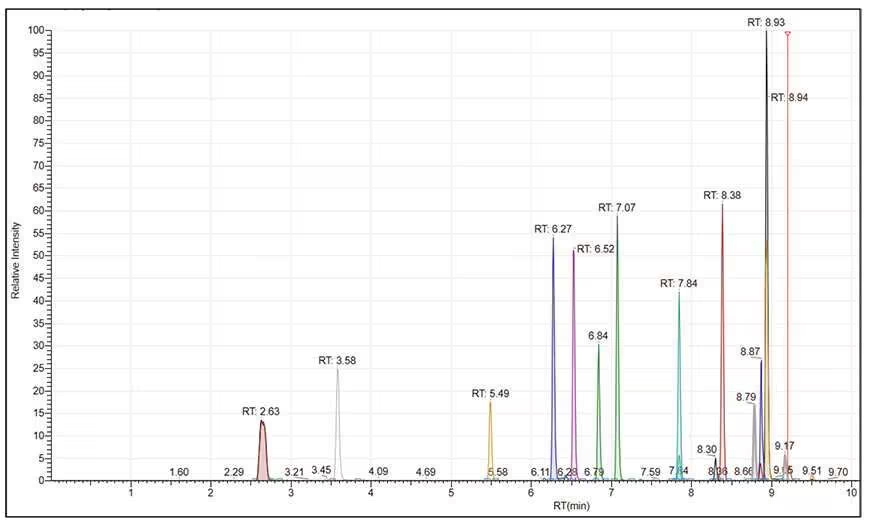
Every Janoshik Certificate of Analysis includes an HPLC chromatogram alongside the reported purity figure. Reading the chromatogram is straightforward once you understand what each visual element represents. Four elements appear on every HPLC chromatogram and together document the purity verification result:
|
Chromatogram Element |
What It Shows |
What to Check |
|---|---|---|
|
Target peptide peak |
The dominant peak at the expected retention time |
Single, well-defined peak (not split or shouldered) |
|
Retention time (x-axis) |
Time in minutes from injection to elution |
Target peak at a consistent retention time across batches |
|
Detector signal (y-axis) |
UV absorbance at 214 nm or 220 nm |
The target peak signal is substantially higher than the baseline |
|
Impurity peaks |
Smaller peaks at different retention times |
Total integrated area ≤2% of total chromatogram area |
Visual Quality Indicators on a Good HPLC Chromatogram
-
For a single dominant peak, the target peptide should appear as one clean, symmetrical peak. Split peaks, shouldered peaks, or doublets indicate co-elution of two compounds or partial degradation.
-
Flat baseline before and after the target peak, the detector signal should return to baseline between peaks. A drifting or noisy baseline indicates analytical issues that may affect peak integration accuracy.
-
Impurity peaks at different retention times, small impurity peaks should appear at retention times different from the target peptide. Their presence is normal at ≤2% combined area; their absence is unusual and suggests either an exceptionally pure batch or an analytical method that is not resolving impurities adequately.
-
Clear peak labelling of the Janoshik chromatogram labels the target peptide peak and reports the integrated area percentage. The label is the bridge between the visual chromatogram and the numerical purity figure on the CoA.
Free Download — Batch Verification Checklist
The HPLC analytical method covered on this page is one component of the complete batch verification framework. The Batch Verification Checklist is a free downloadable PDF that converts the verification framework into a practical buyer checklist. Run any supplier’s Certificate of Analysis (including the HPLC chromatogram and purity figure) against the 9-point checklist before purchase. If any item is missing, the CoA is not a real batch verification.
📥 FREE DOWNLOAD
Batch Verification Checklist
A practical checklist for UK research buyers. Run any peptide supplier’s Certificate of Analysis against this 9-point checklist before purchase. The same framework that Ascend Peptides UK applies to its own batch verification.
Inside the checklist:
✓ Product name verification — confirm test was performed on the correct compound
✓ Batch / lot number check — must name the specific vial lot
✓ Date of testing — must be recent and apply to current stock
✓ HPLC purity result — must state ≥98% and the analytical method
✓ LC-MS molecular identity — must confirm molecular weight match
✓ Laboratory issuing CoA — must be an independent third-party testing lab
✓ Method transparency — analytical method documented and reproducible
✓ CoA authentication — reference, signature, or verifiable identifier
✓ Pre-purchase availability — CoA must be accessible BEFORE the order is placed
For research professionals only — instant download, no payment required
HPLC Limitations — What HPLC Cannot Confirm
HPLC is a powerful analytical method, but it has specific limitations that are important for UK research buyers to understand. Recognising what HPLC does NOT confirm is as important as understanding what it does confirm because the limitations are exactly where alternative analytical methods (particularly LC-MS) are required to complete the verification picture.
Limitation 1 — HPLC Does Not Confirm Molecular Identity
HPLC confirms the purity of the supplied product is ≥98% one compound. It does not confirm what the one compound is. A different peptide of comparable hydrophobicity could pass an HPLC purity test if the analytical method does not specifically resolve the target compound from a substituted compound at the same retention time. This is the most important limitation: HPLC catches contamination and impurity, but does not catch identity substitution.
For heavily counterfeited research peptides, particularly BPC-157, TB-500, and the melanocortin compounds MT1 and MT2, identity substitution is the principal counterfeiting risk in the UK market. HPLC alone cannot detect it. LC-MS (Liquid Chromatography Mass Spectrometry) confirms molecular identity by measuring the molecular weight of the supplied compound and matching it to the expected molecular weight of the target peptide. Both HPLC and LC-MS together are required for complete batch verification.
Limitation 2 — HPLC Result Depends on Method Quality
Two HPLC analyses of the same sample, performed by different laboratories using different analytical methods, can produce different reported purity figures.
The differences arise from the choice of column (different C18 column manufacturers and lot variations), the choice of mobile phase gradient (different gradient profiles affect peak separation), the detection wavelength (214 nm vs 220 nm), and the peak integration parameters.
A reported HPLC purity figure is meaningful only when the analytical method is documented, which is why method transparency is an essential property of a real Certificate of Analysis.
Limitation 3 — HPLC Does Not Catch Trace Contamination
HPLC detects compounds at concentrations above the analytical method detection limit, typically around 0.1% of the total sample. Compounds present at lower concentrations may not appear as detectable peaks on the chromatogram.
This is generally not a concern for research-grade purity verification at the ≥98% threshold, but it does mean that “no detectable impurities” on an HPLC chromatogram is not equivalent to “absolutely pure.” A ≥98% purity figure documents what HPLC measured; it does not preclude the existence of trace components below the detection limit.
HPLC Standards in UK Research Peptide Supply
Three operational standards apply to HPLC testing in UK research-grade peptide supply, beyond the basic ≥98% purity threshold. UK research buyers should expect each standard from any supplier claiming HPLC verification and reject suppliers whose HPLC claims fail to meet the documented standards.
|
HPLC Standard |
Industry Norm |
Research-Grade Standard |
|---|---|---|
|
Purity threshold |
Variable or unstated |
≥98% on every batch |
|
Testing party |
Supplier in-house or manufacturer |
Independent third-party laboratory (e.g. Janoshik) |
|
Per-batch testing |
Generic CoA across multiple batches |
Separate HPLC analysis on every manufacturing batch |
|
Analytical method documentation |
Methods not provided |
Column, gradient, detection wavelength, retention time documented on CoA |
|
Chromatogram included on CoA |
Often absent |
Full HPLC chromatogram included for visual verification |
|
Pre-purchase CoA availability |
Sent after order if at all |
Publicly accessible BEFORE the order is placed |
Every research peptide supplied by Ascend Peptides UK meets the right-hand column standard on every HPLC variable.
The HPLC analytical method is independently performed by Janoshik laboratory, the analytical method is documented on the Certificate of Analysis, the chromatogram is included with the report, and the complete CoA is publicly accessible from the Certificates of Analysis page before the order is placed.
Understanding HPLC Testing — Frequently Asked Questions
What is HPLC in simple terms?
HPLC (High Performance Liquid Chromatography) is a laboratory technique that separates the different compounds in a mixture and measures how much of each compound is present. For research peptides, HPLC is used to verify purity to confirm what percentage of the supplied product is the target peptide compound versus what percentage is synthesis-related impurities.
How does HPLC work for peptide testing?
HPLC works by passing a sample through a chromatography column under high pressure. Different compounds in the sample interact with the column packing material at different rates, causing them to separate. As each compound exits the column, it is detected by a UV detector. The output is a chromatogram showing each compound as a peak. The integrated area under the target peptide peak, as a percentage of total chromatogram area, is the HPLC purity figure.
What does ≥98% HPLC purity mean?
≥98% HPLC purity means that 98% or more of the supplied product is one compound, as measured by HPLC analysis. For research-grade peptides, this is the industry standard threshold. Below 98%, synthesis-related impurities reach concentrations that can confound in-vitro research results.
Does HPLC confirm what the peptide actually is?
No. HPLC confirms purity (≥98% one compound) but does NOT confirm identity (that the one compound is specifically the target peptide). Identity confirmation requires LC-MS (Liquid Chromatography Mass Spectrometry), which measures molecular weight and matches it to the expected target. Both HPLC and LC-MS together are required for complete batch verification. See the ” How we test peptides page for the complete framework.
What does a good HPLC chromatogram look like?
A good HPLC chromatogram for a research-grade peptide shows one dominant peak at the expected retention time (the target peptide), a flat baseline before and after the target peak, and small impurity peaks at different retention times accounting for ≤2% combined area. The chromatogram should be clearly labelled with the target peptide identified and the integrated area percentage reported.
Why is reversed-phase HPLC used for peptides specifically?
Reversed-phase HPLC is the standard technique for peptide purity analysis because the C18 stationary phase resolves peptides based on hydrophobicity, a property that varies substantially between the target peptide and its synthesis-related impurities. The trifluoroacetic acid in the mobile phase improves peak shape and reproducibility. Reversed-phase HPLC is the most commonly used method for routine research peptide purity analysis, while other chromatographic techniques may also be used in specialised applications.
Can I verify a supplier’s HPLC results independently?
Yes. A supplier providing genuine HPLC verification should document the analytical method on the Certificate of Analysis — including column type, mobile phase gradient, detection wavelength, and retention time. With method documentation, the analysis can be reproduced by an independent laboratory using the same conditions. The Janoshik Certificate of Analysis includes complete method documentation enabling independent verification. See the batch verification page for the 8 CoA documentation fields, including analytical method.
What is the difference between HPLC and LC-MS?
HPLC measures the purity, the percentage of the supplied product that is one compound. LC-MS confirms the identity the molecular weight of the compound matches the expected target peptide. HPLC uses a UV detector measuring absorbance at 214/220 nm; LC-MS uses a mass spectrometer measuring molecular weight directly. Both methods are required for complete research peptide verification: HPLC for purity, LC-MS for identity. Each catches what the other cannot.
Apply HPLC Understanding to Your Supplier Evaluation
The HPLC analytical method covered on this page is one component of the complete UK research-grade quality framework. To apply your understanding to actual supplier evaluation, review the companion batch verification page for the 8 CoA documentation fields every research-grade supplier should provide, the how we test peptides page for the 4 QC pillars Ascend Peptides UK applies to every batch, and the research grade standards page for the 6 UK research-grade standards. Every research peptide in the Ascend Peptides UK shop collection is HPLC-verified at ≥98% purity by Janoshik laboratory, with the chromatogram documented on the publicly accessible CoA archive.
RESEARCH USE ONLY
All products supplied by Ascend Peptides UK are intended strictly for in-vitro laboratory research purposes only. Compounds are not licensed as medicinal products under the UK Human Medicines Regulations 2012 and are not for human or veterinary use. Products are supplied to qualified research professionals only.
📥 FREE DOWNLOAD
For research professionals only — instant download, no payment required