
How to mix research peptides UK for laboratory use involves reconstituting a lyophilised peptide with an appropriate laboratory solvent under controlled conditions. The correct solvent, volume, handling technique and storage requirements depend on the specific compound and the intended experiment. This guide explains the general principles of research-peptide reconstitution for in-vitro laboratory work only and is not intended for human administration, therapeutic use or medical advice.
Reconstitution is one of the most important practical steps in any research peptide protocol, and it is one of the steps most likely to be performed incorrectly by researchers new to working with lyophilised compounds. Mixing a research peptide is not simply a matter of adding water to a vial and shaking it until it dissolves. The specific solvent you choose, the volume you add, the technique you use to introduce the solvent, the temperature at which you store the result, and how you aliquot and handle the reconstituted solution all directly affect the quality of the compound you will be using in your experiments.
This guide covers everything a UK researcher needs to know about how to mix research peptides correctly from solvent selection and concentration calculation through to aliquoting technique, storage, and the most common mistakes that degrade peptide integrity and compromise experimental reproducibility. All guidance relates to in-vitro laboratory research. All research peptides discussed are for laboratory research use only and are not intended for human consumption under any circumstances.
What Does Mixing a Research Peptide Mean?
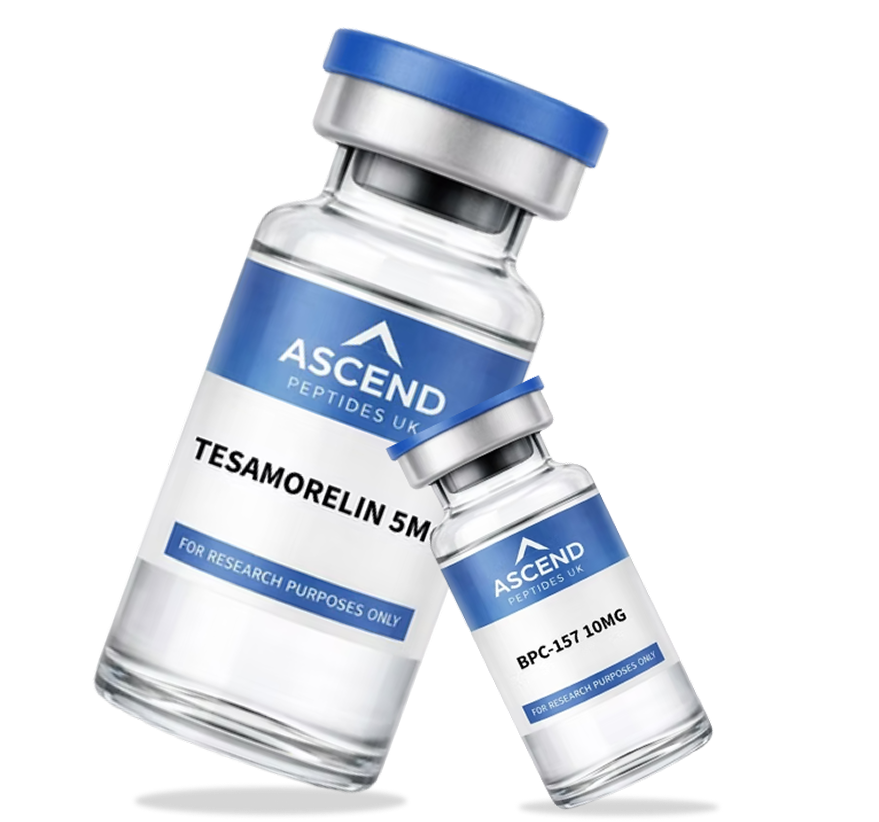
Research peptides from Ascend Peptides UK are supplied in lyophilised (freeze-dried) form — a white to off-white powder contained in a sealed vial. Lyophilisation removes water from the peptide solution under vacuum, producing a stable powder that maintains molecular integrity during storage and transit without the degradation risks associated with liquid formulations.
Official peptide-handling guidance from Thermo Fisher Scientific notes that solvent selection and storage requirements can vary between peptides and should be checked against product-specific documentation.
Before a lyophilised research peptide can be used in a laboratory assay, it must be reconstituted: dissolved in an appropriate liquid solvent to produce a solution at a defined concentration. This reconstitution step is what most researchers informally refer to as “mixing” a peptide. It is a critical step because it determines the concentration, purity, and structural integrity of the compound that will be used in your experiment. An incorrectly reconstituted peptide can produce unreliable assay results, introduce concentration errors, and damage the compound irreversibly.
The reconstitution process for research peptides involves three key decisions that must be made correctly before you open the vial: which solvent to use, how much solvent to add, and what technique to follow when introducing the solvent to the powder.
What You Need Before You Start — Equipment and Materials
Before reconstituting any research peptide, ensure you have all necessary equipment and materials prepared. Beginning the process without the correct materials risks contamination, concentration errors, and wasted compound.
Required materials for research peptide reconstitution:
- The lyophilised research peptide vial sealed, verified against the Janoshik Certificate of Analysis, stored at minus 20 degrees Celsius until needed
- The correct reconstitution solvent BP-grade bacteriostatic water for most research peptides, or 0.1% acetic acid for IGF-1 LR3 cell culture applications (see Section 3 for full solvent selection guidance)
- A sterile syringe appropriately sized for the volume of solvent you are adding
- Single-use aliquot containers sterile microcentrifuge tubes or equivalent, labelled in advance with compound name, batch number, date of reconstitution, and intended concentration
- A permanent marker for labelling
- Clean laboratory gloves wear throughout the entire procedure
- An aseptic work environment perform reconstitution in a laminar flow cabinet where available; at minimum, a clean, disinfected work surface away from air currents
Allow the lyophilised vial to equilibrate to room temperature before opening or introducing solvent. Adding cold solvent to a cold vial can affect dissolution and create condensation inside the vial. Do not apply heat to speed this process.
Which Solvent to Use — Bacteriostatic Water vs Acetic Acid vs Saline
Solvent selection is the first critical decision in research peptide reconstitution. The correct solvent depends on the specific compound and the experimental system you are working with. Using the wrong solvent can affect peptide solubility, alter the compound’s behaviour in your assay, and in some cases cause irreversible precipitation or degradation.
| Solvent | Best For | Advantages | Limitations |
|---|---|---|---|
| BP-grade bacteriostatic water (0.9% benzyl alcohol) | Most research peptides: TB-500, BPC-157, GHK-CU, ipamorelin, CJC-1295, sermorelin, tesamorelin, MT-1, MT-2, AOD-9604, MOTS-C | Multi-use stable — benzyl alcohol prevents bacterial growth across repeated accesses. Extended reconstituted stability. | Not suitable where benzyl alcohol may interfere with specific assay chemistry. Confirm compatibility with your cell line. |
| 0.1% acetic acid | IGF-1 LR3 1mg — particularly for cell culture applications. Some other growth factor peptides. | Lower pH aids dissolution of some peptides with limited aqueous solubility at neutral pH. Standard for IGF-1 research. | Single-use per preparation once diluted into culture medium. Not suitable for multi-access vial use. |
| Sterile saline (0.9% NaCl) | Some GHK-CU protocols. Assays requiring a physiologically neutral pH environment. | Physiologically compatible ionic strength. Suitable where benzyl alcohol may affect experimental system. | Single-use access only — no bacteriostatic preservative, contamination risk increases with repeated entry. |
| Sterile water for injection (no preservative) | Specific assay requirements where neither benzyl alcohol nor acetic acid are compatible. | Neutral pH and minimal additive profile. | Single-use only. No preservative — highest contamination risk. Not the standard choice for most research protocols. |
For the majority of UK research peptide protocols, BP-grade bacteriostatic water is the correct and most widely referenced reconstitution solvent. Ascend Peptides UK supplies BP-grade bacteriostatic water for research alongside all compound orders. It is included free with all orders over £75, allowing researchers to source both their research peptide and its reconstitution solvent from a single UK supplier with same-day dispatch. For a complete guide to bacteriostatic water — what it is, why the 0.9% benzyl alcohol matters, and when to use it — see the bacteriostatic water for research guide.
How Much Bacteriostatic Water to Add — Concentration Calculation
The volume of solvent you add to a lyophilised peptide determines the concentration of the reconstituted solution. Getting this calculation right is essential: adding too little solvent results in a highly concentrated solution where small volume measurement errors produce large concentration errors; adding too much produces a very dilute solution that may not be practical for your assay volumes.
The reconstitution concentration formula is:
Concentration (mcg/ml) = Peptide amount (mcg) divided by Solvent volume added (ml)
For example: a 10mg (10,000 mcg) vial reconstituted with 2ml of bacteriostatic water produces a concentration of 5,000 mcg/ml (5 mg/ml). Each 0.1ml drawn from that vial contains 500 mcg of compound.
The table below provides pre-calculated concentrations for the most common peptide amounts and solvent volumes. Use this as a reference when planning your reconstitution:
| Peptide Amount | Solvent Added | Resulting Concentration | Amount Per 0.1ml | Amount Per 0.5ml |
|---|---|---|---|---|
| 2mg (2,000mcg) | 1ml bacteriostatic water | 2,000mcg/ml (2mg/ml) | 200mcg | 1,000mcg |
| 2mg (2,000mcg) | 2ml bacteriostatic water | 1,000mcg/ml (1mg/ml) | 100mcg | 500mcg |
| 5mg (5,000mcg) | 1ml bacteriostatic water | 5,000mcg/ml (5mg/ml) | 500mcg | 2,500mcg |
| 5mg (5,000mcg) | 2ml bacteriostatic water | 2,500mcg/ml (2.5mg/ml) | 250mcg | 1,250mcg |
| 5mg (5,000mcg) | 5ml bacteriostatic water | 1,000mcg/ml (1mg/ml) | 100mcg | 500mcg |
| 10mg (10,000mcg) | 1ml bacteriostatic water | 10,000mcg/ml (10mg/ml) | 1,000mcg | 5,000mcg |
| 10mg (10,000mcg) | 2ml bacteriostatic water | 5,000mcg/ml (5mg/ml) | 500mcg | 2,500mcg |
| 10mg (10,000mcg) | 5ml bacteriostatic water | 2,000mcg/ml (2mg/ml) | 200mcg | 1,000mcg |
| 10mg (10,000mcg) | 10ml bacteriostatic water | 1,000mcg/ml (1mg/ml) | 100mcg | 500mcg |
When selecting your reconstitution volume, choose a volume that produces a concentration practical for your assay. For most in vitro cell-based assays, working concentrations are in the nanomolar to low micromolar range. Reconstituting to a high concentration stock and then diluting in culture medium or assay buffer is generally the most reliable approach, as it minimises the pipetting error associated with very small volumes of very dilute solutions.
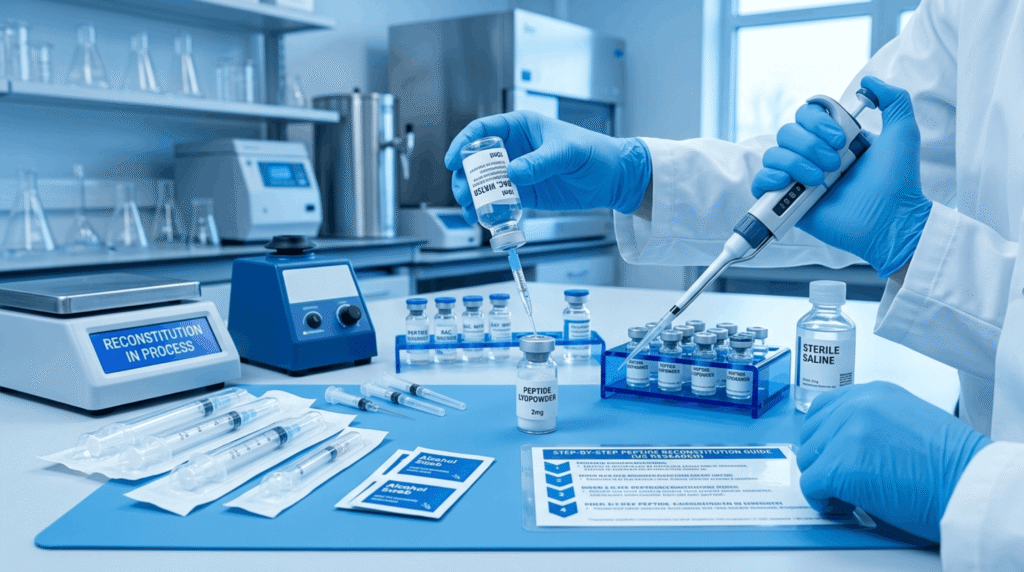
Step-by-Step Research Peptide Reconstitution Method
The following step-by-step protocol represents the correct reconstitution technique for lyophilised research peptides using BP-grade bacteriostatic water as the reconstitution solvent. This method applies to the full range of research peptides available from Ascend Peptides UK including TB-500, BPC-157, GHK-CU, ipamorelin, CJC-1295, tesamorelin, sermorelin, MT-1, MT-2, AOD-9604, and MOTS-C.
Allow the lyophilised vial to reach room temperature. Remove from minus 20 degrees Celsius storage and allow to sit at room temperature for 5 to 10 minutes before beginning. Do not apply heat.
Prepare your aliquot containers in advance. Label each sterile microcentrifuge tube or vial with: compound name, batch number from the Certificate of Analysis, date of reconstitution, volume per aliquot, and resulting concentration. Having containers labelled before you open the peptide vial minimises handling time and contamination risk.
Draw the calculated volume of bacteriostatic water into a sterile syringe. Confirm the volume is exactly correct before proceeding.
Insert the syringe needle through the rubber stopper of the peptide vial at a slight angle, pointing the tip toward the inner wall of the glass vial rather than directly at the powder.
Introduce the bacteriostatic water slowly, allowing it to run down the inner glass wall of the vial. Do not inject directly onto the lyophilised powder. The solvent should reach the powder gently by flowing down the wall. If adding a large volume, introduce it in two or three stages with a brief pause between each addition.
Remove the syringe. Do not replace the stopper with a second needle or introduce air pressure into the vial.
Gently swirl the vial in a slow circular motion. The lyophilised powder should begin to dissolve within 30 seconds to 2 minutes for most research peptides. Do not shake, invert vigorously, or vortex the vial at any point during this process.
If dissolution is incomplete after 2 to 3 minutes of gentle swirling, allow the vial to sit undisturbed at room temperature for a further 5 minutes before swirling again. Do not apply heat. Most peptides will dissolve completely within 5 to 10 minutes using this method.
Inspect the solution visually. It should be clear to slightly opalescent. Visible particles, cloudiness, or precipitate that does not dissolve with further gentle swirling may indicate a solubility issue with the chosen solvent, reconstitution at too high a concentration, or a problem with the compound. Do not proceed with a visibly particulate solution.
Aliquot immediately. Draw the reconstituted solution into the syringe and distribute into your pre-labelled aliquot containers in the planned volumes. Work quickly but carefully. Do not allow the reconstituted solution to remain in the vial for longer than necessary before aliquoting.
Store aliquots at minus 20 degrees Celsius immediately. Do not leave at room temperature after aliquoting is complete.
Why You Must Never Vortex or Shake a Research Peptide
The instruction to avoid vortexing and shaking is one of the most important and most frequently ignored recommendations in research peptide handling. Understanding why it matters mechanistically will help you take it seriously in practice.
Peptides are structurally fragile molecules. Their biological activity depends on their three-dimensional conformation — the specific folded shape that allows them to interact with their target receptor, enzyme, or binding partner. Mechanical disruption of the solution through vortexing or vigorous shaking creates two problems that permanently degrade peptide quality.
The first is shear stress. Vortexing creates high-velocity fluid motion that generates significant mechanical forces at the molecular level. These shear forces can exceed the energy of the non-covalent interactions that maintain peptide conformation, causing the peptide to unfold or misfold into a structurally different arrangement that may not bind its intended target with the same affinity or at all.
The second is air-liquid interface exposure. Vortexing and shaking creates foam millions of tiny air bubbles — and peptides are surface-active molecules that preferentially adsorb to the air-liquid interface of each bubble. At the interface, peptides can undergo conformational changes, aggregate with neighbouring molecules, or form insoluble fibrils. This aggregation is frequently irreversible and reduces the effective concentration of your solution in ways that are not visible to the naked eye.
Gentle swirling moves the solution without creating shear stress or foam. It is the only appropriate mixing technique for research peptide reconstitution.
Aliquoting After Reconstitution — The Only Correct Approach
Aliquoting dividing the reconstituted solution into small, single-use volumes is not optional. It is an essential step in research peptide reconstitution that directly protects the integrity of your compound and the reproducibility of your research data.
The reason aliquoting is necessary is freeze-thaw degradation. If you reconstitute a peptide and store the entire reconstituted vial at minus 20 degrees Celsius, every time you withdraw a sample for use you must thaw the vial, remove what you need, and refreeze the remainder. Each freeze-thaw cycle exposes the peptide solution to the mechanical stress of ice crystal formation and the chemical stress of concentration changes at the freezing front. Multiple freeze-thaw cycles progressively denature the peptide, reduce purity, and introduce batch inconsistency between experiments run at different times from the same stock.
Single-use aliquots solve this problem entirely. Each aliquot is thawed once, used completely, and discarded. The remaining aliquots stay at minus 20 degrees Celsius undisturbed until needed. This ensures that the compound condition is identical across all time points in your experimental series — which is a fundamental requirement for reproducible research data.
Recommended aliquot volumes depend on the assay requirements. For most in vitro cell-based assays, aliquots of 100 to 200 microlitres are appropriate. Each aliquot should be stored in a sterile, clearly labelled container with: compound name, batch number matching the Janoshik Certificate of Analysis, date of reconstitution, aliquot volume, and concentration.
How to Store Reconstituted Research Peptides
Correct storage of reconstituted research peptide aliquots is as important as the reconstitution process itself. Peptide solutions are less stable than lyophilised powder and must be stored under conditions that minimise degradation between preparation and use.
- Store all reconstituted aliquots at minus 20 degrees Celsius immediately after preparation. Do not leave at refrigerator temperature (2 to 8 degrees Celsius) for more than 24 to 48 hours.
- Protect from direct light at all times. Many peptides are light-sensitive in solution. Store in opaque or amber tubes where possible, or wrap tubes in foil.
- Do not store reconstituted peptides in a frost-free freezer. Frost-free freezers cycle through repeated partial thaw cycles to prevent ice build-up this subjects aliquots to mini freeze-thaw cycles even when you are not using them.
- Use within a defined period after reconstitution. For most research peptides, reconstituted solutions stored correctly at minus 20 degrees Celsius are stable for 4 to 8 weeks. After this period, potency may be reduced. Always note the reconstitution date on each aliquot label.
- Never refreeze a thawed aliquot. If you thaw an aliquot and do not use all of it, discard the remainder rather than refreezing.
For guidance on lyophilised powder storage before reconstitution — including long-term storage at minus 20 degrees Celsius, short-term refrigeration options, and light and moisture protection — see the bacteriostatic water for research guide, which covers storage protocols for both solvent and reconstituted compound. For the complete storage reference, see our peptide storage guide.
Common Reconstitution Mistakes and How to Avoid Them
The following table summarises the most frequent reconstitution errors made by UK researchers, explains why each one causes harm, and provides the correct alternative. These mistakes are listed in approximate order of how damaging they are to research peptide integrity.
| Common Mistake | Why It Is Harmful | Correct Approach |
|---|---|---|
| Injecting solvent directly onto the lyophilised powder | The high-pressure stream can mechanically shear peptide bonds and fragment the compound. Particularly damaging to longer peptides. | Always add solvent slowly down the inner wall of the vial, allowing it to run gently down to the powder. |
| Shaking or vortexing the vial to speed dissolution | Mechanical agitation creates air bubbles and shear forces that can denature or aggregate the peptide. Results in irreversible structural damage. | Gently swirl or slowly roll the vial between your hands. Allow 2 to 5 minutes for natural dissolution. |
| Not aliquoting after reconstitution | Accessing the same reconstituted vial multiple times creates repeated freeze-thaw cycles (if stored frozen), accelerates degradation, and risks contamination. | Aliquot immediately after reconstitution into single-use volumes. Label each aliquot with compound name, batch, date and concentration. |
| Reconstituting too far in advance | Reconstituted peptide solutions are less stable than lyophilised powder and degrade more rapidly in solution, even when stored correctly. | Reconstitute only what is needed for immediate or near-term use. Store the remainder as lyophilised powder. |
| Repeated freeze-thaw of reconstituted aliquots | Each freeze-thaw cycle causes ice crystal formation that disrupts peptide secondary structure, reduces purity, and introduces batch inconsistency across experiments. | Prepare single-use aliquots. Thaw one at a time. Discard any unused reconstituted material rather than refreezing. |
| Using tap water or non-sterile water | Tap water contains minerals, chlorine, microorganisms, and variable pH — all of which can interact with the peptide, alter its behaviour in assays, and contaminate the preparation. | Use only BP-grade bacteriostatic water, sterile saline, 0.1% acetic acid, or sterile water for injection — all from a certified laboratory supply source. |
| Storing reconstituted peptide at room temperature | Enzymatic and chemical degradation of peptide solutions proceeds rapidly at room temperature. Most research peptides lose significant activity within hours if not refrigerated. | Store aliquots at minus 20 degrees Celsius immediately after preparation. Use within the shortest practical timeframe. |
Compound-Specific Reconstitution Notes
While the general reconstitution principles above apply to all research peptides, some compounds have specific considerations that researchers should be aware of before beginning:
TB-500 10mg
TB-500 reconstitutes readily in BP-grade bacteriostatic water. The solution should be clear with a slight opalescence. Gentle swirling for 2 to 3 minutes is typically sufficient. See the full TB-500 10mg research guide for complete protocol detail.
BPC-157 10mg
BPC-157 dissolves readily in BP-grade bacteriostatic water. The solution should be clear to very slightly opalescent. If reconstituting at very high concentrations (above 5 mg/ml), allow additional time for complete dissolution. See the BPC-157 10mg research guide for further guidance.
IGF-1 LR3 1mg
For cell culture applications, 0.1% acetic acid is the most widely referenced reconstitution solvent for IGF-1 LR3. When adding to cell culture medium, dilute the acetic acid stock by at least 1:100 to bring the pH to physiological range before cell exposure. If using bacteriostatic water, confirm assay compatibility before use. Full detail in the IGF-1 LR3 1mg research guide.
GHK-CU 50mg and 100mg
GHK-CU reconstitutes in both bacteriostatic water and sterile saline. The copper coordination is maintained in solution. Allow 3 to 5 minutes of gentle swirling for complete dissolution at the 50mg and 100mg scale. Full protocol detail in the GHK-CU 50mg research guide.
CJC-1295 Without DAC 10mg, Ipamorelin, Sermorelin, Tesamorelin
All GHRH and GHRP category peptides reconstitute well in BP-grade bacteriostatic water. Dissolution is typically rapid (1 to 2 minutes). Store aliquots at minus 20 degrees Celsius with immediate freeze to minimise DPP-IV-related degradation in solution. See the CJC-1295 Without DAC research guide for combined protocol reconstitution guidance.
AOD-9604 5mg and 10mg
AOD-9604 reconstitutes readily in BP-grade bacteriostatic water. The N-terminal tyrosine modification does not affect dissolution behaviour. See the AOD-9604 10mg research guide for full reconstitution and storage protocol.
Sourcing Bacteriostatic Water for UK Research Peptide Reconstitution
Ascend Peptides UK supplies BP-grade bacteriostatic water for research alongside all research peptide orders. The bacteriostatic water 10ml is available at £6.00 per vial and is included free with all orders over £75. BP-grade British Pharmacopoeia standard is the appropriate specification for UK laboratory research reagent preparation, confirming the water meets the quality requirements set by the UK national pharmacopoeia body. USP-referenced water (United States Pharmacopeia) is the American standard and is not the correct specification for UK laboratory compliance documentation.
Ordering both your research peptide and bacteriostatic water from Ascend Peptides UK ensures both arrive together with same-day dispatch from a UK facility eliminating the risk of having your peptide ready to reconstitute but no verified reconstitution solvent available. The TB-500 10mg and BPC-157 10mg the two most widely reconstituted recovery research peptides in UK laboratories both ship with same-day dispatch on orders before 4pm, with free shipping on orders over £50.
Frequently Asked Questions — How to Mix Research Peptides UK
Q: How do you mix research peptides?
Q: What water do you use to mix research peptides in the UK?
Q: How much bacteriostatic water do I add to a research peptide vial?
Q: Can I use tap water or distilled water to reconstitute research peptides?
Q: Why should I not vortex or shake a research peptide when reconstituting?
Q: How should I aliquot a reconstituted research peptide?
Q: How long does reconstituted research peptide last?
Q: What is the difference between reconstituting peptides for cell culture vs other assays?
Q: Where can I buy BP-grade bacteriostatic water for research in the UK?
Q: Do I need to do anything to the vial before adding water?
Scientific References
1. British Pharmacopoeia Commission (2024). Water for Injections. British Pharmacopoeia 2024. gov.uk/government/publications/british-pharmacopoeia
2. Malinda KM, et al. (1999). Thymosin beta4 accelerates wound healing. J Invest Dermatol. PMID: 10469335
3. Pickart L, Margolina A. (2018). Regenerative and protective actions of the GHK-Cu peptide. Int J Mol Sci. PMID: 29986520
External authority links: gov.uk/mhra (MHRA regulatory guidance) | British Pharmacopoeia (gov.uk/government/organisations/medicines-and-healthcare-products-regulatory-agency)
DISCLAIMER: All products supplied by Ascend Peptides UK are intended strictly for in-vitro laboratory research purposes only. They are not intended for human consumption or for any therapeutic, diagnostic, or clinical use. None of the items offered are classified as medicinal products by the MHRA. It is the buyer’s responsibility to ensure that all purchases and usage comply with applicable laws and regulations. Ascend Peptides UK accepts no liability for misuse.