
📥 FREE DOWNLOAD
For research professionals only — instant download, no payment required
Skin and Cellular Research Peptides UK — MT1, MT2 and GHK-CU for UK Laboratory Research
Skin research peptides UK suppliers serve a defined laboratory research category: synthetic compounds investigated in melanocortin receptor research, pigmentation biology research, fibroblast research, and copper-dependent cellular research. The compounds in this category cover two principal mechanistic groups: melanocortin receptor agonists (MT1 and MT2) and copper tripeptide complexes (GHK-CU).
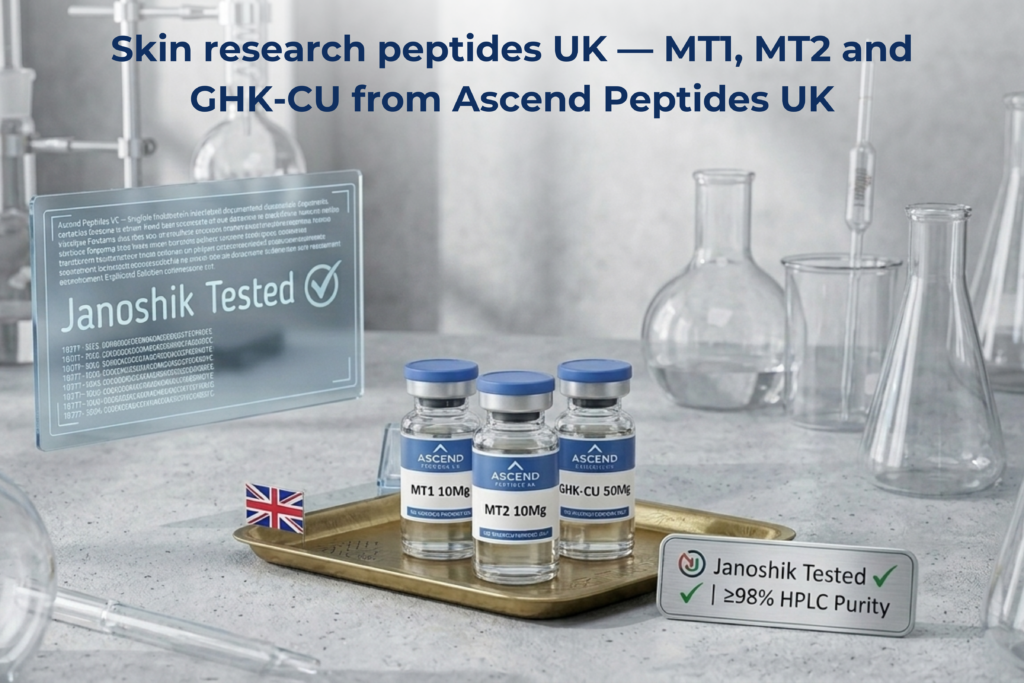
Ascend Peptides UK supplies all three compounds in this category to UK-based research scientists, private laboratories, and academic institutions. Every batch is HPLC-verified at ≥98% purity, LC-MS confirmed for molecular identity, and independently tested by Janoshik with a publicly verifiable Certificate of Analysis.
The three compounds covered on this page, MT1 (Melanotan 1, selective melanocortin receptor agonist), MT2 (Melanotan 2, non-selective melanocortin receptor agonist), and GHK-CU (glycyl-histidyl-lysine copper tripeptide), represent the structural and mechanistic toolkit available to UK researchers working in skin biology and melanocortin pathway research models.
This page sets out exactly how each compound differs, which research applications each is suited to, and how to source skin research peptides in the UK with full transparency on documentation.
📥 FREE DOWNLOAD
For research professionals only — instant download, no payment required
What Are Skin and Cellular Research Peptides?
kin and cellular research peptides are synthetic compounds used in laboratory research to study pathways involved in melanocortin receptor signalling, pigmentation biology, fibroblast biology, and copper-dependent cellular research. In the Ascend Peptides UK catalogue, this category covers three compounds across two distinct mechanistic classes:
- Melanocortin receptor research peptides: synthetic analogues of alpha-melanocyte-stimulating hormone (alpha-MSH) used to study the melanocortin receptor family (MC1R, MC3R, MC4R, MC5R). MT1 (Melanotan 1) is a synthetic alpha-MSH analogue with preferential activity at MC1R. MT2 (Melanotan 2) is a non-selective melanocortin receptor agonist active across multiple subtypes.
- Copper tripeptide research compounds: copper-bound peptides used in skin biology and fibroblast research. GHK-CU (glycyl-histidyl-lysine copper) is the standard research compound in this class, a tripeptide bound to a divalent copper ion through histidine and lysine residues.
The mechanistic distinctions matter for experimental design. MT1 and MT2 act through the melanocortin receptor family in melanocortin signalling research models. GHK-CU acts through copper-dependent cellular signalling at the fibroblast level.
The two classes represent mechanistically independent intervention points in skin biology research. GHK-CU is also a relevant research compound in the recovery research category for the tissue research model context, see the recovery research peptides UK page. To compare MT1, MT2 and GHK-CU side by side by mechanism and format, use the Research Peptide Explorer.
MT1 Research Peptide UK — Selective Melanocortin Receptor Agonist
MT1 (Melanotan 1, also known as afamelanotide or [Nle⁴, D-Phe⁷]-α-MSH) is a synthetic 13-amino acid analogue of alpha-melanocyte-stimulating hormone (alpha-MSH). Molecular formula C78H111N21O19, molecular weight approximately 1646.84 Da.
The defining research property of MT1 is selectivity; it acts preferentially at the MC1R (melanocortin-1 receptor) on melanocytes, with reduced activity across the other melanocortin receptor subtypes (MC3R, MC4R, MC5R) compared to MT2. This selectivity makes MT1 the appropriate research compound when the experimental focus is the MC1R pathway in isolation.
Research Applications of MT1
In UK laboratory research, MT1 is studied as a reference compound for MC1R-specific melanocortin receptor research. Published laboratory research has investigated MT1 in MC1R binding affinity studies using melanocyte cell models, melanocortin receptor pharmacology research, alpha-MSH analogue selectivity research, and pigmentation biology research at the cellular level.
MT1 is the appropriate research compound when researchers need to isolate the MC1R signalling pathway from the broader melanocortin receptor family activity.
MT1 is supplied by Ascend Peptides UK at £15 per vial, with HPLC purity verified at ≥98% by Janoshik laboratory, LC-MS molecular identity confirmation, and a batch-specific Certificate of Analysis available pre-purchase. Reconstitute with BP-grade bacteriostatic water and store at −20°C. Browse the MT1 product page for batch documentation and same-day UK dispatch.
MT2 Research Peptide UK — Non-Selective Melanocortin Receptor Agonist
MT2 (Melanotan 2) is a synthetic cyclic heptapeptide analogue of alpha-MSH with the structure Ac-Nle-cyclo[Asp-His-D-Phe-Arg-Trp-Lys]-NH₂. Molecular formula C50H69N15O9, molecular weight approximately 1024.18 Da.
The defining research property of MT2 is non-selectivity, unlike MT1, MT2 binds and activates multiple melanocortin receptor subtypes, including MC1R, MC3R, MC4R and MC5R. This broader receptor profile makes MT2 the appropriate research compound when the experimental design covers the wider melanocortin receptor family rather than the MC1R pathway in isolation.
Research Applications of MT2
GHK-CU is one of the most extensively characterised research peptides in published skin biology research literature, non-selective melanocortin receptor pharmacology research, MC4R pathway research in hypothalamic cell models (relevant to energy homeostasis cellular research), melanocortin receptor cross-talk research, and comparative agonist studies alongside MT1 as the selective comparator compound. MT2 is the standard research compound when the experimental focus is the broader melanocortin receptor family rather than MC1R-specific signalling.
MT2 is supplied by Ascend Peptides UK at £15 per vial, with the same Janoshik documentation standard applied across the catalogue. Browse the MT2 product page for batch documentation and same-day UK dispatch.
GHK-CU Research Peptide UK — Copper Tripeptide for Skin Biology Research
GHK-CU (glycyl-histidyl-lysine copper) is a copper-bound tripeptide complex. Molecular formula C14H22CuN6O4, molecular weight approximately 401.93 Da. The compound consists of the three-amino acid sequence Gly-His-Lys bound to a divalent copper ion (Cu²⁺) through the histidine and lysine residues.
GHK- CU is one of the most extensively characterised research peptides in published skin biology research literature, with substantial research bodies covering fibroblast research, collagen gene expression research, copper-dependent enzyme research, and antioxidant pathway research at the cellular level.
Research Applications of GHK-CU in Skin Biology
In skin biology research model literature, GHK-CU has been studied for its role in fibroblast research in skin cell models, collagen gene expression research in dermal fibroblast models, copper-dependent enzyme research relevant to extracellular matrix biology, and antioxidant pathway research at the cellular level.
GHK-CU is the standard research compound when the experimental focus is the copper-dependent component of skin biology research at the in-vitro cellular level. The compound is structurally and mechanistically distinct from the melanocortin agonists MT1 and MT2, making it a third independent variable for researchers building multi-compound skin biology research programmes.
GHK-CU is supplied by Ascend Peptides UK at £22 per vial, with HPLC purity verified at ≥98% by Janoshik laboratory and LC-MS molecular identity confirmation on every batch. GHK-CU is also a relevant research compound in the recovery research category for the tissue research model context and combined research bundle options (Tri-Regenerative Complex), see the recovery research peptides UK page.
Skin Research Peptide Supplier UK — How Ascend Peptides UK Documents Every Batch
When sourcing skin research peptides, UK suppliers must meet four documentation standards that distinguish a verified supplier from an unverified one. These standards are particularly important in the melanocortin category, MT1 and MT2 show significant quality variation across the UK research peptide market, and unverified compounds frequently fail HPLC purity testing when independently retested. See our guide to choosing a UK peptide supplier for the full evaluation criteria.
|
Documentation Standard |
Industry Norm |
Ascend Peptides UK |
|---|---|---|
|
HPLC purity verification |
Self-reported by the supplier |
Independent HPLC by Janoshik laboratory, ≥98% verified |
|
Molecular identity |
Often not tested |
LC-MS confirmation on every batch |
|
Certificate of Analysis |
Generic or unavailable |
Batch-specific, publicly verifiable, pre-purchase |
|
Storage and dispatch |
3–7 working days |
Same-day UK dispatch before 16:00 GMT, −20°C cold chain |
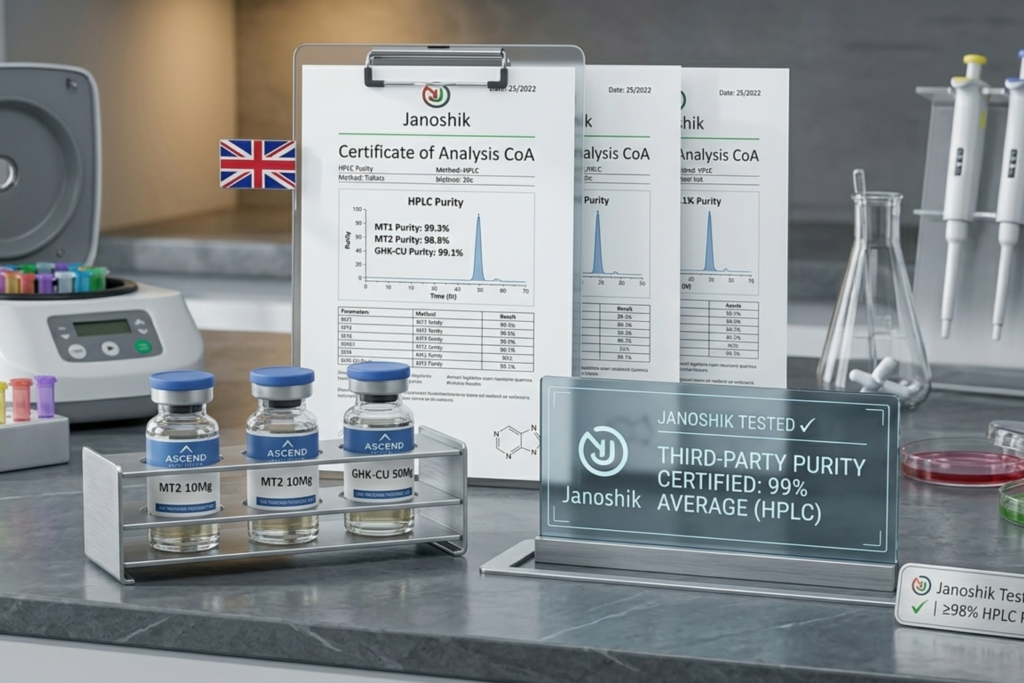
Every skin research peptide supplied by Ascend Peptides UK carries a publicly verifiable Janoshik Certificate of Analysis. The full archive of batch documentation is available on the Certificates of Analysis page, and the complete quality control workflow is set out on our ” How We Test Peptides ” page.
Before You Order — Free Research Buyer Starter Pack
The skin research peptide category, particularly the melanocortin compounds MT1 and MT2, has substantial supplier quality variation in the UK research peptide market. Before placing an order for any skin or cellular research peptide, UK research buyers should review the documentation and supplier evaluation checklist.
The Research Buyer Starter Pack is a free download from Ascend Peptides UK covering exactly what to verify before ordering, including how to read a Certificate of Analysis, what HPLC and LC-MS results actually confirm, and how to evaluate a UK peptide supplier against measurable standards.
📥 FREE DOWNLOAD
Research Buyer Starter Pack
A practical guide for UK research buyers. What to check before ordering a metabolic research peptide. What documentation to request from any supplier? What storage and dispatch standards to expect.
Inside the checklist:
Inside the pack:
✓ What “research-use only” means under UK regulation
✓ How to evaluate a UK research peptide supplier — 9-point checklist
✓ What documentation to request before purchase (CoA, HPLC, LC-MS)
✓ What storage and reconstitution standards to verify
✓ Pre-order buyer checklist — 16 items to confirm
✓ How to spot a low-quality metabolic peptide supplier — 7 warning signs
For research professionals only — instant download, no payment required
Buy Skin Research Peptides UK — Documentation Buyer Framework
UK researchers buying skin and cellular research peptides should apply the same documentation framework to every supplier, every batch, and every order. The framework has four steps:
- Step 1: Verify the Certificate of Analysis is batch-specific and publicly accessible. For MT1 and MT2, both heavily counterfeited in the UK market, a generic CoA that does not name the specific lot number is the single largest red flag.
- Step 2: Confirm the HPLC purity result is ≥98% and the analytical method is named. “HPLC tested” without a specific purity figure is not a real result.
- Step 3: Confirm LC-MS molecular identity is reported. HPLC alone confirms purity, but does not confirm what the 98% actually is. For melanocortin analogues where structural variations affect receptor selectivity, LC-MS identity confirmation is essential.
- Step 4: Confirm storage and dispatch standards. Lyophilised powder format, −20°C cold chain, same-day or next-day UK dispatch with insulated packaging.
Ascend Peptides UK meets all four standards on every batch of every skin research peptide supplied. The Janoshik Certificate of Analysis is publicly accessible, the HPLC purity figure is stated on every batch, the LC-MS molecular identity is reported, and all compounds are dispatched same-day before 16:00 GMT in temperature-controlled packaging.
Order Skin and Cellular Research Peptides UK — Same-Day Dispatch
The Ascend Peptides UK skin and cellular research peptide range is available for direct order with same-day UK dispatch before 16:00 GMT. Orders over £75 qualify for a free 10ml bacteriostatic water bonus.
For selective MC1R-pathway research, MT1 is the standard research compound, a 13-amino acid alpha-MSH analogue supplied at £15 per vial with HPLC purity verified at ≥98% and Janoshik’s third-party Certificate of Analysis on every batch. MT1 is the appropriate research peptide for MC1R-specific melanocortin receptor research in melanocyte cell line models.
For non-selective melanocortin receptor research covering the broader MC1R, MC3R, MC4R and MC5R receptor family, MT2 is the standard research compound, a cyclic heptapeptide alpha-MSH analogue supplied at £15 per vial with the same documentation standard applied across the Ascend Peptides UK catalogue.
Researchers running parallel melanocortin pharmacology research using both selective and non-selective comparator compounds typically order MT1 and MT2 together for single-supplier batch matching across the comparator pair.
For copper-dependent skin biology research, GHK-CU is the standard research compound a glycyl-histidyl-lysine copper tripeptide supplied at £22 per vial. GHK-CU is relevant to both skin biology research and tissue recovery research for the tissue research context and combined research bundle options, see the recovery research peptides UK page.
Browse the complete catalogue on the Ascend Peptides UK shop collection, review the documentation transparency standard on the batch verification page, or see the complete Ascend Peptides UK supplier model on the main research peptides UK page. All orders placed before 16:00 GMT are dispatched same-day via Royal Mail Tracked 24 to UK research addresses.
Skin and Cellular Research Peptides UK — Frequently Asked Questions
What are skin research peptides?
Skin research peptides are synthetic compounds used in laboratory research to study pathways involved in melanocortin receptor signalling, pigmentation biology, fibroblast biology, and copper-dependent cellular research. In the Ascend Peptides UK catalogue, the category covers MT1 and MT2 (melanocortin receptor agonists) and GHK-CU (a copper tripeptide). All are supplied strictly for in-vitro laboratory research.
What is the difference between MT1 and MT2?
MT1 (Melanotan 1) is a 13-amino acid linear alpha-MSH analogue that acts selectively at the MC1R receptor. MT2 (Melanotan 2) is a cyclic heptapeptide alpha-MSH analogue that acts non-selectively across multiple melanocortin receptor subtypes (MC1R, MC3R, MC4R, MC5R). MT1 is the appropriate compound for selective MC1R research; MT2 is the appropriate compound for broader melanocortin receptor family research.
Why does GHK-CU appear in both the skin and recovery research categories?
GHK-CU has substantial published research literature across both skin biology research models (fibroblast research, collagen gene expression, copper-dependent enzymes) and tissue research models (regenerative biology research, cellular signalling research). It is the same compound with the same Certificate of Analysis documentation in both research contexts — researchers select GHK-CU based on the specific experimental focus. For the tissue research context, see the recovery research peptides UK page.
What is the MHRA status of skin research peptides in the UK?
Skin and cellular research peptides supplied by Ascend Peptides UK are not licensed as medicinal products under the UK Human Medicines Regulations 2012. They are supplied strictly for in-vitro laboratory research. The Medicines and Healthcare products Regulatory Agency (MHRA) is the relevant medicines regulator in the UK post-Brexit. MT1 (afamelanotide) has a specific licensed medicinal product version in certain jurisdictions, but the research-format compound supplied by Ascend Peptides UK is not the licensed medicinal product and is supplied strictly for research use.
How should skin research peptides be stored?
Lyophilised skin research peptides should be stored at −20°C in the original sealed container. Following reconstitution with BP-grade bacteriostatic water, the reconstituted compound should be stored at 2–8°C and used within the research literature-recommended timeframe for each specific compound.
Can MT1 and MT2 be studied together?
Yes, MT1 and MT2 are routinely studied in parallel as selective (MT1) and non-selective (MT2) melanocortin receptor agonist comparator compounds. The two compounds act through the same receptor family but with different selectivity profiles, making them appropriate independent variables in melanocortin pharmacology research programmes that examine receptor selectivity effects.
Why UK Researchers Source Skin Research Peptides from Ascend Peptides UK
- ≥98% HPLC purity on every batch — independently verified by Janoshik laboratory
- LC-MS molecular identity confirmation — critical for heavily counterfeited compounds like MT1 and MT2
- Publicly verifiable Certificate of Analysis — batch-specific, available pre-purchase
- Same-day UK dispatch before 16:00 GMT — Royal Mail Tracked 24
- FREE 10ml bacteriostatic water on orders over £75
- All three skin/cellular compounds stocked together — single-supplier batch matching
- Temperature-controlled storage chain — lyophilised powder, −20°C cold chain
RESEARCH USE ONLY
All products supplied by Ascend Peptides UK are intended strictly for in-vitro laboratory research purposes only. Compounds are not licensed as medicinal products under the UK Human Medicines Regulations 2012 and are not for human or veterinary use. No dosing guidelines are provided. Products are supplied to qualified research professionals only.
📥 FREE DOWNLOAD
For research professionals only — instant download, no payment required