
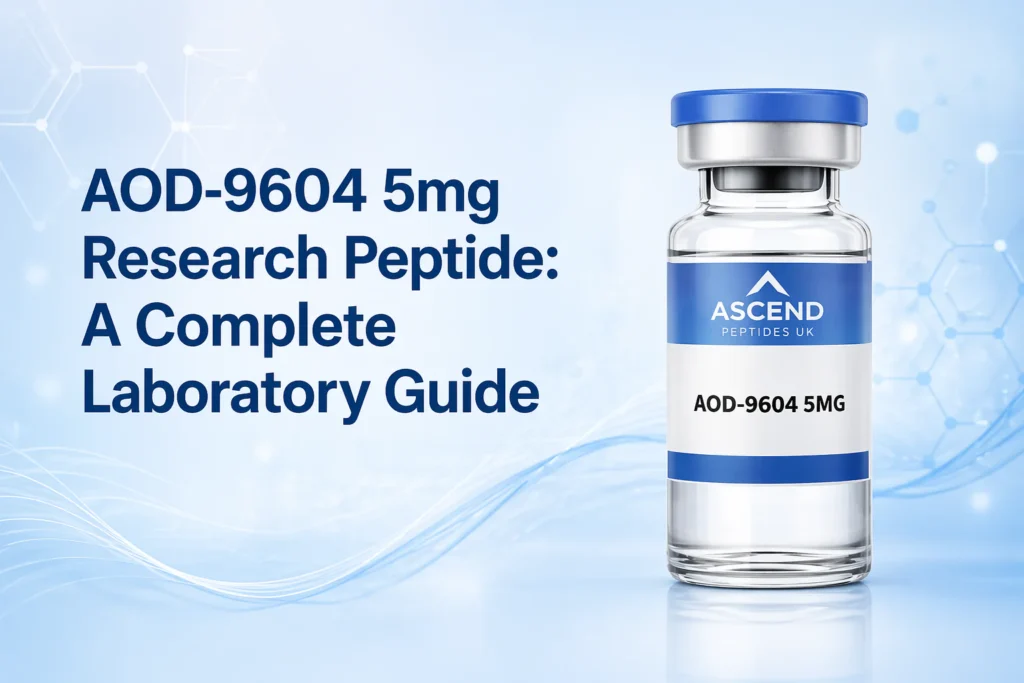
⚠️ Research Use Only. AOD-9604 5mg is supplied strictly for in-vitro laboratory research. It is not intended for human consumption, therapeutic, diagnostic, or clinical use. All information below reflects peer-reviewed preclinical and scientific literature only. This content is not medical advice. Ascend Peptides UK accepts no liability for misuse of this product
AOD-9604 is a research peptide that has attracted significant scientific interest across the metabolic biology and adipose tissue research communities. Derived from a specific fragment of human Growth Hormone, it presents a focused tool for laboratory investigations into lipid metabolism, adipocyte biology, and cellular energy regulation without the full growth-promoting activity of the complete GH molecule.
This guide is written for both laboratory scientists and research professionals who need a thorough scientific reference, and for scientifically curious individuals who want to understand the biochemistry behind this compound and why it continues to generate active research interest. Every section is grounded in published scientific research and framed in the context of controlled laboratory investigation.
Ascend Peptides UK supplies AOD-9604 5mg as a high-purity research peptide for laboratory investigation only. All content in this guide is provided strictly for scientific and educational purposes. This compound is not intended for human consumption, clinical application, or therapeutic use under any circumstances.
The Scientific Foundation: Human Growth Hormone and the GH C-Terminal Fragment
To understand AOD-9604 and its significance as a research compound, it is essential to first understand its origin: the human Growth Hormone molecule and the biological significance of its C-terminal region.
Human Growth Hormone (hGH) is a 191-amino acid peptide hormone produced and secreted by somatotroph cells of the anterior pituitary gland. It is one of the most pleiotropic hormones in human biology, regulating a wide range of physiological processes, including cell growth and proliferation, protein synthesis, carbohydrate and lipid metabolism, and body composition.
The biological actions of GH are mediated through multiple mechanisms. Its anabolic and growth-promoting effects are largely indirect, primarily via stimulation of hepatic IGF-1 production, whilst its direct metabolic effects, particularly those related to lipid metabolism and adipose tissue regulation, are believed to be mediated by specific domains within the GH molecule itself.
Early research into the structure-function relationships of the GH molecule identified the C-terminal region, specifically residues 176–191 as a domain with particular relevance to metabolic activity in laboratory models. This region was found to exhibit lipolytic properties in adipose tissue research without the insulin-antagonistic and growth-promoting effects associated with the full GH molecule. This discovery formed the scientific basis for the development of AOD-9604 as a focused research tool for metabolic biology investigation.
What Is AOD-9604? Structure, Derivation, and Research Rationale
AOD-9604 is a synthetic peptide consisting of residues 176–191 of the human Growth Hormone sequence, with the addition of a tyrosine (Tyr) residue at the N-terminus. The ‘AOD’ designation stands for ‘Anti-Obesity Drug’, reflecting the original research focus of the compound’s development. The number 9604 is a laboratory identifier assigned during its development at Monash University in Australia.
The complete sequence of this research compound is: Tyr-Leu-Arg-Ile-Val-Gln-Cys-Arg-Ser-Val-Glu-Gly-Ser-Cys-Gly-Phe, with a disulphide bond between the two cysteine residues (Cys-7 and Cys-15) that contributes significantly to the structural stability of the peptide loop conformation.
The addition of the N-terminal tyrosine residue was incorporated to facilitate radiolabelling for pharmacokinetic research studies, and has since become a standard part of the compound’s structure as used in laboratory research. The disulphide bond between the two cysteine residues creates a constrained loop structure that is believed to be important for the compound’s specific receptor interactions in metabolic research models.
AOD-9604 vs Full-Length Growth Hormone: Why the Fragment Matters
Understanding the distinction between AOD-9604 and full-length human Growth Hormone is fundamental to appreciating its value as a focused research tool. The key differences that make this fragment scientifically interesting are:
-
Absence of IGF-1 stimulation: Unlike full-length GH, this compound does not appear to stimulate hepatic IGF-1 production in laboratory models, an important distinction for researchers wishing to study metabolic GH-related pathways without the confounding variable of IGF-1 pathway activation. For comparison, our IGF-1 LR3 research provides insight into how IGF-1 signalling is studied as a separate downstream variable.
-
Selective metabolic activity: Research has documented that the C-terminal GH fragment exhibits activity in lipid metabolism pathways in laboratory models, particularly in relation to adipocyte biology and lipolytic enzyme activity, without the full growth-promoting and insulin-antagonistic effects of the complete GH molecule.
-
Receptor specificity: The fragment may interact with a distinct receptor or signalling pathway from the primary GH receptor (GHR), which is the subject of ongoing research investigation. This receptor selectivity is a key area of scientific interest in the literature.
-
Structural focus: As a 16-amino acid peptide, this research compound is significantly smaller and more structurally defined than the 191-amino acid full GH molecule, making it a more tractable research tool for studying specific receptor-ligand interactions and downstream signalling mechanisms in controlled laboratory settings.
Mechanism of Action in Laboratory Research Models
The precise mechanism by which AOD-9604 exerts its effects in laboratory research models is an area of active scientific investigation. Published research has proposed and examined several potential mechanisms:
Beta-3 Adrenergic Receptor Interactions
A substantial body of published research has examined interactions between this GH fragment and beta-3 adrenergic receptors (β3-AR) in adipose tissue research models. The β3-AR is expressed predominantly in adipose tissue and plays an important role in regulating lipolysis the breakdown of stored triglycerides into free fatty acids and glycerol. Laboratory studies examining this interaction have documented that the compound can stimulate lipolytic activity in adipocyte models through β3-AR-dependent pathways.
Lipid Metabolism Enzyme Activity
Research has documented interactions with lipid metabolism enzymes in adipose tissue laboratory models, particularly hormone-sensitive lipase (HSL) and lipoprotein lipase (LPL). These enzymes play central roles in triglyceride hydrolysis and fatty acid metabolism. Studies examining how this compound influences these enzymatic activities in controlled laboratory conditions have contributed to the understanding of the GH C-terminal fragment’s role in adipose tissue biology.
Adipogenesis Research
Several published laboratory studies have examined the influence of this research compound on adipogenesis, the process of pre-adipocyte differentiation into mature fat cells. In vitro studies using adipocyte precursor cell lines have investigated how this fragment influences adipogenic transcription factor expression, including PPARγ and C/EBPα, which are key regulators of the adipocyte differentiation programme.
Cartilage and Bone Research
An interesting and perhaps unexpected area of published research has examined this compound’s interactions with cartilage biology. Studies using chondrocyte cell models have investigated whether the GH C-terminal fragment influences cartilage matrix synthesis, chondrocyte proliferation, and growth factor expression in bone and cartilage biology research contexts. This represents an emerging area of scientific interest for the compound beyond its primary metabolic research applications.
Relationship to the GH-IGF-1 Axis
Because this fragment does not appear to stimulate IGF-1 production in laboratory models, it provides researchers with a tool to study the IGF-1-independent aspects of GH signalling in metabolic biology. This makes it a complementary research compound to IGF-1 receptor studies. For laboratories investigating the downstream growth factor signalling pathway separately, our IGF-1 LR3 research guide provides detailed information on how IGF-1 LR3 is used to study growth factor receptor biology in controlled research settings.
Research Applications of AOD-9604 5mg in Laboratory Settings
The scientific literature documents a range of laboratory research contexts in which AOD-9604 5mg has been applied. The following summarises the primary research disciplines:
1. Adipose Tissue and Lipid Metabolism Research
The primary and most extensively published research application of this GH fragment is the investigation of adipose tissue biology and lipid metabolism pathways. In vitro studies using adipocyte cell lines, including 3T3-L1 cells and primary adipocyte cultures, have used this compound to examine lipolytic signalling, triglyceride hydrolysis mechanisms, fatty acid oxidation pathways, and adipokine secretion. For researchers investigating the cellular basis of lipid metabolism, this compound provides a focused and tractable research tool with a well-established, published evidence base.
2. Adipogenesis and Pre-Adipocyte Differentiation Research
Research examining the differentiation of pre-adipocytes into mature adipocytes a process known as adipogenesis, has incorporated this compound as an experimental variable to investigate how GH-related signalling influences adipocyte development. Studies examining transcription factor regulation, lipid droplet formation, and insulin sensitivity in differentiating adipocyte models have used this fragment to probe the GH signalling contribution to these processes.
3. Beta-3 Adrenergic Receptor Pharmacology Research
The documented interactions between this research compound and the β3-adrenergic receptor have made it a useful tool in β3-AR pharmacology research. Laboratories studying β3-AR expression, signalling kinetics, and downstream cAMP/PKA pathway activation in adipose tissue models have incorporated this fragment as a β3-AR-interacting research compound, generating insights into the role of this receptor in adipose tissue metabolic regulation.
4. Metabolic Regulation and Energy Homeostasis Research
Broader metabolic regulation research including studies on energy substrate utilisation, fatty acid oxidation, mitochondrial function in adipocytes, and the molecular basis of metabolic flexibility, has drawn on this compound as a research tool. Its ability to interact with lipolytic pathways without the confounding growth-promoting effects of full GH makes it particularly useful for dissecting the metabolic arm of GH signalling in laboratory models.
5. Cartilage and Musculoskeletal Biology Research
As noted in the mechanism section, published research has begun to examine this compound’s interactions with cartilage biology and chondrocyte function. Laboratories studying cartilage matrix biology, chondrocyte proliferation and differentiation, and growth factor signalling in musculoskeletal research models have incorporated this fragment as an experimental variable representing an expanding research frontier beyond its primary metabolic applications.
6. Comparative GH Signalling Research
Research programmes studying the relative contributions of different GH signalling domains, growth-promoting vs. metabolic use this compound in comparison with full-length GH, other GH fragments, and related research tools. For laboratories studying the broader GH-related research peptide landscape, this compound complements GHRH analogue research. Our CJC-1295 Without DAC research guide covers GHRH receptor activation as the upstream stimulus for GH secretion, providing important context for understanding where AOD-9604 sits within the broader GH signalling research framework.
7. Multi-Pathway Research Programmes
Some research programmes investigate multiple peptides operating across complementary biological pathways simultaneously. For researchers studying metabolic and cellular biology research peptides alongside this compound, our BPC-157 10mg research guide provides a comprehensive overview of how that pentadecapeptide is applied in connective tissue and cellular signalling research a complementary area of laboratory investigation.
AOD-9604 5mg vs 10mg: Choosing the Right Format for Your Research
AOD-9604 is available from Ascend Peptides UK in both 5mg and 10mg formats. Selecting the appropriate quantity depends on the scale and stage of the research programme:
-
AOD-9604 5mg is ideal for smaller-scale laboratory work, pilot studies, method development, and research programmes that are incorporating this compound for the first time. The 5mg quantity allows researchers to validate their experimental approach and confirm compatibility with their assay system before committing to larger quantities. It minimises material investment in the early stages of a research project.
-
AOD-9604 10mg is the preferred format for established research programmes with higher throughput requirements, dose-response studies, multi-arm experiments comparing several concentration levels, or extended research programmes requiring multiple experimental runs. The 10mg format offers better value per milligram for programmes with confirmed demand.
Both formats are produced to the same research-grade purity specification, supplied with identical analytical documentation, and dispatched under the same-day UK shipping standard. The compound is chemically identical in both quantities.
Sourcing AOD-9604 5mg in the UK: Quality Standards
The quality of AOD-9604 5mg directly determines the reliability and reproducibility of your experimental results. When evaluating potential suppliers as your AOD-9604 supplier UK, the following standards should be treated as non-negotiable:
-
HPLC purity verification: Research-grade purity must be 98% or above, confirmed by High-Performance Liquid Chromatography with a batch-specific Certificate of Analysis (CoA) available on request.
-
Mass spectrometry identity confirmation: Molecular weight must be verified via LC-MS to confirm the 16-amino acid sequence and the intramolecular disulfide bond, both critical structural features of this compound.
-
Disulphide bond integrity: Uniquely important for this compound, the disulphide bond between Cys-7 and Cys-15 must be correctly formed. Suppliers should confirm this through an appropriate analytical methodology.
-
Lyophilised format: Freeze-dried powder is the only appropriate format for research-grade stability during transit and long-term storage. Liquid preparations cannot maintain adequate stability for research-grade use.
-
Batch traceability: Full batch documentation, synthesis parameters, purification chromatograms, and QC release data must be maintained and available for institutional procurement compliance.
-
Research-only labelling: All products must carry unambiguous research-use-only designations with no therapeutic, clinical, or health-related claims.
-
UK-based dispatch: Sourcing from a UK-based peptide distributor minimises transit time and cold chain risk during shipping.

Reconstituting AOD-9604 5mg: Complete Laboratory Reference
AOD-9604 5mg is supplied in lyophilised (freeze-dried) powder form and requires reconstitution before use in laboratory assays. This section is provided for general laboratory reference and does not constitute dosing, medical, or clinical guidance.
Recommended Reconstitution Solvents
-
Sterile bacteriostatic water (0.9% benzyl alcohol) is the most widely used solvent for research peptide reconstitution, offering extended post-reconstitution stability when stored at -20°C. Recommended for most laboratory applications.
-
Sterile 0.9% saline is appropriate where a physiological salt concentration is required by the experimental design.
-
Phosphate-buffered saline (PBS) at pH 7.4 is suitable for in vitro cell culture applications requiring a neutral, isotonic, buffered environment.
Reconstitution Protocol
Special Handling Note: Disulphide Bond Stability
The intramolecular disulfide bond between the two cysteine residues is a critical structural feature of this compound. Reconstituted solutions should be protected from reducing agents (such as DTT or beta-mercaptoethanol), which can cleave the disulfide bond and disrupt the active conformation. Avoid prolonged exposure to air, as oxidative conditions can affect disulfide bond integrity. Store reconstituted solutions in sealed containers under inert gas if extended storage is required.
The following reconstitution guidance reflects standard laboratory practices and is intended for qualified research personnel only. All procedures must comply with institutional protocols and applicable regulations. Not for clinical or human use.
Regulatory Compliance and Research Responsibility
AOD-9604 is classified as a research chemical in the United Kingdom. It is not a licensed medicine, is not approved for human consumption, and must not be used in any clinical, therapeutic, diagnostic, or veterinary context. The fact that this compound is derived from a fragment of human GH does not confer any clinical or therapeutic status in the UK.
All purchasing researchers and institutions are fully responsible for ensuring their acquisition and use of this compound complies with applicable UK legislation and any relevant institutional ethics or procurement requirements. Ascend Peptides UK provides fully compliant, research-only labelled products and makes no health, clinical, metabolic, or performance-related claims about any compound in our range.
Conclusion: AOD-9604 5mg as a Metabolic Research Tool
AOD-9604 5mg occupies a unique and scientifically interesting position in the peptide research landscape. As the C-terminal fragment of human Growth Hormone residues 176–191 with an N-terminal tyrosine addition, this compound provides researchers with a focused tool for investigating the metabolic arm of GH signalling independently of the growth-promoting and IGF-1-stimulating effects associated with the full GH molecule.
Its documented interactions with beta-3 adrenergic receptor pathways, lipolytic enzyme systems, adipogenesis regulation, and cartilage biology make it a versatile research compound across multiple laboratory disciplines. The 5mg format makes it particularly accessible for pilot studies, method development, and programmes at the early stages of incorporating this GH fragment into their experimental design.
For UK laboratories and research institutions seeking a reliable source of AOD-9604 5mg, Ascend Peptides UK supplies this compound to research-grade purity standards with HPLC verification, disulphide bond confirmation, full batch documentation, and same-day UK dispatch. Our team is ready to support your metabolic research programme.
Frequently Asked Questions About AOD-9604 5mg Research Peptide
Q: What is AOD-9604 5mg used for in research?
Q: What does AOD-9604 stand for?
Q: What is the difference between AOD-9604 5mg and 10mg?
Q: How does AOD-9604 differ from full-length Growth Hormone?
Q: Is AOD-9604 legal to buy in the UK?
Q: How does AOD-9604 work in laboratory research models?
Q: How should AOD-9604 5mg be stored?
Q: How do you reconstitute AOD-9604 5mg for laboratory use?
Q: What purity level is required for research-grade AOD-9604?
Q: Where can I buy AOD-9604 5mg research peptide in the UK?
DISCLAIMER
All products supplied by Ascend Peptides UK are intended strictly for research purposes only. They are not intended for human consumption or for any therapeutic, diagnostic, or clinical use. None of the items offered are classified as medicinal products by the MHRA. It is the buyer’s responsibility to ensure all purchases comply with applicable laws and regulations. Ascend Peptides UK accepts no liability for misuse.