
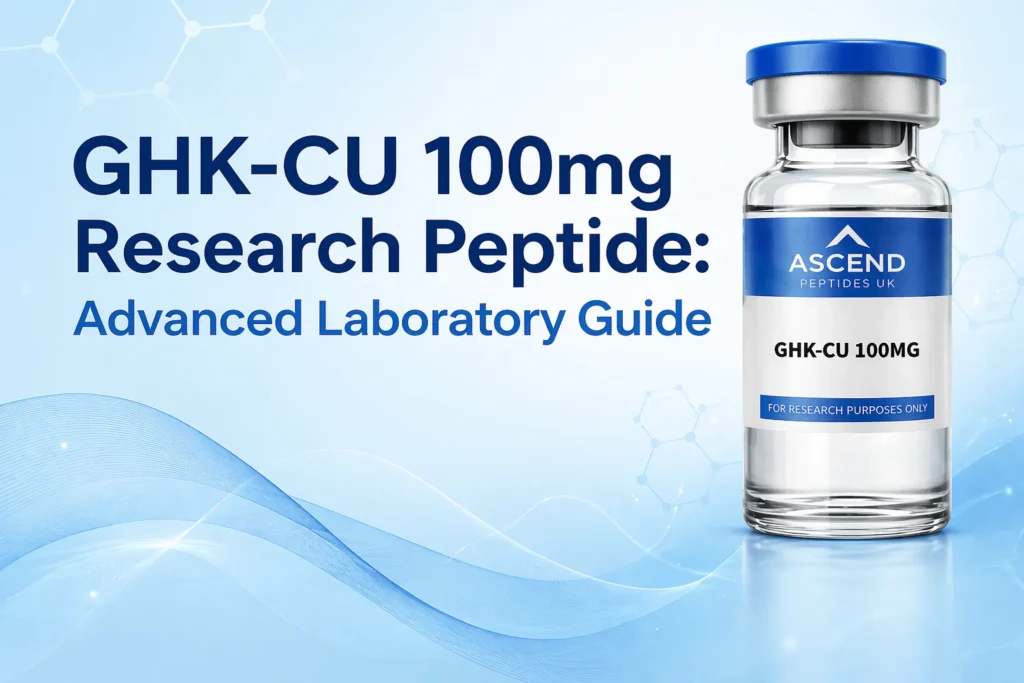
⚠️ Research Use Only. GHK-CU 100mg is supplied strictly for in-vitro laboratory research. It is not intended for human consumption, therapeutic, diagnostic, or clinical use. All information below reflects peer-reviewed preclinical and scientific literature only. This content is not medical advice. Ascend Peptides UK accepts no liability for misuse of this product
GHK-CU is one of the most scientifically documented copper-binding peptides in biochemical research. First isolated from human plasma in the early 1970s, this naturally occurring glycine-histidine-lysine copper complex has accumulated one of the most extensive published evidence bases of any research tripeptide spanning skin biology, extracellular matrix research, antioxidant signalling, angiogenesis models, and genomic studies involving has been associated with differential expression of thousands of genes in transcriptomic studies.
This guide focuses specifically on the GHK-CU 100mg research format the compound’s advanced-quantity option, designed for established research programmes with higher throughput requirements, multi-arm experimental designs, and institutional laboratory settings where extended single-batch consistency matters as much as the science itself.
This guide is written for two audiences: laboratory scientists and research professionals who are building or expanding research programmes incorporating this copper peptide complex, and scientifically engaged individuals who want to understand the full scope of what makes this compound one of the most scientifically versatile tripeptides available to UK researchers today.
All content here relates strictly to laboratory research and scientific investigation. Ascend Peptides UK supplies GHK-CU 100mg as a high-purity research peptide for laboratory use only not for human consumption, cosmetic application, veterinary, or clinical use of any kind. For the complete mechanism-level research guide, see What Is GHK-Cu?
What Is GHK-CU? Structure, Origin, and Unique Properties
GHK-CU is a naturally occurring tripeptide-copper complex found in human plasma, saliva, and urine. The peptide component GHK consists of three amino acids: glycine, histidine, and lysine. The CU designation refers to copper (II), which the tripeptide binds with remarkably high affinity through a coordination involving the imidazole group of histidine and the free amino terminus of the glycine residue.
This copper-binding characteristic is not incidental; it is the defining feature of the compound’s biochemical identity and the basis for much of its documented laboratory activity. Copper is an essential trace element involved in a wide range of enzymatic processes in biological systems, including collagen crosslinking, free radical neutralisation, and angiogenic signalling.
GHK’s ability to chelate and transport copper ions with precision in laboratory models has made it a subject of research interest across disciplines far beyond its initial discovery context in skin biology.
GHK-CU Molecular Identity: Reference Table
|
Identifier |
Value |
|---|---|
|
Full name |
Copper(II) glycyl-L-histidyl-L-lysine |
|
Common name |
GHK-Cu / Copper peptide |
|
Tripeptide sequence |
Gly-His-Lys (Glycine-Histidine-Lysine) |
|
Copper ion |
Cu(II) — bound via His imidazole + N-terminal amine |
|
Molecular formula |
C14H24CuN6O4 (approximate) |
|
Molecular weight |
~340.84 Da (GHK tripeptide component: ~340 Da) |
|
Natural source |
Human plasma, saliva, urine |
|
CAS number |
89030-95-5 |
|
Supplied form |
Lyophilised powder, blue-green tinted to off-white |
|
Research quantity |
100mg per vial |
|
Category |
Skin Research Peptide / Copper-binding tripeptide |
What distinguishes this compound from most other research peptides is the extraordinary breadth of its documented influence on cellular behaviour in laboratory models. Published genome-wide studies have reported interactions with over-differential expression of thousands of genes in transcriptomic studies that have no parallel in the research tripeptide category and positions GHK-CU as one of the most far-reaching small peptide tools available to modern biochemical research programmes.
Mechanism of Action: How GHK-CU Behaves in Laboratory Models
Understanding the mechanisms through which GHK-CU acts in research settings is essential for designing rigorous experiments and interpreting results correctly. The compound operates through several interconnected pathways, many of which have been independently verified across a substantial body of peer-reviewed research.
Key Mechanisms Identified in Published Laboratory Research
|
Mechanism |
How It Works in Research Models |
Key Enzymes / Pathways |
|---|---|---|
|
Copper chaperone activity |
Delivers Cu(II) ions to copper-dependent enzymes |
Lysyl oxidase, Superoxide dismutase (SOD) |
|
Collagen/ECM regulation |
Modulates fibroblast gene expression and ECM protein synthesis |
Collagen I, III, fibronectin, laminin |
|
Antioxidant signalling |
Upregulates antioxidant enzyme expression in cell models |
SOD, catalase, glutathione peroxidase |
|
Anti-inflammatory signalling |
Modulates pro-inflammatory cytokine activity |
TNF-α, IL-6, NF-κB pathway |
|
Angiogenic pathway activation |
Stimulates angiogenic signalling in vascular research models |
VEGF, FGF pathway components |
|
Gene expression modulation |
Documented interactions with 4,000+ human genes in genome-wide studies |
Tissue remodelling, stem cell, metabolic gene networks |
It is important for researchers to note that these mechanisms have been studied predominantly in in vitro cell culture models and animal research systems. None of this research constitutes clinical evidence of efficacy in human subjects, and GHK-CU is supplied strictly for research purposes only.

Why GHK-CU 100mg? The Case for the Advanced Research Format
The choice between GHK-CU 50mg and GHK-CU 100mg is not simply a question of quantity, it reflects the scale, ambition, and design of your research programme. For researchers moving beyond preliminary investigations into established, multi-arm, or institutionally funded studies, the 100mg format offers meaningful advantages that the smaller quantity cannot match.
|
Consideration |
GHK-CU 50mg |
GHK-CU 100mg |
|---|---|---|
|
Best suited for |
Pilot studies, method development, early-stage research |
Established programmes, high-throughput assays, multi-arm studies |
|
Dose-response studies |
Limited concentration range |
Full concentration range (0.1nM–100µM+) |
|
Cost per milligram |
Higher (smaller quantity) |
Lower — better value for active programmes |
|
Multi-assay capacity |
Single assay type |
Multiple assay types from single batch |
|
Batch consistency |
Single batch reference |
Extended single-batch use — fewer batch changes |
|
Institutional procurement |
Individual researchers, smaller labs |
Core facilities, institutional labs, CROs |
|
Reconstitution aliquots |
Fewer aliquots possible |
Greater number of single-use aliquots |
|
Purity specification |
≥98% HPLC-verified |
≥98% HPLC-verified (identical standard) |
The most significant practical advantage of the 100mg format is batch consistency. Every lyophilised peptide compound carries inherent variation between production batches, even when manufactured under tightly controlled conditions.
For researchers running extended experimental programmes particularly those publishing results or contributing data to systematic reviews working from a single 100mg batch throughout a study eliminates batch-to-batch variation as a confounding variable.
This is a standard requirement in serious laboratory research that is easily overlooked when ordering in smaller increments.
Researchers who are earlier in their GHK-CU programme, or who are validating methods before committing to larger-scale work, may find our GHK-CU 50mg research peptide guide a useful starting point. It covers the same compound at an entry-level quantity suited to pilot studies and method development work.
Research Applications of GHK-CU 100mg in Laboratory Settings
The GHK-CU 100mg format is particularly suited to research programmes where multiple experimental arms, extended duration, or high-volume assay protocols are involved.
The following research areas represent the established contexts in which this copper peptide has been most extensively investigated and in which the larger format provides the most practical benefit.
1. Skin Biology and Dermatological Cell Research
Skin biology is the most extensively published research area for GHK-CU, and the area where the 100mg format offers the most direct advantage.
Multi-well plate assays using primary fibroblast and keratinocyte cell lines, dose-response studies examining collagen gene expression across concentration gradients, and comparative studies incorporating multiple cell types simultaneously all require compound volumes that make the 50mg format insufficient for serious programme-level work.
Research in this field has examined fibroblast proliferation and collagen gene expression, extracellular matrix dynamics, basement membrane integrity, and cellular responses to oxidative stress. The 100mg format supports all of these simultaneously from a single, analytically verified batch.
2. Extracellular Matrix and Collagen Research
Among the most consistently replicated findings in the GHK-CU literature is the compound’s influence on extracellular matrix biology. Multiple independent in vitro studies have documented effects on fibroblast expression of collagen type I, collagen type III, fibronectin, and laminin, the primary structural proteins of the extracellular matrix.
For researchers conducting quantitative PCR arrays, proteomics-based ECM profiling, or mechanical stiffness assays across a range of GHK-CU concentrations, the 100mg format provides the volume required to run these protocols robustly.
Researchers studying extracellular matrix dynamics and tissue biology sometimes incorporate multiple peptide compounds into parallel experimental arms. Our BPC-157 10mg research peptide guide covers a recovery research peptide studied in models of cellular signalling and connective tissue biology, a mechanistically distinct but complementary tool for laboratories building multi-compound ECM or tissue biology research programmes.
3. Antioxidant and Oxidative Stress Research
Published laboratory research has consistently documented GHK-CU’s interactions with antioxidant defence systems at the cellular level, including upregulation of superoxide dismutase and catalase expression in cell culture models.
Oxidative stress research programmes incorporating GHK-CU frequently require multiple experimental conditions varying copper concentrations, different cell line types, co-treatment with oxidative stressors that rapidly consume smaller compound quantities. The 100mg format supports the full breadth of these study designs without the risk of batch changes mid-programme.
4. Anti-Inflammatory Signalling Research
Several well-cited studies have examined GHK-CU’s influence on inflammatory cytokine profiles in cell culture models, including modulation of TNF-alpha, IL-6, and NF-κB pathway activity. For researchers designing multi-condition inflammatory signalling studies comparing GHK-CU against positive and negative controls, across multiple cytokine readouts, at several time points the 100mg format provides the compound volume needed to execute the complete experimental matrix without compromise.
5. Genomics and Gene Expression Research
Perhaps the most scientifically striking aspect of the GHK-CU literature is the scale of its documented influence on human gene expression. Genome-wide studies have reported interactions with over 4,000 genes across tissue remodelling pathways, stem cell regulatory networks, inflammatory gene programmes, and metabolic gene clusters.
For researchers conducting RNA-sequencing, microarray analysis, or pathway-level gene expression studies with GHK-CU, the 100mg format enables robust technical replication, the prerequisite for any genomics work that will be submitted for peer review.
6. Hair Follicle Biology Research
A substantial body of in vitro and in vivo research has examined GHK-CU in the context of hair follicle biology, including dermal papilla cell behaviour, hair follicle cycling parameters, and follicular growth factor signalling.
For researchers investigating hair biology across multiple cell populations and treatment conditions simultaneously, the larger format supports the experimental scope that this research area demands.
7. Neuroprotective Research Models
An emerging and growing body of laboratory research has examined neuroprotective mechanisms associated with this copper-binding tripeptide in neuronal cell models. Studies investigating nerve growth factor (NGF) signalling, oxidative stress parameters in neuronal cultures, and copper homeostasis in neuronal biology have incorporated GHK-CU as a research tool.
This represents one of the newer research frontiers for this compound, and one in which programme-scale investigation suited to the 100mg format is increasingly prominent.
Researchers working on cellular migration and cytoskeletal biology alongside ECM and tissue research may also find our TB-500 10mg research peptide guide relevant TB-500 is a Recovery Research Peptide studied for its actin-binding properties and role in cytoskeletal dynamics, providing a mechanistically distinct research reference point for laboratories studying cellular behaviour and matrix interactions.

Sourcing GHK-CU 100mg in the UK: What to Look For
The quality of your copper peptide research compound directly determines the reliability and reproducibility of your experimental results. When evaluating a GHK-CU supplier UK for research-grade GHK-CU 100mg, the following standards should be non-negotiable:
-
HPLC purity verification: Research-grade purity should be confirmed at 98% or above by High-Performance Liquid Chromatography, with a batch-specific Certificate of Analysis provided.
-
LC-MS molecular weight confirmation: Mass spectrometry should verify the molecular weight matches the expected copper-tripeptide complex and confirm that copper coordination is intact, a critical check for a metal-chelating compound.
-
Lyophilised format only: Freeze-dried powder is the only appropriate format for research-grade stability. Liquid preparations are unsuitable for reliable long-term storage and introduce variability.
-
Batch traceability: Full batch records including synthesis parameters, purification chromatograms, and QC release documentation. For the 100mg format especially — where extended programme use from a single batch is the objective — full traceability is essential.
-
Independent third-party testing: A CoA from an independent analytical laboratory, not in-house testing, is the gold standard. At Ascend Peptides UK, every batch is independently tested by Janoshik.
-
Research-only labelling: All legitimate copper peptide research products must carry clear research-use-only designations with no health, cosmetic, or clinical claims.
At Ascend Peptides UK, our GHK-CU 100mg research peptide meets all of these standards. Every batch is independently tested by Janoshik, with a verifiable Certificate of Analysis available before any order is dispatched. We are a UK-based copper peptide supplier serving research laboratories, institutions, and scientifically engaged researchers across the United Kingdom.
Reconstituting GHK-CU 100mg: A Laboratory Reference
GHK-CU 100mg is supplied as a lyophilised powder and must be reconstituted before use in laboratory assays. This section is provided for general laboratory reference and does not constitute dosing, medical, or clinical guidance. For the 100mg format, proper aliquoting strategy is especially important; correct preparation at the outset protects the full compound investment.
Commonly used reconstitution solvents in published research include:
-
Sterile bacteriostatic water is the most widely used choice for research peptides and the recommended option for the 100mg format, offering extended post-reconstitution stability and supporting a larger number of stable aliquots. Ascend Peptides UK also supplies bacteriostatic water for research, allowing researchers to source both compounds from a single trusted UK supplier.
-
Sterile 0.9% saline is appropriate when a physiological salt environment is required by the experimental design.
-
Phosphate-buffered saline (PBS) at pH 7.4 suitable for in vitro cell culture applications where a neutral, buffered environment is essential.
GHK-CU is generally water-soluble and reconstitutes readily in aqueous solvents. Gently swirl or invert to dissolve do not vortex or shake vigorously, as mechanical agitation can disrupt the copper-peptide coordination complex. For the 100mg format, calculate your aliquot volume requirements before reconstitution and prepare the minimum number of stock solutions needed to cover your experimental programme.
Each aliquot should be stored at -20°C in a sealed, light-protected container. Avoid repeated freeze-thaw cycles every additional cycle introduces the risk of complex degradation and experimental inconsistency.
Research Compliance: What UK Researchers Need to Know
GHK-CU 100mg is classified as a research chemical in the United Kingdom. It is not a licensed medicine, it is not approved for human consumption, or veterinary and it must not be used in any clinical, cosmetic, veterinary, or diagnostic context outside of properly regulated research frameworks. This classification applies regardless of the compound’s natural origin in human biology.
Unlike some synthetic research peptides, GHK-CU is naturally occurring but natural origin confers no special regulatory status in the UK research chemical framework. Researchers must apply the same institutional compliance standards to this compound as they would to any synthetic research peptide.
For any in vivo animal research conducted in the United Kingdom, full compliance with the Animals (Scientific Procedures) Act 1986 (ASPA) is mandatory, requiring valid Home Office project and personal licences and full institutional ethical approval before any experimental work begins. All buyers are responsible for ensuring their acquisition and use of this compound complies with applicable UK legislation and institutional ethics requirements.
Ascend Peptides UK provides fully compliant, research-only labelled products and makes no health, cosmetic, or clinical claims about any compound in our range.
Why Researchers Choose Ascend Peptides UK
Ascend Peptides UK is a dedicated research peptides company built specifically to serve the needs of laboratories, research institutions, and scientifically engaged individuals across the United Kingdom. Our GHK-CU 100mg research peptide is one of over twenty independently verified compounds available directly from our UK-based operation.
-
High-purity research peptides: Every compound independently tested by Janoshik before dispatch, with verifiable CoA documentation available for every batch.
-
UK-based copper peptide supplier: Fast, reliable delivery nationwide with same-day dispatch for orders placed before 4pm.
-
Complete Skin Research Peptide range: GHK-CU in both 50mg and 100mg formats, alongside a comprehensive portfolio of research-grade peptides spanning Growth Hormone, Recovery, Melanotan, Mitochondrial, and Fat Loss Research categories.
-
Full documentation: Purity certificates, batch records, and clear research-use labelling on every product with no exceptions.
-
Accessible ordering: Buy directly from our website with straightforward product pages and transparent pricing.
Whether you are a laboratory scientist looking for a trusted GHK-CU supplier UK for a high-throughput research programme, a core facility procurement team building institutional supply relationships, or a scientifically engaged individual exploring the copper peptide research literature, Ascend Peptides UK is your reliable UK source for scientific research peptides.
Conclusion: GHK-CU 100mg as an Advanced Research Tool
GHK-CU is one of the most scientifically documented copper-binding research peptides available to the laboratory community and the 100mg format is the format of choice for researchers who are serious about their programme. Its well-characterised interactions with collagen synthesis pathways, antioxidant signalling systems, angiogenic mechanisms, and gene expression networks documented across decades of peer-reviewed research and genome-wide studies involving has been associated with differential expression of thousands of genes in transcriptomic studies make it a genuinely versatile research compound. The 100mg quantity extends that versatility to the scale demanded by serious experimental design: multi-arm studies, full dose-response matrices, high-throughput assays, and institutional research programmes where batch consistency matters.
For UK researchers and laboratories seeking a reliable, independently verified, and fully documented source of GHK-CU 100mg, Ascend Peptides UK supplies this compound to research-grade purity standards with full batch documentation, HPLC-verified analytical data, and same-day UK dispatch.
Frequently Asked Questions About GHK-CU 100mg Research Peptide
Q: What is GHK-CU 100mg used for in research?
A: GHK-CU 100mg is used as an advanced-format copper-binding research peptide for laboratory investigations into skin biology, extracellular matrix dynamics, collagen synthesis, antioxidant and anti-inflammatory signalling, angiogenesis models, hair follicle biology, gene expression studies, and neuroprotective research. The 100mg format is suited to established programmes with high-throughput requirements, dose-response studies, and multi-arm experimental designs. It is supplied strictly for laboratory research only not for human consumption, cosmetic, or clinical use.
Q: What is the difference between GHK-CU 50mg and GHK-CU 100mg?
A: The compound is chemically identical in both formats the difference is quantity and the research programme scale each format supports. GHK-CU 50mg is suited to pilot studies, method development, and early-stage investigations. GHK-CU 100mg is the appropriate choice for established programmes requiring extended single-batch consistency, full dose-response concentration ranges, multi-arm experimental designs, and higher-throughput assay volumes. Both are supplied to the same ≥98% HPLC-verified purity specification by Ascend Peptides UK.
Q: Why is batch consistency important for GHK-CU 100mg research?
A: Every peptide production batch carries inherent variation, even under tightly controlled manufacturing conditions. For researchers running extended experimental programmes particularly those contributing data to publications or systematic reviews working from a single 100mg batch throughout a study eliminates batch-to-batch variation as a confounding variable. This is a standard requirement in rigorous laboratory research. The 100mg format supports this approach in a way that multiple 50mg orders from different batches cannot.
Q: What does GHK-CU stand for?
A: GHK-CU stands for Glycine-Histidine-Lysine Copper. The GHK component refers to the tripeptide sequence of three amino acids: glycine, histidine, and lysine. CU is the chemical symbol for copper (from the Latin cuprum). Together, GHK-CU refers to the naturally occurring tripeptide-copper(II) complex found endogenously in human plasma, saliva, and urine.
Q: How does GHK-CU interact with genes in research models?
A: Genome-wide studies have documented GHK-CU interactions with over 4,000 human genes in laboratory research settings. These include genes associated with tissue remodelling pathways, stem cell regulatory networks, inflammatory gene programmes, and metabolic gene clusters. This scale of documented gene interaction is without parallel in the research tripeptide category and positions GHK-CU as one of the most far-reaching small peptide tools available for genomics and gene expression research programmes.
Q: Is GHK-CU 100mg legal to buy in the UK?
A: Yes. GHK-CU is legal to purchase in the United Kingdom as a research chemical for legitimate scientific and laboratory purposes. It is not classified as a controlled substance under UK law. However, it is not a licensed medicine and must not be used for human consumption, clinical application, or cosmetic purposes. All buyers are responsible for ensuring their use complies with applicable UK legislation and any institutional ethics requirements.
Q: How should GHK-CU 100mg be stored in a laboratory?
A: Lyophilised GHK-CU 100mg should be stored at -20°C in a sealed, light-protected container. Once reconstituted, solutions must be divided into single-use aliquots immediately and stored at -20°C. For the 100mg format, pre-calculating the number of aliquots required before reconstitution is strongly recommended to maximise compound utilisation. Repeated freeze-thaw cycles degrade the copper-peptide coordination complex and introduce experimental variability avoided at all times.
Q: How do you reconstitute GHK-CU 100mg for laboratory use?
A: GHK-CU 100mg is reconstituted from lyophilised powder using sterile bacteriostatic water (most widely used for extended stability), sterile 0.9% saline, or PBS at pH 7.4, depending on experimental requirements. Gently swirl or invert to dissolve do not vortex or agitate vigorously, as this can disrupt the copper coordination complex. Immediately aliquot into single-use volumes and store at -20°C, protected from light. Ascend Peptides UK also supplies bacteriostatic water for research, allowing researchers to source both from a single UK supplier.
Q: What purity standard should research-grade GHK-CU meet?
A: Research-grade GHK-CU should be at least 98% pure, confirmed by HPLC analysis. Copper-peptide complex formation and molecular identity should be verified by LC-MS (liquid chromatography-mass spectrometry) to confirm that copper coordination is intact, a critical check that distinguishes a properly formed copper complex from a free tripeptide. A batch-specific Certificate of Analysis from an independent third-party laboratory should be provided for every batch.
Q: Where can I buy GHK-CU 100mg research peptide in the UK?
A: GHK-CU 100mg is available from Ascend Peptides UK a UK-based copper peptide supplier providing research-grade compounds with HPLC-verified purity, full Janoshik third-party CoA documentation, and same-day dispatch for orders placed before 4pm. Both 50mg and 100mg formats are available. All products are supplied for laboratory research use only.
Q: What copper-dependent enzymes does GHK-CU target in research?
A: In laboratory research models, GHK-CU acts as a copper chaperone, delivering Cu(II) ions to copper-dependent enzymes. The two most well-documented targets in published research are lysyl oxidase, the enzyme responsible for collagen and elastin crosslinking in the extracellular matrix and superoxide dismutase (SOD), a key antioxidant enzyme. These enzyme interactions form the mechanistic basis for much of the compound’s documented activity in collagen synthesis and antioxidant signalling research.
DISCLAIMER
All products supplied by Ascend Peptides UK are intended strictly for research purposes only. They are not intended for human consumption or for any therapeutic, diagnostic, or clinical use. None of the items offered are classified as medicinal products by the MHRA. It is the buyer’s responsibility to ensure all purchases comply with applicable laws and regulations. Ascend Peptides UK accepts no liability for misuse.