
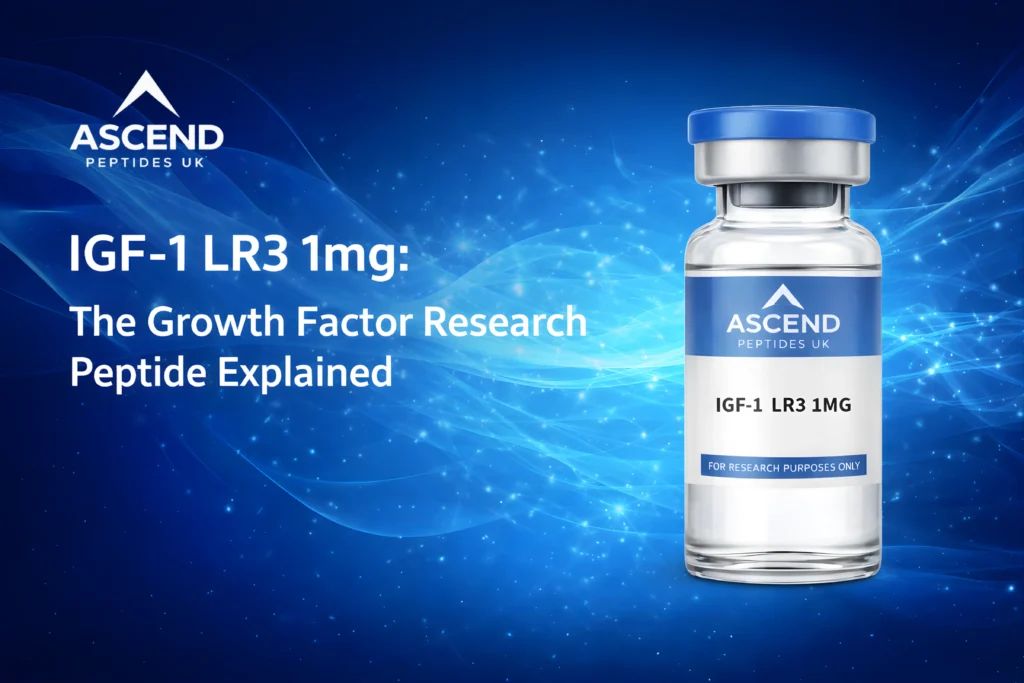
⚠️ Research Use Only. IGF-1 LR3 1mg is supplied strictly for in-vitro laboratory research. It is not intended for human consumption, therapeutic, diagnostic, or clinical use. All information below reflects peer-reviewed preclinical and scientific literature only. This content is not medical advice. Ascend Peptides UK accepts no liability for misuse of this product
If you have spent any time exploring the world of peptide research, you will have come across the name IGF-1 LR3. It is one of the most studied and widely referenced growth factor peptides in the scientific community, used in laboratories across the UK and internationally to investigate everything from cell proliferation to metabolic signalling.
This guide is designed as an educational resource for laboratory scientists, biotechnologists, and research professionals utilizing IGF-1 LR3 in formal, controlled in vitro studies. It outlines the biochemical structure, laboratory applications, and handling protocols for this widely referenced growth factor.
Everything discussed here relates strictly to research and scientific investigation. Ascend Peptides UK supplies IGF-1 LR3 1mg and other high-purity research peptides exclusively for laboratory use, not for personal or clinical application.
What Is IGF-1 and Why Is It Important in Research?
To understand IGF-1 LR3, you first need to understand its parent molecule: insulin-like Growth Factor 1 (IGF-1).
IGF-1 is a naturally occurring polypeptide hormone made up of 70 amino acids. While it is structurally similar to insulin and produced systemically by the liver (triggered by pituitary growth hormone signals), it is also synthesized locally in muscle, bone, and brain tissue, acting in both an autocrine and paracrine manner. In biological systems, IGF-1 plays a central role in regulating cell growth, differentiation, and survival.
From a research perspective, IGF-1 sits at the crossroads of several major scientific fields: oncology, metabolic research, and intracellular signaling. Its receptor, the IGF-1 receptor (IGF-1R), is one of the most studied receptor tyrosine kinases in biomedical science. The downstream signaling cascades it activates, particularly the PI3K/Akt and MAPK/ERK pathways, govern everything from normal tissue growth to cancer cell survival.
What Makes IGF-1 LR3 Different from Standard IGF-1?
IGF-1 LR3 (Insulin-like Growth Factor 1 Long Arg3) is a synthetic, modified analog of IGF-1 specifically designed to perform more consistently in laboratory research conditions. It differs from native IGF-1 in two key structural ways:
-
An arginine substitution at position 3 of the peptide chain (the source of “Arg3”).
-
The addition of a 13-amino acid extension at the N-terminus, extending the total chain length from 70 to 83 amino acids.
These modifications drastically alter how the compound behaves in experimental environments:
-
Extended Half-Life & IGFBP Evasion: Native IGF-1 has a very short active half-life of approximately 12–15 minutes because it is rapidly sequestered by IGF-binding proteins (IGFBPs). The structural changes in LR3 dramatically reduce its affinity for IGFBPs, resulting in an extended in vitro half-life of roughly 20 to 30 hours.
-
Clearance Mechanisms: Standard IGF-1 is also cleared via interaction with the IGF-2R/Mannose-6-phosphate receptor (M6PR). IGF-1 LR3 demonstrates reduced binding to this clearance receptor, further sustaining its bioavailability in experimental models.
-
Receptor Nuance: While highly selective for IGF-1R, researchers must note that IGF-1 LR3 retains a residual affinity for the insulin receptor (IR) and hybrid IR/IGF-1R receptors, which is a critical variable when designing metabolic studies.
- Receptor Downregulation: Because of its extended half-life and continuous receptor stimulation, researchers running longer-duration assays must account for dose-dependent receptor downregulation as an experimental variable.
For the complete structural and mechanistic background on IGF-1 LR3, see our full guide, What Is IGF-1 LR3?

Who Uses IGF-1 LR3 in Research and For What Purpose?
IGF-1 LR3 is utilized across a broad range of scientific disciplines. Here are the main research contexts in which this compound plays a role:
Cell Culture and Tissue Biology Research
The most common application of IGF-1 LR3 in laboratory settings is as a defined growth factor supplement in cell culture media. Researchers working with serum-free or reduced-serum formulations use it to support consistent cell proliferation and viability. Its extended in vitro activity makes it exceptionally well-suited to longer-duration culture experiments where sustained receptor stimulation is required.
Cancer and Oncology Research
The IGF-1 signaling axis is extensively studied in cancer biology. IGF-1R overexpression or dysregulation has been observed in multiple cancer cell line models and is associated with tumor progression, resistance to targeted therapy, and dysregulated cell survival in multiple solid tumor models. Oncology researchers use IGF-1 LR3 to reliably activate IGF-1R signaling in these models, enabling the investigation of receptor inhibition strategies and drug resistance mechanisms.
Metabolic and Endocrine Research
Given the structural overlap between IGF-1 and insulin, IGF-1 LR3 is used in research exploring insulin signaling and metabolic regulation at the cellular level. Its distinct binding profile makes it a useful tool for dissecting the signaling crosstalk between these related pathways.
Private and Independent Laboratories
Beyond formal academic and institutional settings, IGF-1 LR3 is also utilized by private research entities and independent biochemistry laboratories. Understanding how this peptide influences cellular growth signaling remains a vital area of study in advancing in vitro methodologies. Ascend Peptides UK welcomes inquiries from all legitimate research entities.
How to Source IGF-1 LR3 1mg in the UK: Quality Indicators
The quality of your research compound directly affects the reliability of your results. When sourcing an IGF-1 LR3 supplier, rigorous analytical standards are non-negotiable.
Look for these key quality indicators:
-
HPLC-Verified Purity: Purity should be confirmed via High-Performance Liquid Chromatography, ideally exceeding 98% for research-grade compounds.
-
Mass Spectrometry (MS): Verifies that the peptide’s molecular weight and sequence precisely match the expected 83-amino acid structure.
-
Endotoxin Testing (LAL Test): Crucial for cell culture applications. The compound must be tested via the Limulus Amebocyte Lysate (LAL) assay to ensure endotoxin levels are low enough that they will not trigger immune responses or compromise cell viability.
-
Lyophilised Format: Freeze-dried peptides maintain stability far better than liquid formats during storage and transit.
-
Batch Traceability: Essential for referencing specific production lots in published research and ensuring consistency across longitudinal experiments.
At Ascend Peptides UK, our IGF-1 LR3 1mg meets all of these stringent standards. Whether you represent an academic institution, a biomanufacturing facility, or a private analytical laboratory, you can order directly from our website with confidence.
Reconstituting IGF-1 LR3 1 mg: A Laboratory Reference
IGF-1 LR3 1 mg is supplied in lyophilised (freeze-dried) powder form and must be reconstituted before use in laboratory assays. Common reconstitution solvents referenced in published methodologies include:
-
Sterile Bacteriostatic Water: The most widely used option for extended peptide stability in laboratory settings.
-
0.1M Acetic Acid: Suitable where aqueous solubility is limited and a mildly acidic environment is acceptable for the experimental design.
-
Phosphate-Buffered Saline (PBS): Appropriate for short-term in vitro applications requiring a neutral pH environment.
Once reconstituted, IGF-1 LR3 solutions should be aliquoted into single-use volumes and stored at -20°C. Repeated freeze-thaw cycles must be avoided to preserve peptide integrity and ensure consistent experimental results.

Research Compliance: What You Need to Know
IGF-1 LR3 is classified strictly as a research chemical in the United Kingdom. It is not a licensed medicine, it is not approved for human consumption, and it must not be used in any clinical, therapeutic, or diagnostic context.
The regulatory landscape for research biochemicals is continually evolving. All buyers—whether institutional researchers or private laboratories—are responsible for verifying that their acquisition and application of this compound comply with current UK legislation. Furthermore, we highly recommend consulting your institution’s ethics or regulatory compliance team before purchasing to ensure alignment with internal protocols.
Ascend Peptides UK provides fully compliant, research-only labelled products and makes no health, performance, or clinical claims about any compound we supply.
Frequently Asked Questions
Q: What is the difference in half-life between native IGF-1 and IGF-1 LR3?
Q: Does IGF-1 LR3 bind only to the IGF-1 receptor?
Q: Is IGF-1 LR3 legal to buy in the UK?
Q: Why is endotoxin testing important for IGF-1 LR3?
Q: How should IGF-1 LR3 1mg be stored?
Q: Can IGF-1 LR3 1mg be used in cell culture research?
Q: What is the molecular weight of IGF-1 LR3?
Q: Is IGF-1 LR3 the same as IGF-1 DES?
Q: Where can I buy IGF-1 LR3 1mg in the UK?
Scientific References
-
Tomas, F. M., et al. (1995). “IGF-I variants that bind poorly to IGF-binding proteins show more potent biological activity than native IGF-I.” Journal of Endocrinology.
-
Yakar, S., et al. (1999). “Normal growth and development in the absence of hepatic insulin-like growth factor I.” Proceedings of the National Academy of Sciences. (Demonstrating the importance of local/paracrine IGF-1 production).
-
Soos et al. (1993) in the Journal of Biological Chemistry, which specifically characterises hybrid receptor binding.
DISCLAIMER
All products supplied by Ascend Peptides UK are intended strictly for research purposes only. They are not intended for human consumption or for any therapeutic, diagnostic, or clinical use. None of the items offered are classified as medicinal products by the MHRA. It is the buyer’s responsibility to ensure all purchases comply with applicable laws and regulations. Ascend Peptides UK accepts no liability for misuse.